DbcultAccessing Vault...
5.5/10
Senior Film Conservator
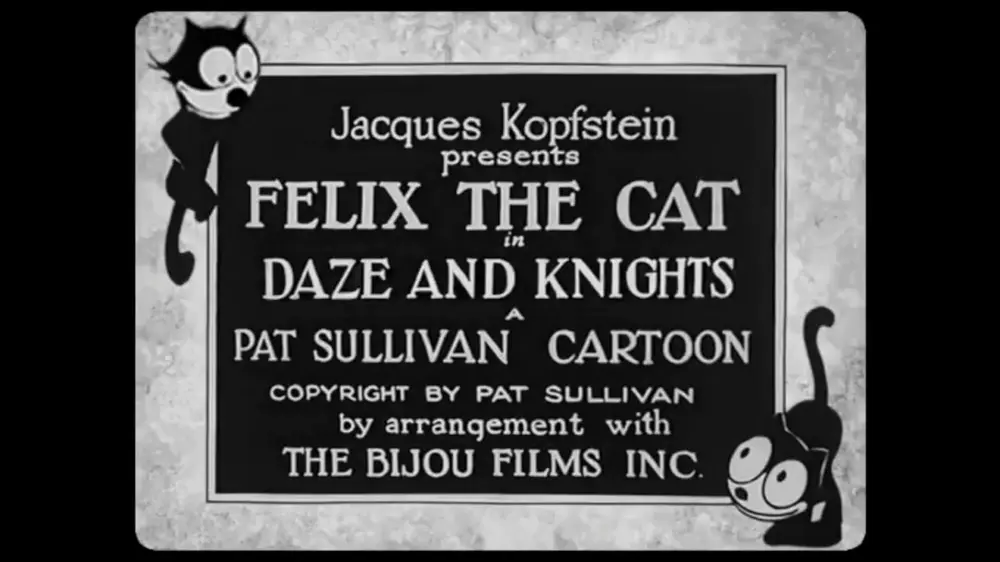
A definitive 5.5/10 rating for a film that redefined the boundaries of cult cinema. Daze and Knights remains a cornerstone of transgressive art.
Short answer: yes, but only if you appreciate the raw, unpolished energy of early 20th-century surrealism. This film is for animation buffs and those who enjoy visual logic puzzles, but it is definitely not for viewers who require high-definition spectacle or a traditional three-act structure.
Daze and Knights represents a pivotal moment in the 1920s where animation began to diverge from the theatrical constraints of live-action. Unlike the grounded slapstick found in Cops, Messmer’s work here embraces the impossible. It is a fever dream captured on celluloid that asks the audience to accept a world where a cat’s tail is more versatile than a knight's sword.
1) This film works because it understands that animation is the only medium where thoughts can become physical objects without breaking the internal logic of the world. 2) This film fails because its pacing feels frantic to a modern eye, often discarding a brilliant gag before the audience has fully processed it. 3) You should watch it if you want to see the literal blueprint for every 'rubber hose' cartoon that followed in the next century.
While Pat Sullivan’s name usually took top billing, Daze and Knights is undeniably the child of Otto Messmer’s brain. By 1927, Messmer had refined Felix into a character that was less of an animal and more of a walking, breathing geometric experiment. In this specific short, the medieval setting serves as a perfect foil for Felix’s modern, cynical attitude. The juxtaposition of a jazz-age cat against the backdrop of chivalry creates a tension that fuels the film’s best moments.
Consider the scene where Felix encounters a locked gate. In a live-action film of the era, like Her Great Hour, the protagonist would search for a key or climb the wall. Felix, however, simply detaches his tail, shapes it into a skeleton key, and walks through. This isn't just a gag; it is a declaration of independence from reality. It works. But it’s flawed in its simplicity.
The animation quality here is surprisingly fluid for 1927. When compared to something like The Tail of a Cat, you can see how much Messmer had learned about weight and movement. Felix doesn't just walk; he struts with a rhythmic confidence that suggests he knows he’s the smartest being in the room. The backgrounds are sparse, yet they feel intentional, focusing the viewer’s eye on the kinetic energy of the characters.
Yes. Daze and Knights is a foundational text for anyone interested in the history of visual comedy. It offers a pure, unfiltered look at the creative freedom animators enjoyed before the advent of synchronized sound and the rigid studio systems of the 1930s. It is short, punchy, and intellectually stimulating in its weirdness.
The 'Daze' in the title is likely a reference to the dream-like state of the narrative. The film flows with a stream-of-consciousness logic that mirrors the avant-garde movements happening in Europe at the time, such as those seen in Le brasier ardent. One of the most striking sequences involves Felix interacting with a dragon. Instead of a terrifying beast, the dragon is treated as a mechanical problem to be solved through physics and wit.
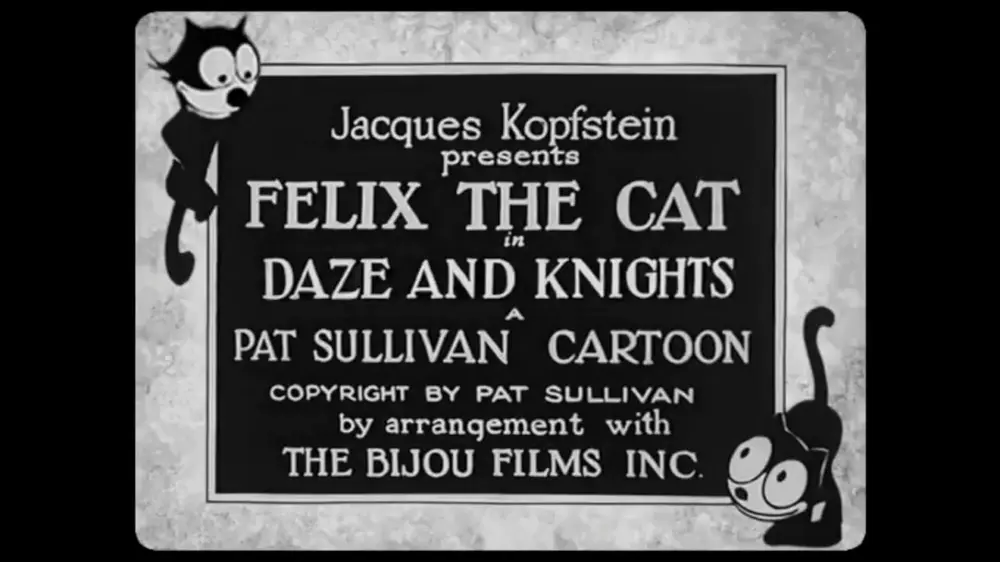
There is a specific moment where Felix uses a question mark—generated from his own confusion—as a physical ladder. This is a level of meta-commentary that we rarely see even in modern animation. It suggests that Felix is aware of his own medium. He isn't just a character in a story; he is an architect of the frame. This makes the film feel incredibly modern despite its nearly century-old age.
However, the film isn't without its dated elements. The treatment of the 'damsel' is typical for 1927, acting more as a trophy than a character. If you compare this to the female agency explored in The Deciding Kiss, the cartoon feels somewhat regressive. But one doesn't come to a 7-minute Felix short for progressive character arcs; one comes for the anarchy.
The cinematography, if you can call it that in animation, is static but effective. Messmer uses the 'center-frame' technique to ensure the gags land with maximum impact. There are no wasted movements. Every frame is hand-drawn with a precision that puts some modern digital shortcuts to shame. The use of black and white is particularly effective here, creating high-contrast visuals that make Felix’s silhouette pop against the gray medieval stones.
Contrast this with the atmospheric lighting in Die weisse Wüste. While that film uses light to evoke dread, Daze and Knights uses clarity to evoke laughter. The timing is impeccable. The delay between a character seeing a threat and reacting to it is tuned to a millisecond, a precursor to the legendary timing of the Looney Tunes era.
The pacing is relentless. Unlike Jacques of the Silver North, which takes its time to build a cold, northern atmosphere, Daze and Knights starts at a sprint and never slows down. This can be exhausting, but it also means that if a gag doesn't work for you, a better one is coming in approximately six seconds. It’s a shotgun approach to comedy that largely hits its mark.
Pros: Extremely inventive visual gags; historically significant animation; short runtime ensures it doesn't overstay its welcome; Felix remains a charmingly mischievous lead.
Cons: Some gags are repetitive; the medieval setting is a bit generic; the lack of sound (unless watching a restored version with a score) can be jarring for modern audiences.
Daze and Knights is a fascinating relic that still has plenty of teeth. It’s not a masterpiece of storytelling, but it is a masterpiece of imagination. Otto Messmer was playing with the very fabric of reality at a time when most filmmakers were still trying to figure out where to put the camera. It’s weird, it’s fast, and it’s undeniably clever. It’s a small slice of history that proves a cat, a tail, and a medieval castle are all you need for a good time. Just don't expect it to make any sense. It doesn't have to. It’s a cartoon, and in 1927, that was enough.
IMDb 5.3
1930
Community
Log in to comment.