DbcultAccessing Vault...
4.9/10
Senior Film Conservator
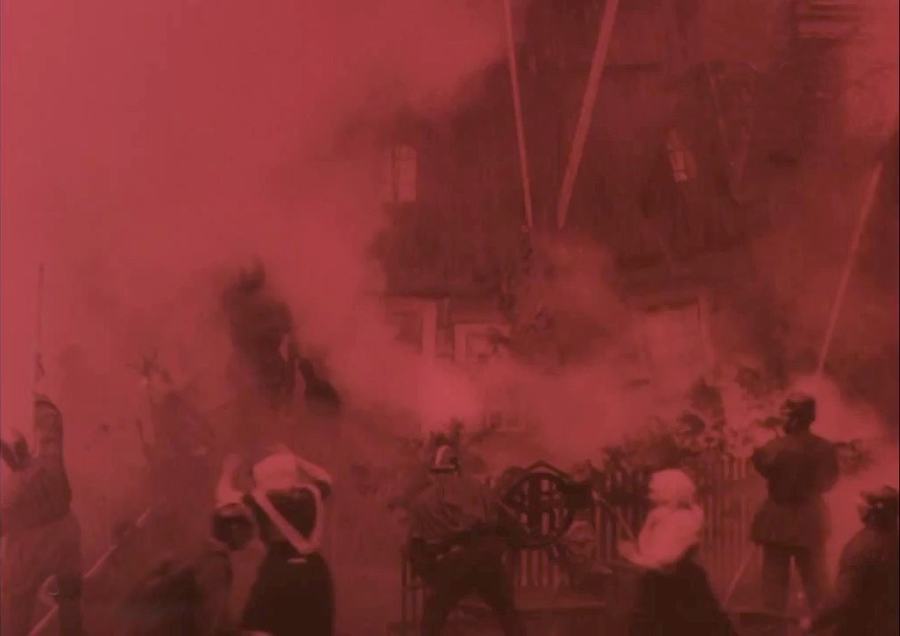
A definitive 4.9/10 rating for a film that redefined the boundaries of cult cinema. De levende ladder remains a cornerstone of transgressive art.
Imagine celluloid as a nervous system: every perforation a synapse, every frame a spark. In De Levende Ladder the spark becomes wildfire—literally. A windmill, that emblem of Calvinist order, is torched by some off-screen malevolence; its sails rotate like deranged pinwheels vomiting sparks into the polder night. Inside, a girl—anonymous, iconographic—waits for death. Salvation arrives not via horse-drawn fire brigade but through a kinetic sculpture: six acrobats who interlock wrists-ankles-shoulders until flesh supplants wood and sinew replaces rungs. The metaphor is brazen—humanity as portable architecture—yet the execution is so tactile you smell the scorched linen.
Director-writer Maurits Binger was already Netherlands’ foremost exporter of images—his Glacier National Park travelogue had proven that spectacle sold tickets—but here he fuses melodrama with tableaux vivants of peril. The camera never budges; the set burns for real. Result: a single-take inferno whose horizon line tilts vertiginously as the mill’s cap shifts, a trick achieved by loosening the structure’s foundation rails so the entire building lists like a drunk cathedral. You feel the tilt in your inner ear.
Barend Barendse, rubber-limbed vaudevillian, plays the apex of the ladder—the man who must dangle upside-down while flames lick his epaulettes. Contemporary Dutch reviewers praised his “salamander grace,” a phrase so baroque it deserves resurrection. Beside him, Annie Bos—later diva of Anna Karenina tragedies—appears in a micro-cameo as the girl’s screaming cousin outside the mill, her mouth a perfect Munch oval. The gender politics are antique yet weirdly progressive: men become infrastructure, woman becomes projectile, audience becomes complicit voyeur of pain.
Compare The Great Circus Catastrophe: there, blaze equals backdrop for lion-tamer heroics; here, fire eats the proscenium. Or take Saved in Mid-Air—aeronautical rescue via balloon basket—whose suspense is cushioned by altitude. Binger keeps everything grounded, literally: the rescue unfolds at eye-level, so every cinder that drifts toward the lens threatens your eyelashes. The film’s length, a terse 270 feet of 35mm, means no time for narrative padding; instead, tension compresses like a coiled spring, then releases in the girl’s ballistic toss into darkness.
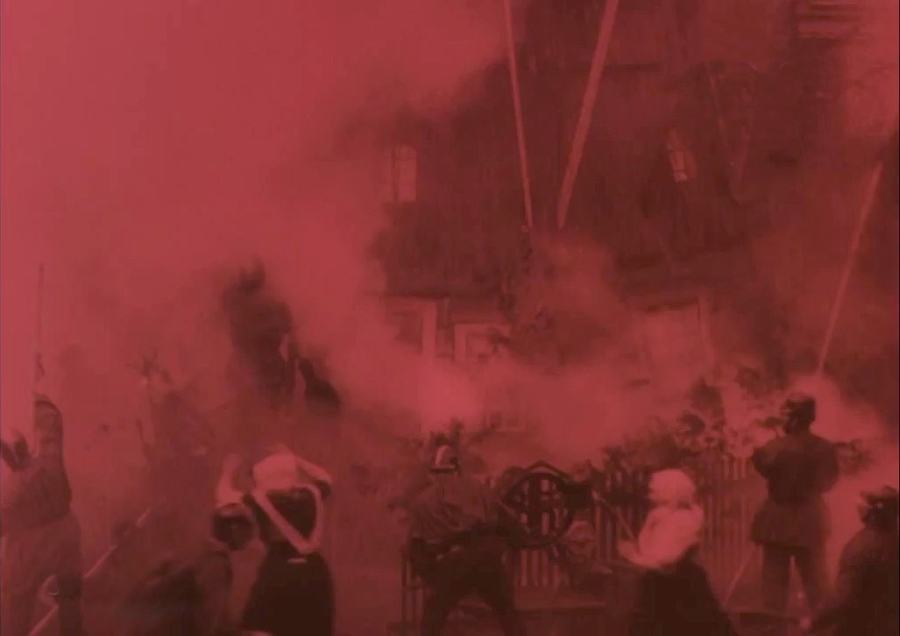
Though shot orthochromatically, the original prints were tinted rose for interiors, cobalt for exteriors, amber for conflagration. Most archival copies lost these hues, yet even in monochrome the contrast sears: alabaster girl against obsidian smoke; scarlet tongues of flame lapping indigo night. The acrobats’ harlequin diamonds strobe as they climb, creating a zoetrope effect inside the static frame. Binger understood that early audiences craved kinetic wallpaper—patterns that move—so he costumes his troupe like a living Piet Mondrian decades before the painter’s grid-phase.
Exhibitors in 1913 frequently accompanied the short with klompendans rhythms tapped on wooden shoes, segueing into a gallop when the rescue commences. Modern restorations at Eye Filmmuseum pair it with a prepared-piano score: bass strings prepared with metal screws to mimic creaking timber, high keys plucked for the girl’s heartbeat. The result is foley-by-piano, a reminder that silent cinema was never mute—merely unvoiced.
For decades the only known element was a decomposing 9.5mm Pathe-Baby shrink-wrapped around its own sprockets. Then, in 2017, a 35mm nitrate reel surfaced at a Haarlem flea market, tucked inside a tin labelled “Misidentified documentary – windmills”. The lab scan revealed details invisible for a century: the acrobat’s blistered shoulder blades, the girl’s tear tracking across soot. Digital cleanup removed water damage yet preserved spark chatter—those white-hot flecks that leap frame-to-frame like temporally displaced fireflies. Viewers can now stream a 4K rendering whose bit-rate rivals contemporary blockbusters, proving that entropy is negotiable if archivists hustle.
Scale is not acreage but intensity per frame. Quo Vadis? devotes hectares of extras to burning Rome yet feels pageant; De Levende Ladder burns one structure and singes your psyche. The difference? Proximity. Binger denies you the Establishing Shot Safety Clause; the camera squats at child-height, so when the sails collapse they crash toward you, not toward a matte horizon.
Yes. Not because of fire—film can’t scald—but because it reminds that rescue is corporeal. In an age of drone-drops and CGI cape-saves, watching six men turn their ligaments into civic infrastructure feels almost obscene in its intimacy. You walk out (or click away) wondering whose back you could climb, whose wrist you could trust to bear your weight while the world burns. That lingering aftershock is the real flame De Levende Ladder refuses to extinguish.
IMDb 6
1922
Community
Log in to comment.