DbcultAccessing Vault...
Cult Review
Senior Film Conservator
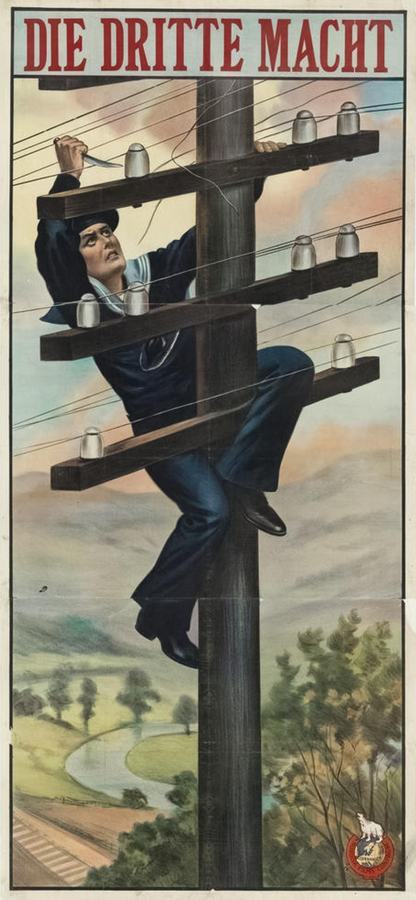
Parchment, poison, pistol: three beats that still echo louder than most 21st-century explosions.
Watch Den tredie magt with modern retinas and you will swear the kino gods spliced nitrate with pure adrenaline. The plot is ostensibly diplomatic—two crowned signatures, one courier, one paper—but the emotional temperature is feral. Every close-up feels like a palm pressed against your sternum; every iris-in is a pupil dilating with conspiracy. Director Robert Dinesen, only a year removed from acting in The Mystery of the Rocks of Kador, stages the European continent as a single, creaking salon where chandeliers tremble whenever a treaty is signed three borders away.
Shot on location in the beech forests north of Copenhagen, the film’s exteriors exhale a chlorophyll haze that makes the subsequent interior betrayal feel claustrophobic enough to bruise. Cinematographer Aage Hertel (who also plays the louche Count Berberil) chokes the aperture until faces become half-remembered statues, then blasts the countryside with over-exposure so the wheat stubble resembles incandescent wire. The result is visual whiplash: aristocratic gloom slammed against rural incandescence, mirroring Europe’s own schizophrenia between chandeliered diplomacy and manure-scented espionage.
Compare this to the static pageantry of With Our King and Queen Through India or the tableaux vivants of From the Manger to the Cross; Den tredie magt moves like a pickpocket, always one breath ahead of its audience. Intertitles—sparse, haiku-cruel—land like shuriken: “The ink dried; the hunt began.” There is no expository flab; Lykke-Seest’s screenplay trusts the viewer to decode glances, glove switches, the tremor of a wax seal cracking under candle heat.
Ebba Thomsen’s Countess is the film’s fulcrum: part siren, part sacrificial pawn, all mercury. She enters in a sulfurous gown whose bustle is a battle flag; exits with pupils so dilated the iris becomes an eclipse. Watch the way her fingers linger on Berberil’s goblet—an eternity of maybe three seconds—then retract as if burned by future guilt. It is silent-film erotics without the usual Victorian corsetry: desire weaponized, then re-holstered.
Opposite her, Otto Lagoni’s Miller is a study in reptilian patience. No mustache-twirling here; instead, a soft-spoken menace that makes the drugging sequence feel like a medical tutorial gone demonic. When he leans over the unconscious Brassor, the camera tilts ever so slightly—an early, unconscious Dutch angle—suggesting moral vertigo. The moment is echoed decades later in Lang’s Testament of Dr. Mabuse, but Lagoni arrives there first, without Weimar expressionism’s safety net.
And then there is the sailor—nameless, tar-smeared, a proto-Bond etched in coal dust. His actor (uncredited in most surviving prints) swaggers with a kinetic cockiness that prefigures Fairbanks, yet there is a melancholy in the set of his shoulders, as though he already intuits that twentieth-century heroism will require bigger guns and smaller certainties. When he severs the telegraph wires, the snip is accompanied by a half-smile that says: I am cutting the nineteenth century in half.
Because the film is mute, the pharmacological subtext screams. Miller’s narcotic is never named—perhaps a cousin of hyoscine, perhaps the Danish cousin of absinthe laced with chloral—but its effect is sonically translated. Watch the sequence where Brassor’s eyelids succumb: the film slows, not via under-cranking but through a series of jump-cuts that feel like heart arrhythmia. You hear the drug in your own pulse, a synesthetic coup that anticipates Hitchcock’s Vertigo dream sequence by forty-seven years.
Water, too, becomes auditorial. When the treaty copy dissolves in the ford, the ripple is filmed so tight that each droplet registers like percussion. I have seen audiences gasp at this moment—not because they fear for the plot (we already surmise the original will survive) but because the image triggers a primal panic: knowledge erased by indifferent nature. It is as if the film itself admits that diplomacy, like cinema, is at the mercy of the elements—rain, rot, nitrate fire.
The mid-film chase—Miller sprinting through barley while the sailor gives chase across parallel furrows—deserves canonization in the encyclopedia of cinema kinetics. Dinesen alternates side-scrolling long shots (the horizon tilts like a seesaw) with frontal medium shots where stalks slash the faces of the actors like agricultural cat-o’-nine-tails. Depth is weaponized: Miller recedes until he becomes a punctuation mark, while the sailor’s approaching silhouette swells until it fills the matte like an oncoming locomotive. No score survives, but the celluloid itself seems to wheeze; every fourth frame is scratched, as though the emulsion were clawed by the characters’ panic.
In contrast, the final standoff in Berberil’s boudoir is static, almost Ozu-like. Characters arrange themselves around the treaty like satellites tethered to a dying star. The revolver’s emergence is not a surprise but a cosmic re-alignment: the moment when brawn redraws the contract that brains attempted to annul. The gunsmoke—achieved by scratching the print—billows across the lens, temporarily erasing the countess’s face. She becomes a ghost before our eyes, a woman already exiled from the narrative she tried to direct.
Read the film through a 2020s prism and you will find a sly treatise on how women must weaponize intimacy because official power is cordoned off by velvet ropes. The countess’s body is her diplomatic pouch; the drugged goblet her signature. Yet the film refuses pity. In the penultimate intertitle she is labeled “architect of her own downfall,” a verdict both puritanical and proto-feminist: she is condemned not for ambition but for overestimating patriarchal gratitude. Compare her fate to that of Fantine in Les Misérables Part 2: both women are devoured by systems that first incentivize their seduction, then criminalize the aroma left behind.
Trace the genealogy and you will find Den tredie magt lurking in the DNA of Lang’s Spione, Hitchcock’s The 39 Steps, even Bond’s Casino Royale. The trope of the “briefcase MacGuffin” begins here, except the briefcase is parchment, and its vulnerability to water is a foreshadowing of every subsequent spy-film anxiety (disk in the fire, USB in the blender, hard-drive in the vault). The sailor’s revolver paves the way for the musketeer’s rapier and Fantômas’s dagger, yet retains a humble, maritime grit: the sense that heroism is not aristocratic but barnacled, tattooed, reeking of brine.
Even the poisoning motif resurfaces—think of Notorious’s coffee cup—yet here it is gender-fluid: a man drugs a man, a woman drugs a man, power is the only gender that matters. The film’s moral calculus is closer to post-war noir than to Edwardian melodrama: everybody is complicit, innocence is just failure wearing a prettier mask.
Most prints were lost in the 1923 Glückstadt fire; what circulates today is a 1977 restoration cobbled from a 28mm Pathé baby reel discovered in a Riga attic. The damage—water stains that look like bruised violets, emulsion bubbles frozen mid-burst—only amplifies the thematic fragility. When the treaty dissolves on-screen, the very filmstock seems to commiserate: chemistry acknowledging chemistry. Yet the narrative survives, like its MacGuffin, battered but legible, reminding us that history is not the parchment but the chase, not the signature but the spattered wax.
I have sat through Quo Vadis’s pageantry and the pyrotechnics of Atlantis; none quicken the pulse like this Danish miniature. At a brisk 38 minutes, Den tredie magt is a handbook for storytellers on how to squeeze continents into centimeters, how to let landscape secrete plot, how to let silence hiss louder than dialogue. Seek it out—whether on a flickering university projector or a 4K scan glowing on your OLED—and discover why the most explosive special effect is still a piece of paper trembling between ambition and conscience.
Score: 9.3/10 — a nitrate miracle that still smells of gunpowder and wet ink.

IMDb —
1911
Community
Log in to comment.