DbcultAccessing Vault...
Cult Review
Senior Film Conservator
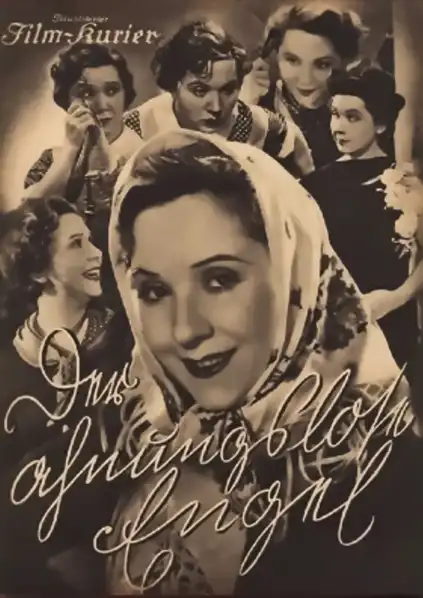
Okay, so Der ahnungslose Engel isn't going to be everyone's cup of tea. If you’re into old German cinema, especially those light, slightly melancholic comedies from the 30s, you might find something really sweet here. But if you need fast pacing or big plot twists, well, you’ll probably just find it a bit… slow. It’s a film for a quiet afternoon, maybe with a cup of coffee. ☕
The whole thing hinges on Jola Jobst as Lotte, our titular 'naive angel.' And she really nails it. She’s got this wide-eyed look that never really goes away, even when things are clearly going wrong around her. You almost want to reach into the screen and warn her about pretty much everything.
One scene sticks with me. Lotte is trying to explain something fairly straightforward, about a misunderstanding with a train ticket, to a very stern-looking Franz Nicklisch, who plays Herr Schmidt, some kind of official. She just keeps looking down at her shoes, then back at his unyielding face. It’s a good five seconds of just her fidgeting, selling her complete innocence. It makes you feel for her, honestly.
The film has this gentle, almost sleepy rhythm. Not in a bad way, mostly. It just takes its time. You can tell they weren’t rushing through scenes back then. Sometimes it feels like the camera just lets things play out, longer than you'd expect today. This works for Lotte’s character, making her slow understanding of the world feel earned, somehow.
Erika Glässner shows up as Frau Müller, a sort of gossipy landlady, and she’s a hoot. Her expressions are just perfect, a mix of curiosity and mild annoyance. Every time she’s on screen, there’s a little spark, a shift in energy. She’s the kind of character who knows everyone's business, or at least thinks she does. And the way she raises an eyebrow? Classic.
There’s a part where Lotte gets a bit tangled up with a street performer, thinking he’s genuinely lost his last coin. She insists on giving him her own, even though it’s clear he’s just doing his act. The performer, played by Ludwig Ten Cloot, has this great, subtle look on his face – a mix of surprise, pity, and maybe a little guilt. It’s a quick moment, but it tells you so much about both characters.
The whole 'lost letter' plot, which kicks everything off, is pretty charming too. It's the kind of misunderstanding that feels like it could only happen in an older film. No cell phones to just clear things up, you know? Just letters and chance encounters. It really makes you appreciate the simpler stakes.
The dialogue is quite formal, as you’d expect, but there are these unexpected bursts of humor. Not laugh-out-loud stuff, more like a gentle chuckle. Like when someone tries to explain bureaucracy to Lotte, and she just responds with a totally earnest, 'Oh, I see!' when it's clear she absolutely doesn't. 😅
Some of the outdoor shots, particularly around what looks like a city market, are lovely. You get a real sense of the era, the clothes, the old cars. It's not a visually flashy film, not like a big Hollywood production of the time, but it feels authentic. You can almost smell the pastries from a baker's cart in the background. Or maybe that's just me.
The film doesn't really have a big, dramatic climax. It kind of… resolves itself. Which feels right for the story. It’s not about grand gestures, but about Lotte navigating a world that’s just a bit too complicated for her straightforward heart. The final scene, where she finally understands something everyone else grasped ages ago, is just sweet. Not powerful, just sweet.
It’s not trying to be Le grand jeu with its dramatic tension or anything. It’s far more modest. Sometimes that's exactly what you need. A film that just exists, letting you spend some time with kind, if a little clueless, people.
Didja notice?
IMDb —
1917
Community
Log in to comment.