DbcultAccessing Vault...
7/10
Senior Film Conservator
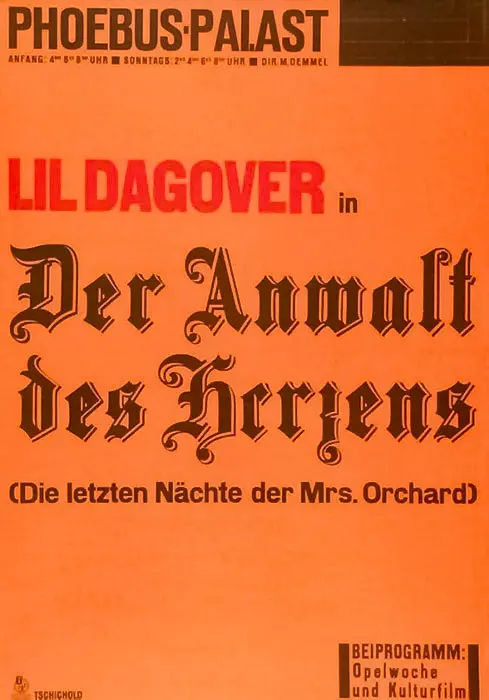
A definitive 7/10 rating for a film that redefined the boundaries of cult cinema. Der Anwalt des Herzens remains a cornerstone of transgressive art.
Is this film worth watching today? Short answer: Only if you have a deep-seated reverence for the silent era's specific brand of theatrical melodrama. For the casual viewer, it is a historical curiosity that lacks the kinetic energy of its contemporaries.
This film is for the silent cinema completionist and students of UFA’s technical evolution. It is absolutely not for those who require fast-paced plotting or the psychological nuance of modern legal thrillers.
1) This film works because: The presence of Lil Dagover provides a much-needed emotional anchor in a script that otherwise feels overly mechanical and dry.
2) This film fails because: The central conflict—the lawyer who loses his cool—is telegraphed so early that the middle hour feels like a slow crawl toward an inevitable conclusion.
3) You should watch it if: You want to see Wilhelm Thiele’s early directorial flourishes before he pivoted to the more famous musicals that defined his later career.
Der Anwalt des Herzens (The Lawyer of the Heart) is a film obsessed with the architecture of authority. The sets are massive, the desks are imposing, and the men are stiff. Ernst Stahl-Nachbaur plays Peter Paul with a rigidity that borders on the statuesque. In the opening scenes, his movements are sharp, almost robotic. He represents the 1920s ideal of the professional man: detached, logical, and entirely devoid of sentiment.
The cinematography by Werner Brandes uses high-contrast lighting to emphasize this coldness. The courtroom is bathed in a harsh, unforgiving light that leaves no room for shadows—or secrets. It is a stark contrast to the more fluid, dreamlike visuals found in films like The Innocent Lie, which handled similar themes of deception with more visual grace.
The drama begins when the law meets a force it cannot quantify. When Lil Dagover enters the frame, the lighting softens. She represents the 'heart' mentioned in the title, and her performance is the only thing preventing the film from becoming a dull lecture on ethics. She uses her eyes to convey a level of desperation that the intertitles fail to capture. It is a performance of restraint, which was rare in an era known for over-the-top gesticulation.
If you are looking for entertainment, the answer is no. If you are looking for a window into the soul of 1927 Germany, the answer is a qualified yes. The film captures a society in transition, caught between the rigid structures of the past and the messy, uncertain freedoms of the Weimar Republic.
The pacing is the primary obstacle. Silent films often suffer from 'the middle act slump,' and this film is a prime example. Once the initial premise is established, Thiele spends far too much time on repetitive scenes of Peter Paul staring at legal documents or looking pensively out of windows. It lacks the punchy, experimental editing found in The Pride of New York, which understood how to keep a narrative moving through visual rhythm alone.
While Wilhelm Thiele is best remembered for his later sound-era successes, you can see his interest in spatial dynamics here. He uses the depth of the frame to show the distance between his characters. In one specific scene, the protagonist stands in the foreground, sharp and clear, while his love interest is a blurred figure in the background. It’s a simple visual metaphor for his inability to truly see her as a person rather than a case file.
This focus on the visual representation of psychology is what saves the film from being a total wash. Thiele isn't interested in just telling a story; he's interested in how the environment reflects the internal state. It’s a technique used more effectively in My Little Sister, but here it feels like a director experimenting with his tools. It’s a process. It’s interesting to watch, but it’s not always successful.
The inclusion of Jean Murat and Käthe von Nagy adds some international flavor, but they are underutilized. Von Nagy, in particular, has a spark that the film desperately needed more of. Whenever she is on screen, the energy levels rise, only to plummet back into the doldrums of the legal drama once the camera shifts back to Stahl-Nachbaur.
The film boasts incredible costume design that tells its own story about class and gender roles in the late 1920s. The way Lil Dagover’s wardrobe shifts from structured, dark fabrics to lighter, more flowing silks mirrors her character's emotional journey. Additionally, the restoration quality (if you can find it) highlights the crispness of the original 35mm photography.
The script is remarkably predictable. By the twenty-minute mark, you know exactly how the 'lawyer of the heart' will sacrifice his career for love. There is a lack of genuine tension. It’s a film that follows the rules too closely, much like its protagonist. It lacks the raw, visceral impact of contemporary dramas like The Forfeit.
One thing that struck me was how the film treats the concept of 'divorce.' In 1927, this was still a scandalous topic, yet the film approaches it with a surprisingly modern sense of weariness. It doesn't treat marriage as a sacred bond, but as a transaction that has gone bad. This cynical worldview is far more interesting than the central romance. The film is at its best when it's being bitter, not when it's being sweet.
The legal arguments presented are, frankly, nonsense, but they serve as a backdrop for the emotional stakes. It’s an anti-intellectual film disguised as a smart one. It argues that thinking too much is the problem and that feeling is the solution. It’s a populist message wrapped in an elitist package. It works. But it’s flawed.
Der Anwalt des Herzens is a handsomely mounted but ultimately hollow experience. It relies too heavily on the star power of Lil Dagover to carry a narrative that lacks momentum. While technically competent, it fails to leave a lasting impression once the final intertitle fades. It is a movie that exists in the shadow of greater works from the same era.
Ultimately, this is a film for the archives. It serves as a reminder that even in the golden age of silent cinema, there were 'programmers'—films made to fill seats rather than break new ground. It is a professional piece of work, but it lacks the fire of true inspiration. If you want to see what UFA was capable of at its peak, look elsewhere. If you want a quiet evening with a forgotten relic, this lawyer might just take your case.
Compared to something like Mary Moves In, which handles its domestic themes with a lighter touch, Der Anwalt des Herzens feels like it's wearing a heavy wool coat in the middle of summer. It’s uncomfortable, a bit sweaty, and you can’t wait to take it off.

IMDb 3.9
1915
Community
Log in to comment.