DbcultAccessing Vault...
7.6/10
Senior Film Conservator
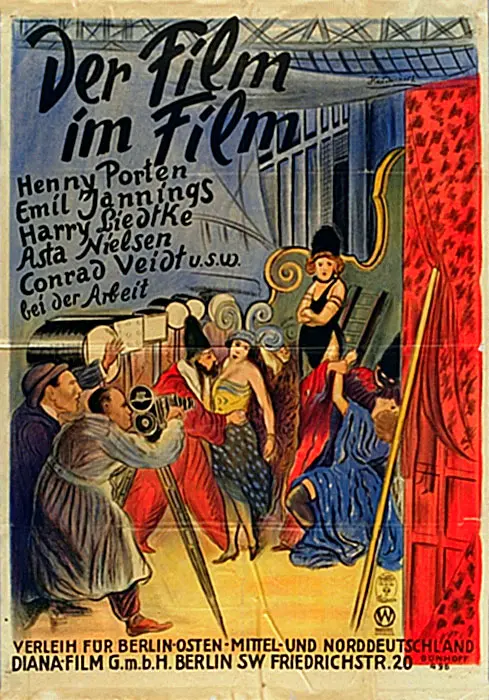
A definitive 7.6/10 rating for a film that redefined the boundaries of cult cinema. Der Film im Film remains a cornerstone of transgressive art.
Is Der Film im Film worth watching today? Short answer: yes, but with a significant, undeniable caveat. This isn't a film designed for casual Friday night viewing; it's a profound historical document and an unparalleled educational tool, making it an absolute must-see for film students, historians, and anyone fascinated by the foundational mechanics of cinema. Conversely, those seeking traditional narrative thrills, emotional arcs, or fast-paced entertainment will likely find its didactic approach challenging, if not entirely unengaging. It demands a specific kind of intellectual curiosity.
This film works because it provides an utterly unique, contemporaneous window into the technical and artistic aspirations of early cinema, demonstrating its principles rather than merely describing them, making abstract concepts tangible for its audience. It’s a masterclass in showing, not telling.
This film fails because its inherent nature as a purely educational, silent-era piece means it often lacks the narrative drive and emotional resonance modern audiences expect, demanding a specific kind of intellectual engagement that not everyone will be prepared to offer. Its pace is deliberate, its focus unwavering.
You should watch it if you possess a genuine curiosity for film history, aspire to understand the building blocks of visual storytelling, or simply appreciate the rare opportunity to witness cinema explaining itself, in its own language, from its own infancy. It’s a singular experience.
Der Film im Film, literally 'The Film in the Film,' is precisely what its title suggests: a film about filmmaking. Released in the silent era, it stands as a testament to cinema's early self-awareness and its burgeoning desire to understand and articulate its own craft. At a time when the medium was still defining its language, this production dared to turn the camera on itself, dissecting the very elements that brought moving pictures to life.
Friedrich Porges, the writer, conceived an ambitious project that moved beyond simple instruction. He aimed for a comprehensive overview, encapsulating both the mechanical marvels and the artistic sensibilities that were rapidly evolving. This wasn't merely a technical manual; it was an attempt to codify the emerging grammar of a new art form. It’s an act of profound introspection for a medium still in its youth.
The film’s historical value is immeasurable. It offers an authentic, contemporaneous perspective on what filmmakers of the era considered important, innovative, and fundamental. We see not just the technology, but the attitudes towards that technology – the sense of wonder, the meticulous care, the experimental spirit. It’s a time capsule. Pure and simple.
In a film devoid of conventional narrative, the role of its sole credited cast member, Lee Parry, is crucial. She is not a character in the dramatic sense, but rather a presenter, a demonstrator, and a visual metaphor for the filmmaking process itself. Her performance, if one can call it that, is one of clarity and precision, executed entirely through gesture, expression, and interaction with the various pieces of equipment.
Parry’s presence lends a human touch to what could otherwise be a dry, purely technical exposition. She guides the viewer through the intricacies of camera operation, the subtle art of lighting, and the mechanics of film editing with an understated elegance. Her movements are deliberate, her expressions informative, conveying complex concepts without a single spoken word. It’s a unique form of silent acting, far removed from the melodrama often associated with the era.
Consider, for instance, how she might demonstrate the effect of different lighting setups. Without dialogue, Parry must rely on exaggerated gestures to highlight the contrast created by a single key light versus the softer illumination of a fill light. Or how she might mime the cranking of a camera, then point to the resulting image, forging a direct, understandable link between action and outcome. Her performance is less about emotion and more about empirical demonstration, a challenging feat she achieves with remarkable grace.
The true genius of Der Film im Film lies in its meta-narrative: it uses the medium of film to explain film. This self-referential approach is both audacious and incredibly effective. Instead of a textbook, we get a living, breathing demonstration. The film itself becomes the ultimate teaching aid, embodying the very principles it seeks to elucidate.
We are treated to detailed explorations of early camera technology, from the cumbersome studio models to the more portable hand-cranked devices. The film doesn't just show us a camera; it illustrates its inner workings, perhaps even demonstrating the loading of film stock or the adjustment of apertures. This level of granular detail is invaluable for understanding the physical constraints and possibilities that shaped early cinematic expression. It’s a peek behind the curtain that few films dared to offer.
Lighting techniques are demonstrated with practical examples, showing how different sources and angles can dramatically alter mood and highlight subject matter. Imagine a sequence where Parry stands before a simple backdrop, and the film cuts between shots illuminated by harsh, direct light and those softened by diffusers or reflectors. The contrast would be stark, the lesson immediate. This visual pedagogy is far more impactful than any written description could be.
Moreover, the film delves into the nascent art of editing. It likely showcases the fundamental cuts, fades, and dissolves that were the building blocks of cinematic rhythm. Perhaps it even illustrates early forms of continuity editing, showing how disparate shots could be seamlessly joined to create a coherent flow of action. This was revolutionary for an audience still accustomed to static, theatrical presentations. The idea that time and space could be manipulated through editing was a revelation, and this film makes that revelation explicit.
One could even speculate about demonstrations of early special effects, such as double exposure for ghostly apparitions or stop-motion techniques for animating objects. These were the magic tricks of the nascent cinema, and Der Film im Film would have been the perfect platform to demystify them, showing the audience the wizard behind the curtain. It’s a film that asks you to appreciate the 'how' more than the 'what,' a rare beast in an industry obsessed with narrative.
Approaching Der Film im Film with modern sensibilities regarding pacing is an exercise in recalibration. As an educational silent film, its rhythm is deliberately slow, allowing ample time for the viewer to absorb the visual information presented. There are no rapid-fire cuts or frenetic camera movements designed to jolt the audience; instead, the emphasis is on clarity, meticulous demonstration, and thoughtful observation.
The tone is unequivocally didactic. It is a film crafted to inform and instruct, not to entertain in the conventional sense. This isn't to say it lacks fascination, but its appeal is intellectual rather than emotional. Viewers must be prepared to engage with it as a historical document and a technical tutorial, rather than a narrative journey akin to The Conspiracy or The Red Ace, which prioritize plot and character development.
For contemporary audiences, this deliberate pacing can be a hurdle. We are conditioned by a century of cinematic evolution to expect faster cuts, more dynamic storytelling, and constant stimulation. Der Film im Film offers none of that. Its power lies in its unhurried dissection of craft, a quality that, while challenging, is also deeply rewarding for the patient and curious viewer. It demands attention, but rewards it with insight.
Yes, Der Film im Film is absolutely worth watching today, especially for those with a serious interest in film history or the technical aspects of filmmaking. It provides an unparalleled, direct insight into the foundational principles of cinema as understood and practiced in its infancy. For general audiences, its appeal is more niche, but its historical significance makes it a valuable artifact.
Its value isn't in its entertainment factor, but in its educational and archival importance. It’s a primary source document for understanding the evolution of a global art form.
The legacy of Der Film im Film is subtle yet profound. It represents an early, bold attempt by the film industry to articulate its own practices and to educate both its practitioners and its audience. In an era before film schools were commonplace, this was a pioneering effort to formalize cinematic knowledge and disseminate it widely. It laid groundwork, quietly.
This film, along with similar educational shorts of the era, contributed to the professionalization of filmmaking. By demystifying the process, it helped standardize techniques and fostered a shared understanding of best practices. It's a foundational text, albeit a visual one, for the craft of cinematography. Its influence, though indirect, can be felt in every subsequent attempt to teach the art of cinema.
Perhaps its biggest flaw is also its greatest strength – its unwavering dedication to didacticism. While it might alienate those seeking pure escapism, this very commitment ensures its lasting relevance as a unique historical artifact. It's a testament to the fact that even in its nascent stages, cinema was capable of critical self-reflection. It works. But it’s flawed. And those flaws are part of its charm.
Der Film im Film is not a film you 'enjoy' in the conventional sense; it's a film you study, appreciate, and learn from. Its value is purely academic and historical, yet within that niche, it is utterly indispensable. It offers an unparalleled window into the birth of cinema's technical and artistic grammar, a rare opportunity to witness the medium reflecting on its own nascent power. While it demands patience and a genuine intellectual curiosity, the rewards for those who engage with it are profound. It is a vital piece of film history, a silent testament to the ingenuity and ambition of early filmmakers. For the right audience, it is nothing short of essential viewing. It's a film that defines its own genre, and does so with quiet authority.
IMDb 5.3
1929
Community
Log in to comment.