DbcultAccessing Vault...
Cult Review
Senior Film Conservator
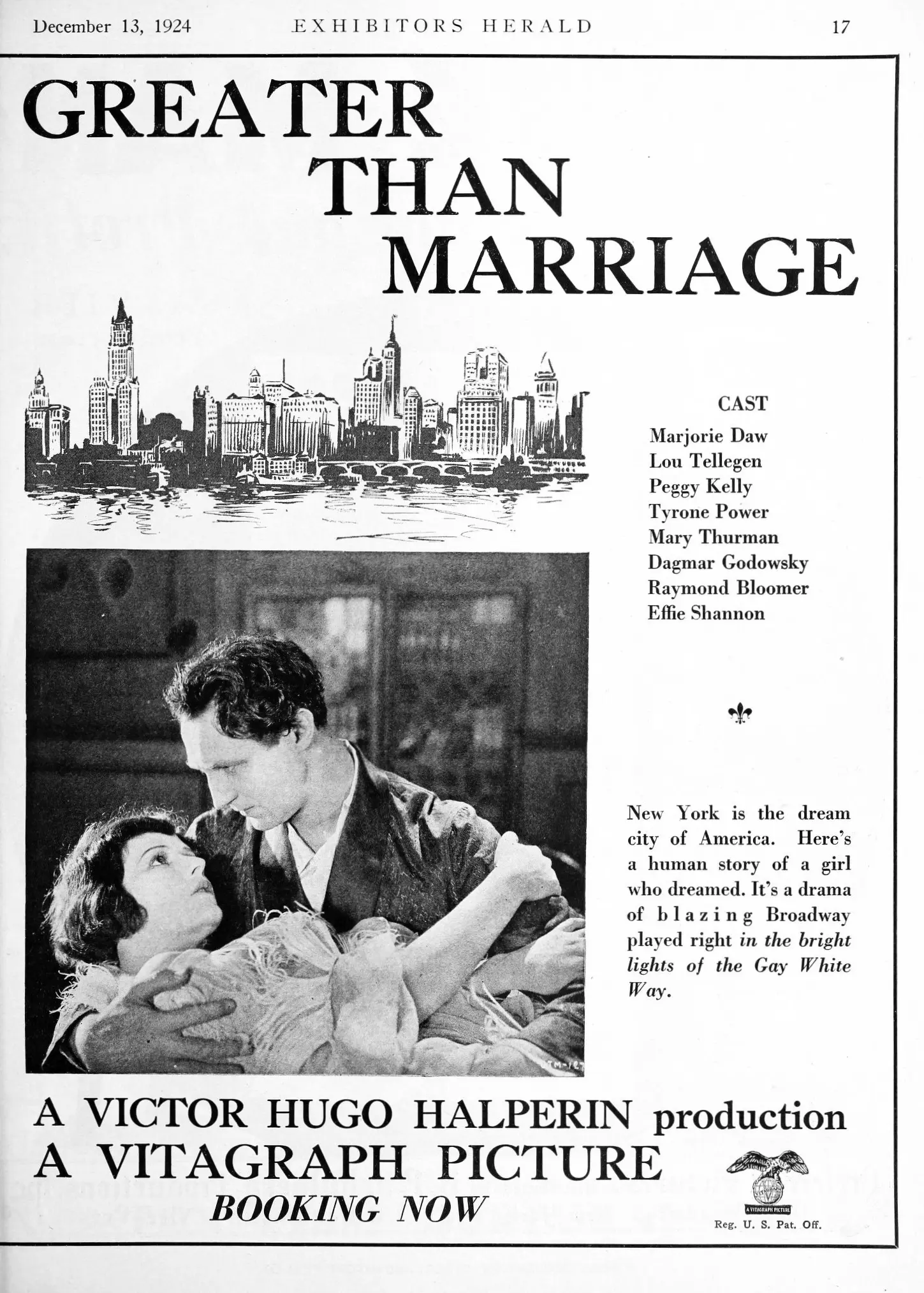
The silent era of cinema remains a fertile ground for exploring the shifting tectonic plates of gender roles and the burgeoning independence of the 'New Woman.' Victor Halperin’s 1924 drama, Greater Than Marriage, serves as a poignant, if somewhat conservative, artifact of this transition. It is a film that breathes through its silences, capturing the agonizing friction between a woman's individual agency and the societal mechanisms designed to harvest her domesticity.
The narrative arc of Joan Thursday, portrayed with a delicate yet palpable intensity by Peggy Kelly, begins not with a whisper but with a rupture. Her departure from her father’s home is an act of existential secession. The patriarchal shadow cast by her father is not merely a plot point but a thematic weight that informs every subsequent interaction. This film, much like The Faithful Heart, grapples with the concept of loyalty—not just to others, but to the self. However, Joan’s search for autonomy leads her directly into the arms of John Masters, a man whose creative temperament as a playwright does not preclude him from harboring the same archaic possessiveness as the father she fled.
Raymond Bloomer’s portrayal of John Masters is a study in the fragile male ego. He is a man who builds worlds on paper but cannot tolerate a wife who wishes to inhabit a world of her own making. The irony is thick and suffocating: a creator of drama who denies his partner the right to perform it. Their marriage is established as a sanctuary that quickly morphs into a gilded cage. The visual language of the film emphasizes this entrapment through tight framing and the lingering shots of domestic interiors that feel increasingly claustrophobic as Joan’s professional hunger grows.
When the narrative shifts its focus to the theatrical world, the aesthetic of the film undergoes a metamorphosis. The shadows deepen, and the lighting becomes more expressionistic, reflecting the seductive and dangerous nature of the stage. The introduction of Vincent Marbridge, played with a slick, reptilian charm by Lou Tellegen, introduces the 'casting couch' archetype long before it became a pervasive cultural shorthand. Marbridge is the catalyst for Joan’s ascent, but he is also the personification of the predatory cost of female ambition in the early 20th century.
As Joan tastes the intoxicating nectar of public adulation, the film juxtaposes her success with John’s failure in California. This narrative choice is crucial; it posits that in the zero-sum game of 1920s marriage, a woman’s professional gain must inherently result in a man’s loss. The psychological toll on John is depicted not as a personal failure of character, but as a natural consequence of a disrupted social order. It is here that Greater Than Marriage shares a spiritual kinship with Life's Blind Alley, where the characters find themselves navigating the narrow corridors of fate and societal expectation.
The climax of the film is a masterclass in silent melodrama. Joan, besieged by the unwanted advances of Marbridge and the vitriolic abandonment of her husband, finds herself at a literal and metaphorical window. The window represents the ultimate exit—a rejection of both the stage that exploited her and the marriage that stifled her. Halperin’s direction here is visceral. The camera lingers on Kelly’s face, capturing a kaleidoscope of despair, regret, and the sudden, sharp realization of her mother’s dying admonition. This spectral advice—never to sacrifice love for the stage—functions as the film’s moral compass, though to a modern viewer, it feels like a surrender to the status quo.
The inclusion of Tyrone Power Sr. in the cast adds a layer of theatrical gravitas to the production. His presence reminds the audience of the lineage of performance, a meta-commentary on the very stage career Joan is forced to renounce. The film’s resolution, while satisfying the moral appetites of the 1924 audience, leaves a bittersweet resonance for the contemporary critic. Joan’s return to John is framed as a triumph of love, yet it is undeniably a retreat. It is a return to a man who rejected her at her most successful, a man whose love was conditional upon her invisibility.
In the broader landscape of 1920s cinema, Greater Than Marriage stands as a fascinating counterpoint to more whimsical fare like Going! Going! Gone! or the adventurous spirit of The Secret of the Pueblo. While those films sought to expand the horizons of the viewer, Halperin’s work is an introspective, almost surgical examination of the domestic unit. It lacks the surrealist experimentation of Morphium, but it compensates with a grounded, gritty realism that was quite advanced for its time.
The screenplay by Victor Halperin and Louis Joseph Vance is remarkably tight, avoiding the narrative bloat often found in silent adaptations. Every scene serves to tighten the noose around Joan’s aspirations. The film’s pacing is deliberate, allowing the emotional weight of each betrayal to sink in. We see echoes of this thematic density in Love Without Question, where the central mystery is as much about the human heart as it is about the plot itself.
Visually, the film utilizes the limited technology of 1924 to great effect. The use of shadows to delineate the 'safe' space of the home versus the 'dangerous' space of the theater is a recurring motif. The costumes, too, tell a story. Joan’s transition from simple, modest attire to the extravagant, shimmering gowns of a stage star mirrors her internal transformation. Her return to John is marked by a return to simplicity, a visual shedding of her theatrical skin. This technique of visual storytelling is something we also observe in the character-driven narrative of Dombey and Son.
The performances are universally strong, particularly those of the female leads. Mary Thurman and Dagmar Godowsky provide excellent support, creating a textured social world around Joan. The film doesn't shy away from the complexities of female friendship and rivalry in a male-dominated industry. It captures the essence of the era’s struggle, much like the instructional yet dramatic flair of Literaturno-instruktorskiy agitparokhod vtsik 'Krasnaia Zvezda', albeit in a vastly different cultural context.
Greater Than Marriage is more than a mere melodrama; it is a historical document that captures the anxieties of a world in flux. While its conclusion may feel regressive to modern sensibilities, the journey it depicts is one of harrowing authenticity. The film asks profound questions about the price of ambition and the true nature of partnership. Is a marriage truly 'greater' if it requires the total erasure of one partner’s identity? The film leaves this question hanging in the air, long after the final intertitle has faded.
For those interested in the evolution of silent cinema, this film is an essential watch. It occupies a space between the moralizing tales of the previous decade and the more liberated narratives that would emerge in the late 20s. It is a work of significant lexical diversity in its visual language, a precursor to the psychological dramas that would define the sound era. It stands alongside works like A Common Level and The Spirit of the Conqueror as a testament to the enduring power of the silent image to convey the deepest of human tribulations.
Additional films discussed for contextual comparison: La dame masquée, Dead Eye Jeff, The Book Agent, and A Lyin' Hunt.
IMDb —
1918
Community
Log in to comment.