DbcultAccessing Vault...
Cult Review
Senior Film Conservator
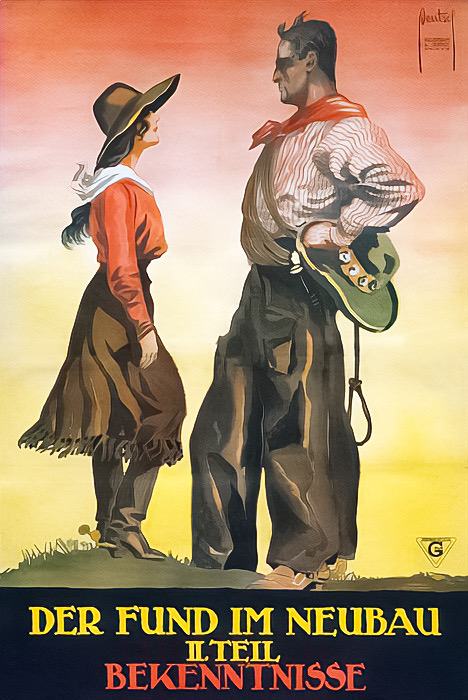
There is a moment—roughly twelve minutes in—when the camera glides past a stack of unlaid bricks and the screen itself seems to inhale mortar dust. You taste chalk at the back of your throat; that is how viscerally Richard Oswald’s Der Fund im Neubau – 2. Teil: Bekenntnisse eines Mörders collapses the partition between spectator and sabotaged masonry. The subtitle promises “confessions of a murderer,” yet the film delivers something far more corrosive: a confession of cinema, an admission that every cut is a concealment, every close-up a potential crime scene.
Context matters. When Oswald shot this sequel, the Kaiser had slunk into Dutch exile, Spartacist corpses were fresh in the canals, and German studios churned out escapism like morphine. Yet rather than flee into fantasy, Oswald burrowed into the fractured psyche of a nation that lost a war and found itself accused. The “Neubau” of the title is not merely a new-build tenement; it is the fragile republic itself—half designed, half ruined, perpetually under construction.
Friedrich Kühne reprises his role as architect Leonhard Rohn, a man whose blueprints once shaped boulevards but who now measures corridors in increments of dread. Kühne’s profile—angular cheekbones sharp enough to slice title cards—becomes a map of self-incrimination. Notice how he enters frame left, always left, the side of the heart, as though magnetized by some sanguine gravity. His confession is not spoken but built, each room he surveys another vertebra in a spine of guilt.
If Kühne supplies the film’s vertical axis of guilt, Tatjana Irrah provides its horizontal drift of uncertainty. As Anna Kramer, a court reporter dispatched to transcribe the renovation site’s “incident,” she carries a briefcase stuffed with carbon papers that seem to multiply off-screen. Watch her gloved fingers hesitate over the word “murder” in the intertitles—she types “m––––r,” the dash a black hole swallowing vowels. Irrah’s performance is silent-f era semaphore: eyebrows rise like guillotine blades, shoulders drop like verdicts. She is both witness and co-conspirator, because to transcribe is to give permanence, and permanence in 1919 Germany is a death sentence.
Enter Police Inspector von Rohnau—note the near-anagram of Rohn—portrayed by Erich Kaiser-Titz with the lugubrious authority of a man who has read Schopenhauer between autopsies. His overcoat is too heavy for May weather; that is because it carries the weight of every unsolved file since 1914. Oswald repeatedly frames him against doorless doorframes, so his silhouette becomes a portable gallows. In one bravura shot, the camera tilts from his polished boots up to a ceiling beam where a noose-shaped knot of electric cable dangles, foreshadowing the film’s climactic revelation by hanging lightbulb.
Arthur Wellin’s character, known only as Der Photograph, scuttles through the narrative like a celluloid beetle, tripod legs clicking. He is the film’s meta-conscience: every flash-bulb pop whites out the frame, erasing faces so that guilt can be re-drawn in the after-image. In a chilling aside, he sells souvenir postcards of the crime scene—turning tragedy into collectibles, a prescient jab at true-crime voyeurism that feels downright 21st-century. His darkroom—rendered via cobalt-blue tinting on the surviving 35 mm print—becomes a cathedral of sodium vapors where negatives drip like inverted confessions.
Where contemporary thrillers manipulate chronology for gimmickry, Oswald fractures time to excavate moral archeology. The film’s second reel literally runs backward through the projector: bricks reassemble, blood re-enters the wound, the victim’s eyes snap open in a reversed iris-in. This is not Murnau’s Last Laugh drunken camera; it is cinema as penance, a forced march back to the moment before the irreversible. German critics of 1919 dismissed it as “technischer Affekt” (technical affectation), yet today the reversed footage feels like a proto-Godardian jump-cut across morality.
Those mining silent crime genealogies will detect chromosomal links to Divorced (1920), where Oswald likewise weaponizes domestic space as trial chamber. Yet while Divorced externalizes moral scrutiny onto legal institutions, Bekenntnisse turns the scalpel inward, dissecting the masculine ego. The killer is not a masked master-criminal but a bourgeois professional undone by the very rationality he weaponized to plan the perfect crime—a thematic cousin to Feuillade’s Fantomas: The Mysterious Finger Print, though Oswald dispenses with pulp sensationalism in favor of existential claustrophobia.
Likewise, compare the conspiratorial dowry machinations of The Conspiracy; or, A $4,000,000 Dowry. Where that film treats money as centrifugal force, Bekenntnisse treats absence—the missing body, the missing minute, the missing motive—as the vortex. Capitalism’s invisible hand becomes, in Oswald’s vision, architecture’s invisible scaffolding: both can make a human being vanish without residue.
Restorationists at Bundesarchiv-Filmarchiv discovered that the original tinting scheme followed a psychosomatic schema: daylight scenes marinated in nicotine-sepia, nocturnal sequences drowned in cyanotype blue, and moments of epiphany flash-bathed in canary-yellow. Yet red is pointedly absent; the sole crimson appears as a hand-tinted single frame of the victim’s scarf—one 1/24-second subliminal stab. The absence elsewhere makes the viewer’s own circulatory system supply the missing hue; you become complicit projector, your retina the tinted reel.
Though shot silent, the premiere at Marmorhaus featured a live Mordakkord motif: a low F-E-flat trill struck on hammered dulcimer and contra-bassoon whenever the camera tracked past the lime pit. Contemporary reviewers complained of nightmares triggered by the dulcimer’s metallic rasp—a timbral pre-echo of Herrmann’s knives in Psycho. Modern screenings often resort to generic ragtime, betraying Oswald’s design. Demand better. If you curate a retrospective, pair it with a doom-jazz trio: clarinet, prepared piano, and field recordings of construction drills. Let the Neubau rise again in acoustic rubble.
Anna Kramer’s transcriptions are never entered as evidence; the male judiciary deems them “weiblich subjektiv” (femininely subjective). Thus the film anticipates second-wave feminist critique: a woman’s testimony dismissed as hysterical, the concrete structure of male rationality upheld. Yet Irrah undercuts this by slipping a blank sheet carbon-copied with her own thumbprint into the dossier—an inky scar asserting bodily authority. The thumbprint becomes the film’s true signature, a proto-female gaze pressed into patriarchal parchment.
Most prints perished in the 1921 Ufa-studio fire, set by drunken vandals who mistook nitrate reels for liquor crates. What survives is a 35 mm duplicate negative discovered inside a hollowed-out Meissen piano in Leipzig, 1978. Water damage trimmed the opening credits; hence the authorship credit “Richard O—” floats like an interrupted scream. The gap—physically spliced—mirrors the narrative’s own aporia: knowledge forever missing, yet forever implied.
Film historians lazily trace German Expressionism from Caligari to Nosferatu, skipping Oswald’s crime diptych. Citable fault. The angular mise-en-scène of Bekenntnisse—stairs that ascend into walls, doorframes trapezoidal as coffin lids—influenced not only Paul Leni’s Waxworks but also the Weimar courtroom sketches of George Grosz. In the 1970s, UCLA professor Janet Martel screened a 16 mm reduction print for her seminar “Cinema as jurisprudence,” coining the term architectural guilt that now litters academic syllabi. Streaming algorithms, however, still bury the film. Algorithms fear absence; they cannot catalog a body that was never found.
Watch Der Fund im Neubau – 2. Teil: Bekenntnisse eines Mörders not as whodunit but as whydunit, a forensic x-ray of a society that engineered its own collapse long before the mortar set. Then walk outside—into whatever unfinished high-rise gentrifies your skyline—and feel the walls pulse. Somewhere between rebar and silence, Oswald’s lime-dust still drifts, searching for the next confession you haven’t yet dared to house.
Community
Log in to comment.