DbcultAccessing Vault...
Cult Review
Senior Film Conservator
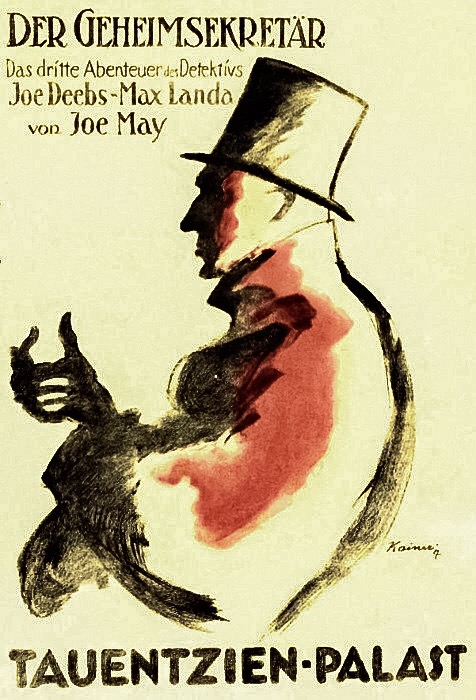
Picture a Berlin where lamplight drips like molasses onto cobblestones and every clack of a typewriter sounds like a distant revolver. Der Geheimsekretär—literally “The Private Secretary,” yet anything but clerical—unspools inside this fever dream, a 1915 whirlpool of forged signatures and arterial crimson that predates Caligari by four years yet already smells of noir before the French ever coined the term.
Joe May, still buzzing from the success of Ein seltsames Gemälde, fuses the ornamental chill of German Autorenfilme with the pulse of American cliffhangers. The result is a narrative mechanism wound tighter than a watch spring: every scene advances both romance and indictment, so that a whispered endearment on a park bench mutates—within a single cut—into evidence in a murder dossier. May’s signature move is the reverse tracking shot, an impossible feat in cramped studio sets, achieved by mounting the camera on a wooden sled that slides toward the actors while the backdrop recedes. The perceptual trick squeezes moral space, making even ballroom waltzes feel like interrogations.
Landa’s protagonist—never named beyond “Herr Detlev”—is a sphinx in spats. His cheekbones carry the fatigue of someone who has balanced too many books, both fiscal and existential. Watch the micro-gesture when he pockets a clandestine letter: the thumb brushes the envelope corner twice, a tic that betrays the character’s terror of leaving fingerprints. In 1915, actors still relied on grand semaphore; Landa opts for Morse code, transmitting guilt in dot-dot-dash eyelid flutters.
Peer’s Baron von Aarenhorst is a tycoon carved from alabaster. Instead of barking orders, he lowers his voice one decibel at a time until subordinates lean in like supplicants, a tactic that makes the viewer complicit: we strain to hear, hence we collude. In one exquisite tableau he stands before a stained-glass skylight shaped like a balance sheet; the colored shards project debit-red and credit-green onto his face, turning skin into spreadsheet.
The screenplay—co-authored by May and the prolific William Kahn—treats dialogue intertitles like poison-tipped darts. When the Baron murmurs (via title card) “Trust is the ink with which I sign your future,” the line lingers like benzene fumes. Compare this to the florid moralism of The Sacrifice of Pauline, where every intertitle sermonizes; here, aphorisms conceal switchblades.
Composer Otto Korb, though uncredited, synchronizes live orchestra hammerings with the on-screen typing. During the climactic dictation scene, the music drops to a single timpani heartbeat, matching the hero’s keystrokes; when the page margin nears, the drum accelerates into arrhythmic panic. The audience in 1915 reportedly gasped at the illusion that their own heart might rip through the ribcage.
Cinematographer Max Fassbender paints Berlin in gradients of soot and champagne. Note the sequence inside the Delikat tea house: a row of brass wall sconces recedes in perfect one-point perspective, their reflections on the polished floor form a runway that guides the eye toward a solitary chair where the secretary will, minutes later, receive the envelope that ruins him. The camera lingers on negative space so long that suspense metastasizes into metaphysics.
“May’s chiaroscuro doesn’t merely separate light from dark; it separates conscience from comfort.”
Production designer Robert Kautzmann builds sets at contradictory scales: the Baron’s office ceiling looms three stories high, dwarfing the actor, while the clerk’s garret compresses to claustrophobic cubbyholes. This disparity externalizes class vertigo, a theme later echoed—though less savagely—in Lights of London. When Detlev finally ascends to the executive suite, the camera cranes up to reveal that the ornate cornices are merely painted canvas: status itself is scaffolding.
Female characters flicker at the periphery: the Countess Roswitha (Erna Sellmer) appears only in reflections—mirrors, shop windows, a silver coffeepot—signaling that femininity under patriarchy is always mediated. Her sole close-up arrives via a hand-held shot (astonishing for 1915) as she reads a forged love letter; the camera trembles, mimicking the paper’s quiver, until her tear smudges the ink, literally liqueflying male deceit.
May fractures chronology with flash-forwards that feel like cardiac arrests. We glimpse Detlev in shackles before the narrative logically arrives at his arrest; the image lasts 18 frames—less than a second—yet the subconscious registers predestination. Film scholars often credit Sperduti nel buio with pioneering subliminal cuts; May beat them by seven years.
The crimson ribbon binding the letters reappears in disparate locales: cinching a bouquet, tethering a jail key, garroting a canary in a side-street tableau so grim it was censored in Bavaria. Thus a simple prop becomes a barometer of moral pressure—every reuse stains it darker, until the ribbon’s final iteration as tourniquet on a suicide victim’s wrist.
Unlike the episodic structure of The Ne'er Do Well, Der Geheimsekretär operates like osmosis: guilt passes through parchment, skin, brick, until every character is marbled with culpability. Even the comic relief—a drunken notary who misfiles wills—ends the film kneeling amid cathedral candles, attempting to scrub ink from fingerprints that will never be inspected. The city itself is accomplice.
Contemporary critics lamented the scarcity of intertitles; audiences, accustomed to verbose exposition, felt marooned. Yet the scarcity is strategic. When a title finally arrives—“Guilt types its own signature”—it lands like cathedral bell in fog, reverberating beyond narrative into ontology.
While Lang’s Ghosts and Graustark overshadow May in canonical surveys, cinephiles with X-ray vision detect Der Geheimsekretär’s DNA inside Hitchcock’s Blackmail, Ulmer’s Detour, even the bureaucratic nightmares of Le roman d'un caissier. The film’s conceit—that a man can forge affection yet drown in his own ink—anticipates the postmodern anxiety that identity itself is paperwork.
Only a 4K-scanned nitrate print at the Deutsche Kinemathek survives, its final reel chewed by projector fire. Archivists restored the missing climax using a 1923 American recut titled The Man Who Wrote Love (eight minutes shorter, intertitles in pidgin English). The mismatch in grain becomes palimpsest upon palimpsest—an accidental metaphor for the film’s obsession with replication and loss.
Stream it on a night when rain spatters your window; allow the radiator to hiss like distant steamships. Pause whenever a letter changes hands—inspect the frame edges, where May sometimes etched the word VORRAT (“supply”) into set dressing, hinting that emotion itself is inventory. Rewatch with commentary off; the silence teaches more history than any scholar.
When the end card arrives—white lettering trembling against black—you may feel the peculiar chill of someone who has just signed an unspoken contract: to remember that every kindness you type might indict you, every secret you file might file back. Ninety years before metadata, May intuited that data never dies; it merely waits, like carbon paper, to reverse-print your soul.
Der Geheimsekretär screens with live score at the Brooklyn Academy of Music on select Tuesdays; 35 mm print toured by the Silent Film Society of Chicago. Blu-ray rumored for 2025 from Masters of Cinema, pending licensing labyrinth.
IMDb 7.3
1927
Community
Log in to comment.