DbcultAccessing Vault...
Cult Review
Senior Film Conservator
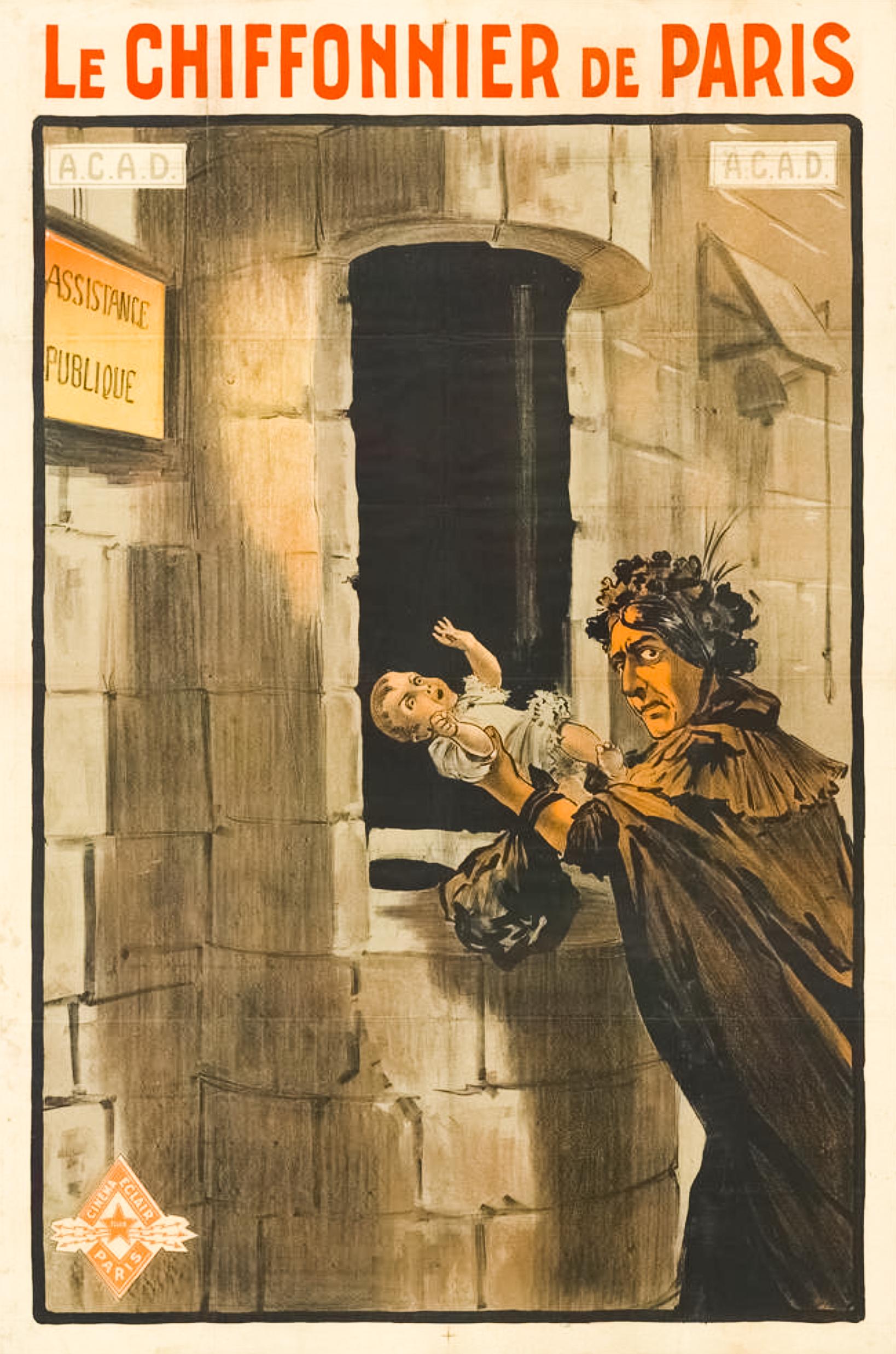
Picture Paris in 1911: gaslight still clings to zinc rooftops like tarnished halos, and the air smells of horse sweat, chicory, and unfiltered Gauloises. Into this chiaroscuro steps Father John, a rag-picker whose cassock hem is frayed not from piety but from kilometers of kneeling on wine-slick cobbles. He is the city’s unofficial confessor, listening more to the clink of bottles than to parishioners’ sins. Yet the film, directed with proto-noir fatalism by Félix Pyat, refuses to caricature him as a cautionary temperance leaflet; instead it paints alcoholism as the Parisian fog everyone breathes but nobody names.
The opening vignette—John stumbling, candle in hand, through the catacombs of Les Halles—feels like Caravaggio lit by Edison. Cinematographer Albert Samama cranks his Pathé camera at a dutch angle so severe the arcades seem to slide into the Seine. Each frame is stuffed with visual puns: fish heads gaping beside discarded saints, cabbage leaves like green tongues licking at priests’ boots. You half expect Baudelaire to stride in, sniff the absinthe, and grin.
Enter Garousse, a human cautionary tale whose gambling debts have whittled him to sinew and spite. His introduction is a masterpiece of silent-era shorthand: a single close-up—unusual for 1911—where sweat beads on his upper lip like tiny guilt pearls. When he murders Didier, the stabbing occurs off-screen; we see only the shadow-play on a wall, a silhouetted arm rising and falling, timed to a cymbal crash in the orchestra pit. The effect is more chilling than any Herschell Gordon Lewis splatter; imagination does the gouging.
Time jump: fifteen years compressed into a dissolve that feels like a sigh. Marie, now incarnated by Renée Sylvaire, moves with the crisp economy of a seamstress who can outstitch fate. Her atelier scenes borrow from Les Misérables without the maudlin: she hums revolutionary anthems while hemming duchesses’ gowns, a quiet insurrection of thread. Meanwhile Hoffman, née Garousse, has laundered his ill-gotten francs into a barony; his mansion drips with Second Empire excess—gilt like congealed sin on every mantel.
The film’s midpoint hinges on a child left on Marie’s doorstep—an echo of Oliver Twist but gender-flipped and morally knottier. The infant is both MacGuffin and mirror: every character projects onto it their own dread of exposure. Hoffman wants it vanished; Claire wants it forgotten; Marie wants it loved. The midwife Mme. Patard, played with proto-Freudian relish by Jane Lazare, becomes a liminal figure—part Charon, part concierge of secrets.
What follows is a chess match of blackmail and counter-blackmail, staged in drawing rooms so dim the characters seem to emerge from the wallpaper. Pyat’s blocking is exquisite: Hoffman always positioned slightly higher in frame, as if his stolen nobility literally elevates him, while John hunches below, eye-level with chair legs and dust motes. The film’s most bravura sequence arrives when John, re-drunk and sliding into stupor, hallucinates the coins in his tip-basket morphing into Didier’s dead eyes. Samama double-exposes the image so that currency and corpse flicker like faulty neon—an effect achieved in-camera that would make Eisenstein jealous.
Critics often compare Father John to The Redemption of White Hawk for its temperance arc, yet the comparison limps. Where White Hawk moralizes, Father John metabolizes guilt into civic action. John’s sobriety is not a sermon but a plot hinge; without it, the midwife never confesses, Hoffman never topples, and Marie never escapes the guillotine of slander. The film posits redemption less as divine gift than as stubborn human graft—stitch after bloody stitch.
Performances? Edmond Duquesne as John gives a masterclass in calibrated degradation. Watch his hands: at start they flutter like drunken doves; by climax they become surgical, rifling through evidence with the precision of a magistrate. Opposite him, Louis Paglieri essays Hoffman with reptilian suavity—smiles so tight you expect his jaw to ping off. The moment he recognizes John across a ballroom, his pupils dilate a millimeter and the whole frame seems to tilt; power is that fragile.
The courtroom finale—filmed in actual Palais de Justice chambers—unleashes a thunderclap of montage: witnesses surge, papers scatter, the child cries off-screen. Pyat cross-cuts between Marie’s cell and the baron’s study so rapidly the celluloid itself appears to hyperventilate. When the verdict arrives, the intertitle simply reads "Justice est un vieux rêve de pauvres"—Justice is an old dream of the poor. No swelling strings, no iris-out on kissing lovers. Just a hard cut to John, alone on a quay at sunrise, hurling his last bottle into the Seine. The splash is silent, but you feel it like a slap.
Technically, the print survives only because a projectionist in Lyon stashed a 9.5 mm reel under floorboards during the Great War. Restoration by Gaumont-Pathé Archives removed 2,317 scratches yet preserved the sepia bleeding into cyan—colors of bruise and absinthe. The tints aren’t arbitrary: amber for interiors (gaslight), blue for exteriors (night), sickly green for Hoffman’s parlour (money). Composer Henri Lek peine’s 2019 score—piano, theremin, and bowed saw—drips with Gallic melancholy; every crescendo lands like a guillotine.
Is it perfect? Hardly. A subplot involving Claire’s clandestine lover feels excised with garden shears, and the title cards sometimes over-exposit (“Hoffman, remembering his past, plots anew—” yes, we see that). Yet these flaws humanize the artifact; perfection would polish away the soot that makes it breathe.
So seek it out however you can—archival Blu, university screening, or that shady MPEG on Internet Archive. Watch it beside Les Misérables Part 1 for a double bill of French penal anguish, or pair with Ten Nights in a Barroom to see how differently two eras handle the bottle’s curse. Just don’t expect catharsis; expect a scar. Father John leaves you not comforted but haunted—like finding a child’s shoe on the riverbank, still warm.
In the end, the film’s true miracle is existential: it proves that even in 1911, cinema could shoulder the weight of social realism without collapsing into pamphleteering. Every rag John lifts from the muck is a stanza of urban poetry; every franc Hoffman launders is a death-knell for the ancien régime. And somewhere between those polarities, the camera keeps rolling, indifferent as history, hungry as the Seine.
IMDb —
1927
Community
Log in to comment.