DbcultAccessing Vault...
Cult Review
Senior Film Conservator
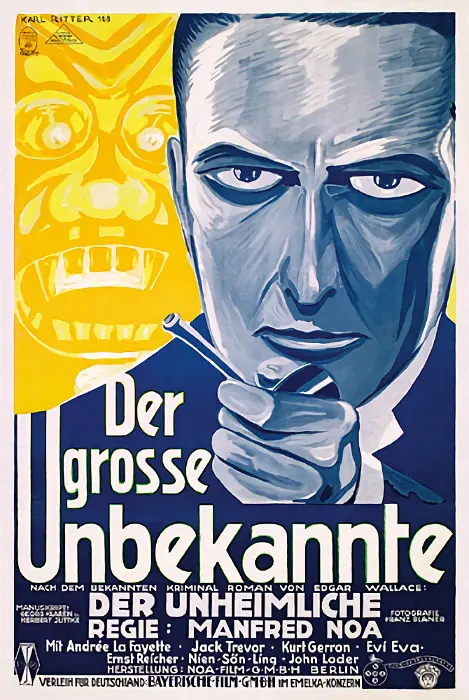
Is 'Der große Unbekannte' (1927) worth watching today? Short answer: yes, but with significant caveats that demand a certain cinematic palate. This silent German thriller, steeped in the atmospheric dread characteristic of its era, offers a fascinating glimpse into early suspense filmmaking, yet it requires patience and an appreciation for historical context.
This film is absolutely for silent film enthusiasts, fans of early detective stories, and those curious about Edgar Wallace's influence on German cinema. It is decidedly NOT for viewers seeking fast-paced action, modern narrative conventions, or a purely accessible viewing experience without the need for historical empathy.
Stepping into the world of 'Der große Unbekannte' is akin to opening a dusty, forgotten tome – a rich, if sometimes challenging, experience. The film, a product of Germany's vibrant silent era, attempts to translate the intricate web of an Edgar Wallace mystery to the screen, a task it approaches with both ambition and a touch of the theatrical.
What immediately strikes one is the sheer audacity of its visual storytelling. Without spoken dialogue, the narrative relies heavily on exaggerated performances, evocative set designs, and the masterful manipulation of light and shadow, hallmarks of German Expressionism, though perhaps less overtly stylized than some of its contemporaries.
The story itself, a classic 'whodunit' centered around a shadowy criminal mastermind, feels comfortingly familiar, even nearly a century later. It taps into primal fears of the unknown and the unseen, a universal appeal that transcends the limitations of its medium.
The direction in 'Der große Unbekannte' is, for its time, remarkably effective in building suspense. There's a palpable sense of tension throughout, achieved not through quick cuts or frantic action, but through lingering shots and the deliberate framing of its characters within their often oppressive environments. The director, working with the inherent limitations of silent film, understands the power of suggestion.
Consider the recurring motif of the 'Great Unknown's' shadow, often cast ominously over a city skyline or across a dimly lit alley. This simple visual cue, devoid of any literal representation of the villain, is far more chilling than any direct depiction could have been. It’s a testament to the directorial choice to prioritize psychological impact over explicit revelation.
However, this deliberate pacing occasionally verges on ponderous. There are moments, particularly in the film's second act, where exposition feels stretched, relying on intertitles that could have been more efficiently conveyed through visual storytelling. This is a common pitfall of the era, but one that perhaps could have been trimmed for a more taut experience.
The performances in 'Der große Unbekannte' are, as expected for a silent film, highly expressive and theatrical. Actors were tasked with conveying complex emotions and plot points solely through their facial expressions and body language, a skill that feels almost alien to contemporary audiences.
Ernst Reicher, as Inspector Brown, delivers a performance that anchors the film. His portrayal is one of persistent, almost weary determination. You can see the weight of the case in his furrowed brow, the frustration in his hand gestures as he examines a clue. He avoids caricature, grounding his detective in a believable, if still heightened, reality.
Ruth Weyher, as the imperiled heiress Mary, embodies the damsel in distress archetype with convincing vulnerability. Her wide-eyed terror during a kidnapping attempt, or her subtle shifts from fear to dawning suspicion, are communicated with clarity, even if the emotional range feels somewhat constrained by the era's performance style.
Nien Soen Ling's portrayal of Mr. Wu is perhaps the most intriguing, and also the most problematic, aspect of the cast. While he imbues the character with an undeniable air of mystery and quiet intensity, the role itself flirts with 'Orientalist' stereotypes prevalent in early cinema. Ling's enigmatic gaze and precise movements are captivating, but the character's exoticism feels like a product of its time, which can be jarring for modern viewers.
The black-and-white cinematography is, without question, a standout element. The film revels in the stark contrasts afforded by the medium, using deep shadows to conceal and dramatic lighting to reveal. This isn't just aesthetic; it's integral to the mystery itself, mirroring the unseen nature of the villain.
One particularly memorable sequence involves a chase through foggy London streets. The swirling mist, illuminated by isolated streetlights, creates a disorienting, almost dreamlike atmosphere that perfectly encapsulates the elusive nature of 'The Great Unknown'. The camera work here, while not groundbreaking for its time, is highly effective in establishing mood and escalating tension.
Close-ups are used judiciously to highlight key emotional beats or crucial evidence, drawing the audience into the characters' inner worlds or the specifics of the investigation. The camera often frames characters in ways that emphasize their isolation or vulnerability, a subtle but powerful visual language.
The pacing of 'Der große Unbekannte' is, by contemporary standards, leisurely. The film takes its time to establish its characters, its setting, and the escalating threat. This slow burn approach allows for a gradual build of suspense, but it also demands a certain level of commitment from the audience.
The tone oscillates between ominous dread and moments of dramatic romantic tension. The constant threat of 'The Great Unknown' permeates every scene, creating a pervasive sense of unease. Yet, there are also touches of melodrama, particularly in the interactions between Mary and Robert, which ground the fantastical elements in human emotion.
It works. But it’s flawed. The resolution, when it finally arrives, feels somewhat rushed compared to the meticulous build-up, a common issue in many early thrillers where the 'reveal' often struggles to match the grandeur of the mystery itself.
Yes, 'Der große Unbekannte' is absolutely worth watching for the right audience. It's a valuable piece of cinematic history, showcasing the early mastery of suspense without dialogue. For those accustomed to modern narratives, it will feel slow, even archaic, but for anyone willing to engage with its unique language, there's a rich experience to be had.
The film offers a fascinating look at how filmmakers of the era used visual storytelling to compensate for the lack of sound, creating a distinct aesthetic that is both beautiful and unsettling. Its influence, though perhaps subtle, can be traced through later German thrillers and even Hollywood's Golden Age mysteries.
Der große Unbekannte (1927) is a fascinating, if imperfect, relic from a bygone era of cinema. It's a film that demands patience and a willingness to adjust one's expectations to its historical context. While its pacing can test the limits of modern attention spans and some of its characterizations are undeniably dated, its strengths lie in its audacious visual storytelling and its ability to conjure a pervasive sense of mystery without uttering a single word. Ernst Reicher's performance as the weary detective is a compelling anchor, and the film's atmospheric cinematography is a masterclass in using light and shadow to build suspense. It's not a casual watch, nor is it a 'masterpiece' in the conventional sense, but it is an important piece of German silent cinema that offers genuine insight into the origins of the thriller genre. For film historians and dedicated cinephiles, it's an experience worth seeking out, a whisper from the past that still holds a quiet, unsettling power. However, for those new to silent film, I'd suggest starting with more accessible works like The City (1926) or even The Awakening before delving into this particular 'unknown'.
IMDb 5.2
1930
Community
Log in to comment.