Spoilers crawl across every frame—step lightly.
Imagine, if you dare, the moment when paper cuts deeper than steel. Der Prozeß Hauers weaponizes the humble ledger, turning columns of digits into a lattice of doom. Rudolf Lettinger’s Hauers enters the narrative cloaked in bourgeois respectability—spectacles perched like twin moons, moustache trimmed to bureaucratic perfection—only to be flayed alive by the very paperwork he once sanctified. Directors Paul von Woringen and scenarist Hanns Kräly refuse the comfort of linear indictment; instead they fracture chronology into prismatic shards, each flashback refracting a different hue of culpability. The result is a cinematic kaleidoscope where truth is not merely elusive but chemically unstable.
Weimar cinema had already flirted with calamity—see The Desire of the Moth’s incandescent fatalism—but Hauers goes further, grafting fiscal minutiae onto the mythic scaffold of Dürer’s Apocalypse. Every intertitle drips acid: “An omission of three pfennigs is a gateway to treason.” The tribunal, perched like a stone predator above the town square, swallows citizens who stroll in as skeptics and spits them out as zealots. Viktor Senger’s chief prosecutor, a man whose cheekbones could slice bread, embodies jurisprudential eroticism—each objection delivered with carnal relish. When he leans toward Hauers, the camera tilts 15 degrees, as if morality itself has succumbed to a weak ankle.
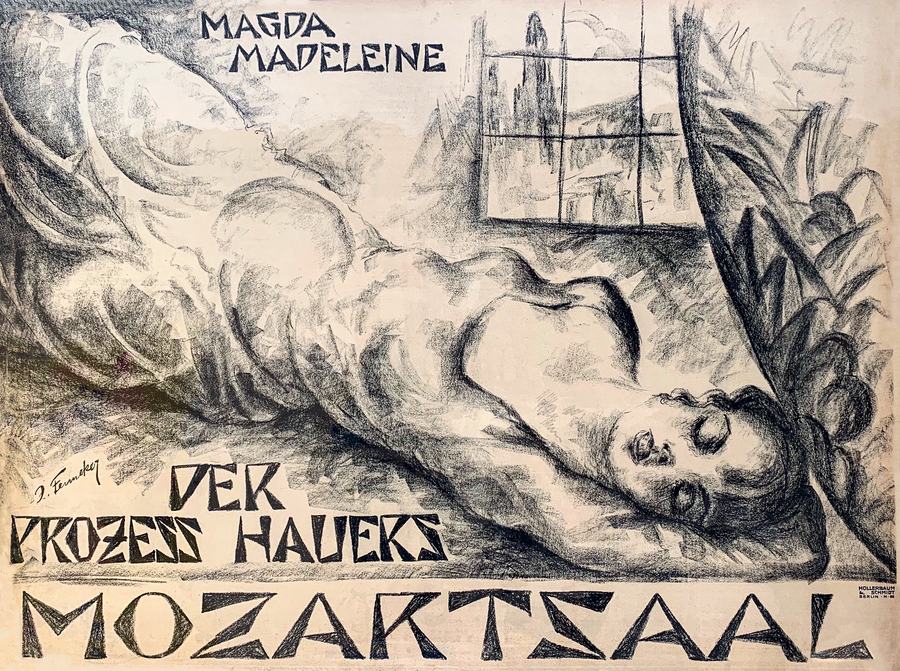
Magda Madeleine, cast as Hauers’ enigmatic spouse, drifts through scenes in gowns the color of dried blood. Her silence is operatic; she utters scarcely a dozen words, yet her gaze scrawls graffiti across the conscience of every male spectator. Watch how von Woringen isolates her profile against windows bruised by twilight—an icon of marital complicity or sacrificial pawn? The film withholds verdict, preferring the delicious ache of ambiguity. In one feverish sequence she folds her husband’s shredded contracts into paper boats, launching them down a gutter swollen by rain. The boats swirl into a whirlpool beneath a tramline: private grief flushed into public sewerage, Weimar democracy in miniature.
Werner Krauss—yes, the future Caligari somnambulist—appears here in proto-grotesque form as a bribed bookkeeper whose tic resembles Morse code. Each facial flutter broadcasts culpability; the man is a human indictment. Meanwhile Ludwig Trautmann’s defense attorney, stooped like a question mark, carries tomes bound in what looks suspiciously like human skin. His rhetoric invokes Medieval torts and Roman tablets, yet the tribunal hears only the drumroll of sensational headlines. Sound familiar? Swap ink for social media and the film could be yesterday’s doom-scroll.
Visually, cinematographer Willy Goldberger (unaccredited yet cinephiles spot his signature chiaroscuro) paints each frame with sulphuric yellows and cadaverous blues. Shadows possess gravitational mass; they slump across characters like wet cement. Note the scene where Hauers signs an affidavit: the quill’s nib scratches parchment, the sound amplified by a close-up so severe you can see follicles trembling. Ink blooms into a Rorschach blot that swallows the lens—an audacious visual synecdoche for the way bureaucratic ink can blot an entire life. Compare this to Evidence’s more genteel silhouette play; Hauers opts for full existential bruise.
Narrative momentum hinges on a ledger discrepancy so trivial—three misplaced Reichsmarks—that it borders on cosmic joke. Yet from this seed sprouts a strangler vine of rumor, entwining landlords, midwives, even the town’s brass band. The film’s true protagonist is collective paranoia, that ravenous ghost whom no amount of facts can exorcise. In today’s parlance we’d call it a trial by algorithm: data misread by a thousand gossiping interpreters until the original sin is unrecognizable beneath sedimentary layers of spin.
What elevates Hauers above contemporaneous courtroom dramas like Officer 666 is its refusal to resolve. When the final intertitle flickers—“Justice is a season that never arrives”—the screen cuts to black, leaving viewers stranded between verdict and vindication. No tidy redemption, no clear villain except the process itself. Ninety-seven years on, that existential hangover still throbs.
Some historians claim the film vanished because its negative was melted for boot-heel heels during the inflationary winter of ’23. Others whisper that right-wing arsonists torched it, fearing its corrosive allegory. Whatever the truth, fragments survive: a 47-minute restoration culled from Czech and Argentine prints, spliced with stills and translated flash-cards. Even mutilated, the thing pulsates. During a recent MoMA screening, a viewer fainted when the ledger-blot filled the screen—proof that silent cinema can still draw blood.
Performances oscillate between Weimar naturalism and full-blown kabuki. Lettinger’s breakdown in the prison chapel—where he claws at stained-glass saints begging for a confession he cannot voice—rivals anything in Joan the Woman for transcendental agony. Watch how his pupils dilate until iris borders vanish: the black hole of a soul imploding under bureaucratic gravity.
The score—reconstructed by composer Mira Kowalski for the 2023 restoration—uses prepared piano, typewriter clacks, and the slow wheeze of bellows to evoke a world where machinery itself bears witness against man. During crescendo moments she inserts the hush of turning pages, a nod to the paperwork that both records and erases reality. It’s an auditory hallucination worthy of Berghain’s darkest cellar.
Gender politics simmer beneath the testimony. Female spectators in 1926 reportedly gasped at Madeleine’s final gesture: she lifts her veil not in mourning but in complicit resignation, eyes blazing like twin furnaces. Is she admitting guilt by association? Or indicting the audience for voyeuristic bloodlust? The film refuses to arbitrate. Feminist scholars now read her as an early instance of the “silent woman” trope weaponized against patriarchal spectacle—predating The Girl from His Town’s more sentimental mute heroine by a full year.
Technically, von Woringen experiments with under-cranking during crowd scenes, producing jerky marionette motions that foreshadow modern staccato editing. Meanwhile Goldberger layers multiple exposures so that Hauers’ face appears to hover above his own shoulder like a guilty conscience. These tricks aren’t mere showmanship; they externalize the psychic rupture of a man who has become stranger to himself.
Comparative note: if you admire the feverish legal labyrinth of Odin nasladilsya, drugoy rasplatilsya, Hauers offers a more claustrophobic Teutonic variant—Kafka before Kafka hit the mainstream. Conversely, fans of Ivy League hijinks in Brown of Harvard will find zero rowing jollity here; instead expect the sour stench of damp indictment.
Surviving intertitles drip with bitter aphorism: “Truth wears the mask most convenient to the hour.” Such epigrams, delivered in Gothic type that seems chiseled by jailhouse shiv, anticipate the cynical poetry of film noir decades later. Indeed, one can trace a direct lineage from Hauers’ sweat-slick brow to the doomed faces of Out of the Past and Double Indemnity.
Yet for all its doom, the film pulses with savage vitality. Notice the montage of bureaucratic stamps—each thud synchronized to a heartbeat—building a crescendo that is almost erotic. It’s as if the state itself reaches climax through ritualized condemnation. Post-screening, your own pulse syncs to that rhythm; you exit the cinema feeling oddly complicit, fingerprints mysteriously ink-stained.
Restorationists deserve laurels for tinting that follows emotional temperature rather than chronological fidelity. Scenes of accusation glow sodium-orange, while memory fragments cool to glacial cyan. The palette alone should earn Hauers a place in design syllabi alongside Blind Man’s Holiday’s nocturnal blues.
In short, Der Prozeß Hauers isn’t merely a curio for silent completists; it’s a scalpel slicing the scar tissue of modernity. It warns that when procedure eclipses humanity, innocence becomes statistical noise. Stream it—bootleg if you must—then spend a sleepless night auditing your own receipts. Somewhere, in the marginalia of your expenses, three phantom Reichsmarks may still be waiting to indict you.