DbcultAccessing Vault...
Cult Review
Senior Film Conservator
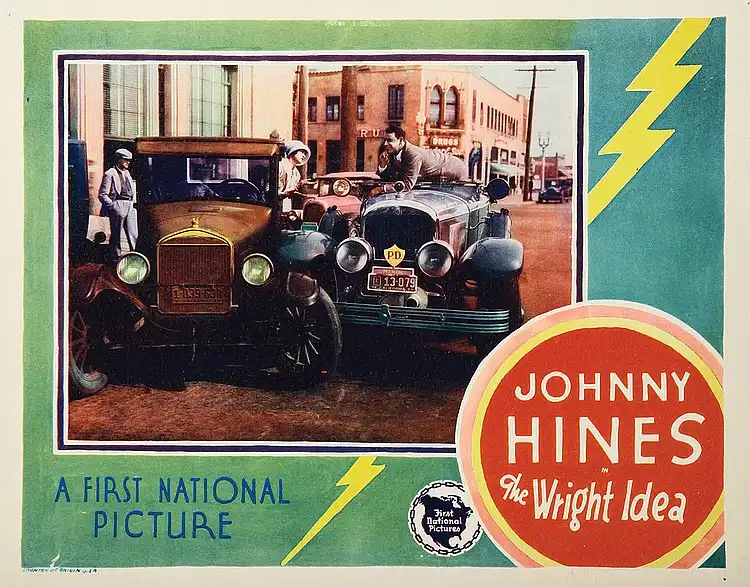
If you have about seventy minutes to spare and a high tolerance for 1920s 'pep' culture, The Wright Idea is worth a look. It is not a lost masterpiece. It isn't going to change your life. It’s the kind of movie you watch because you are curious about Johnny Hines and why he was once considered a rival to the big names of silent comedy. If you want the clockwork precision of Buster Keaton, you will probably be annoyed within ten minutes. But if you like watching a man move as if he’s had six cups of coffee right before the director yelled 'action,' there is something here for you.
Johnny Hines has this very specific, almost twitchy energy. He plays Sylvanus Wright, an inventor who is obsessed with 'luminous ink.' It is such a weird, oddly specific thing to build a movie around. There is a scene early on in an office where he is pitching his invention, and the way he waves his hands around feels less like choreographed slapstick and more like he is genuinely struggling to keep his limbs attached to his body. He knocks things over, but it doesn’t feel 'clean.' It feels messy, which I actually kind of liked. It felt more like a real person being clumsy than a stuntman doing a bit.
The intertitles are doing a lot of heavy lifting here. Some of them try so hard to be 'snappy' and modern for 1928 that they end up being a bit hard to parse. One card describes a character as having 'a face like a tired sponge.' That’s a great line, but the actor’s face doesn't really live up to it. He just looks like a regular guy in a suit. There’s a disconnect between what the writing wants the movie to be and what is actually happening on screen.
There is a sequence on a yacht that takes up a huge chunk of the middle. The editing gets incredibly choppy during the outdoor shots. One second they are on the deck in bright sunlight, and the next there is a jump cut to a medium shot where the lighting is completely different—clearly filmed on a soundstage with a painted backdrop that doesn't quite match the horizon. If you look closely at the windows of the cabin during the interior scenes, you can sometimes see reflections of the studio lights. I love stuff like that. It reminds you that this was just a job for these people, a quick production meant to be consumed and forgotten.
Louise Lorraine is the female lead, and she mostly exists to look concerned. She does 'concerned' very well, but her chemistry with Hines is non-existent. It’s like they are in two different movies. He is performing in a frantic cartoon, and she is in a light social romance. It reminded me of that same tonal mismatch in Paradise for Two, though that film had a bit more of a budget to hide the cracks. Here, the seams are wide open.
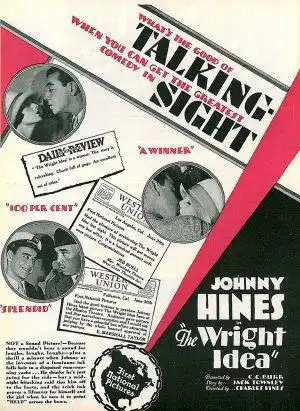
The luminous ink itself is supposed to be the big hook, but the movie keeps forgetting about it for twenty minutes at a time to focus on a weirdly complicated plot about a will and a fake marriage. It feels like the writers, Jack Townley and Paul Perez, had two different scripts lying around and just mashed them together. One minute it’s a comedy about an inventor, and the next it’s a standard 'poor guy pretends to be rich' story. We’ve seen it a hundred times, and we’ve seen it done better in things like The Speed Boy.
There’s a guy in the background of one of the boat scenes—one of the extras playing a sailor—who is clearly just waiting for his cue. He stands perfectly still, staring at nothing, and then suddenly 'activates' and starts scrubbing a rail when Hines runs past him. It’s those little moments that make these late silents interesting to watch now. You see the artifice of it all.
Edmund Breese plays the father figure, and he has an incredible mustache. It is the most interesting thing in the room whenever he is on screen. He spends most of his time looking like he wants to punch Johnny Hines, which, to be honest, is a very relatable emotion by the second act. The way Hines handles props is also worth noting. He doesn’t just use them; he attacks them. When he is writing with a pen, he is stabbing the paper. When he sits in a chair, he is fighting the cushions. It’s an exhausting style of comedy.
The ending is incredibly abrupt. It’s like they ran out of film or the sun was going down and they just decided that was enough. One quick kiss, a title card, and the movie is over. It’s almost refreshing how little they cared about a 'graceful' exit. It isn't a deep film—it's certainly not going for the emotional weight you might find in Judgment of the Storm—but it’s a fast-paced bit of nonsense that captures a very specific moment in the late silent era before everything got slowed down by the arrival of sound.
If you’re a completionist for 1920s comedies, watch it. If you’re looking for a laugh-out-loud riot, you might find it more tiring than funny. But keep an eye out for that mustache. It really is something.
IMDb 6.3
1935
Community
Log in to comment.