DbcultAccessing Vault...
Cult Review
Senior Film Conservator
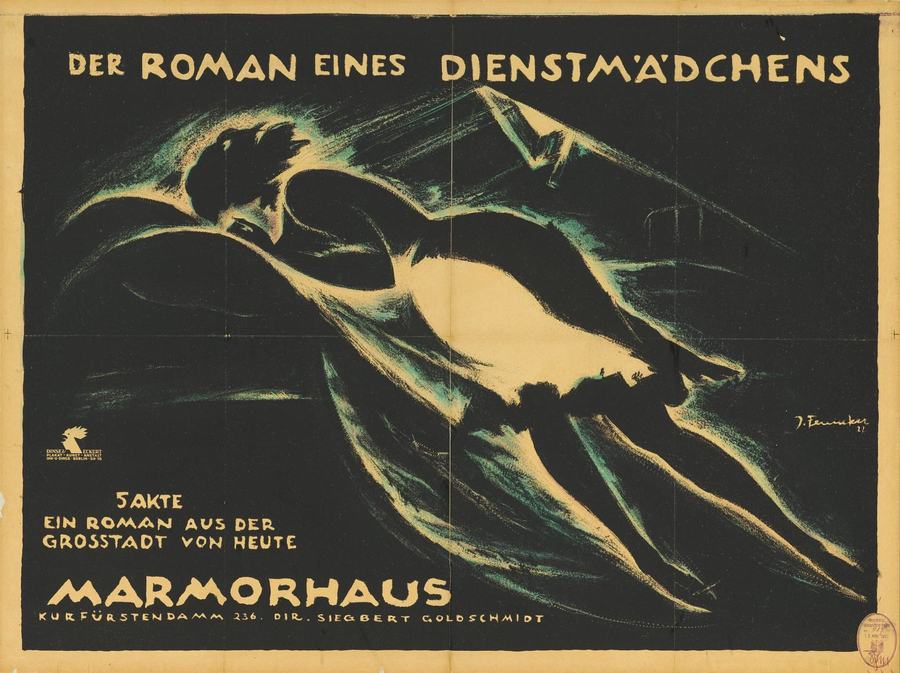
Set against the rigid social stratifications of pre-war Europe, Der Roman eines Dienstmädchens emerges as a chillingly elegant excavation of domestic servitude’s psychological toll. Robert Liebmann’s direction, with its meticulous attention to spatial oppression—opulent drawing rooms suffocating under the weight of unspoken rules—positions the narrative as both character study and socio-political allegory. The maid, portrayed with aching subtlety by an uncredited Margarete Kupfer, becomes a vessel for universal yearning, her every glance a silent manifesto against the invisible chains of class.
What distinguishes this film is its masterful use of negative space. The camera lingers on Kupfer’s face during moments of quiet defiance, the absence of dialogue amplifying the tension as she polishes gilded mirrors that reflect her own invisibility. In one harrowing sequence, her employer’s daughter (Liane Haid) carelessly spills wine across a priceless tapestry, the red stain—a visual metaphor for the bloodline’s disregard—contrasting with the maid’s trembling hands scrubbing at the fabric. Liebmann’s framing often positions the maid in shadow, a chiaroscuro technique that reinforces her liminal status: seen yet unseen, present yet erased.
While the screenplay adheres to its period drama conventions, the cast injects a raw vitality that transcends its era. Leonhard Haskel’s portrayal of the imperious patriarch is a masterclass in restrained menace; his clipped speech patterns and calculating gaze suggest a man whose power is both inherited and deeply insecure. Equally compelling is Eugen Rex as the morally ambiguous footman, whose flirtations with the maid carry an undercurrent of paternalistic mockery. The true standout, however, is Trude Hesterberg as the housekeeper—her scenes with Kupfer crackle with unspoken solidarity, their shared glances a language of mutual survival.
The film’s aesthetic rigor is unparalleled. Liebmann employs vertical compositions to emphasize the hierarchy: the maid is frequently shot from below, dwarfed by architectural elements, while the patrons occupy vast horizontal planes. A pivotal scene uses a rotating camera to mirror the maid’s disorientation as she’s forced to navigate a ballroom of strangers, her uniform a gilded cage. The score—minimalist, with haunting harpsichord motifs—echoes the era’s music halls but is twisted into something ominous, a constant reminder of the social order’s brittle veneer.
While The Dumb Girl of Portici shares its exploration of class conflict, Der Roman eines Dienstmädchens distinguishes itself through its interiority. Unlike Ain’t Love Grand?’s sentimentalism or Golfo’s operatic flourishes, this film’s power lies in its restraint. Its closest cousin may be Who Is to Blame?, with both works dissecting societal complicity through intimate narratives. Yet Liebmann’s piece is darker, more unsparing, its resolution neither tidy nor hopeful—a reflection of the unyielding structures it critiques.
Though largely forgotten in mainstream discourse, Der Roman eines Dienstmädchens prefigures later works like The Trail to Yesterday in its treatment of memory and identity. Its unflinching portrayal of domestic labor anticipates the feminist narratives of later German cinema, while its formal innovations—a blend of expressionism and neorealist techniques—suggested a trajectory that history, unfortunately, did not follow. The film’s 1925 release coincided with Weimar Germany’s cultural zenith, yet its bleakness perhaps explains its marginalization in favor of more escapist fare.
To watch Der Roman eines Dienstmädchens is to witness the silent film’s latent power—an art form that speaks volumes through absence. Its themes of invisibility and entitlement remain disturbingly relevant, its aesthetic choices a masterclass in visual storytelling. For modern audiences, this is not merely a relic but a provocation, a mirror held up to the persisting hierarchies of our own world. Liebmann’s work, though constrained by its era, soars beyond it, offering a haunting meditation on the cost of obedience and the price of freedom.

IMDb 7
1914
Community
Log in to comment.