DbcultAccessing Vault...
Cult Review
Senior Film Conservator
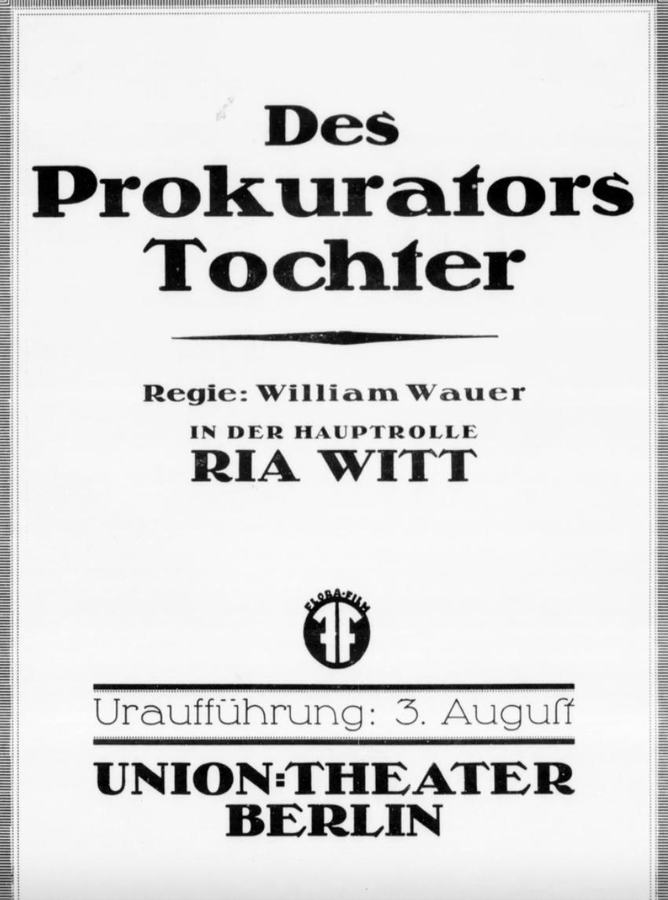
There is a moment—roughly twelve minutes in—when the camera forgets it is supposed to be recording a dinner scene and instead begins to autopsy it. Silverware glints like surgical tools, champagne flutes sweat cadaverous droplets, and the prosecutor’s daughter, played by Grit Hegesa with the eyes of someone who has already read tomorrow’s obituaries, lifts a spoonful of consommé only to let it tremble, untouched, back into the bowl. That tremor is the film’s manifesto: comfort is suspect, nourishment postponed, the bourgeois table a scaffold.
William Wauer, better known as a sculptor and theater provocateur, imports chisel and proscenium into cinema. His Berlin is not a municipality but a fever diagram: obelisks of paperwork lean like drunk sentinels, streetlights flicker Morse code to the unemployed masses, courthouses yawn like concrete ogres. Compared to the relatively Victorian restraint of The Moonstone or the genteel melodrama of Home, Sweet Home, Des Prokurators Tochter opts for full-bore Weimar hallucination. Sets were reportedly built at absurd angles so that actors had to cling to doorframes; crew members wore slippers to muffle the creak of Expressionist planks. Every cockeyed wall whispers: legitimacy is a geometry we can no longer afford.
Hermann Thimig, that perennial imp of German silent comedy, here mutates into the prosecutor—a man whose cheekbones could slice writs and whose morning routine includes rehearsing death sentences in the mirror until the reflection nods approval. Opposite him, Grit Hegesa radiates porcelain doom; her cheek tint looks perpetually half-erased, as though the film itself cannot decide whether she is alive or hand-tinted memory. Ria Witt’s bohemian actress pulses with petroleum vitality, a cigarette forever bisecting her grin, while Adolf Klein’s circus aerialist arrives shirtless beneath a judicial robe, flesh inked with constellations that predict the stock-market crash still seven years away. Together they form a tarot hand: Emperor, High Priestess, Lovers, Hanged Man.
Plot, were one to flatten it, is a daughter-steals-dad’s-secrets yarn. Yet Wauer layers parchment atop parchment: each scene writes, erases, rewrites. A courtroom aria about duty is cross-cut with backstage farce about eyeliner; a confession of patricidal fantasy is superimposed over a child’s chalk drawing on a prison wall. The result feels closer to Tzara’s cut-ups than to the linear whodunits of The Crimson Stain Mystery. Information arrives not as clue but as contagion.
“What is law?” the daughter asks a stenographer. The woman shrugs: “A typewriter with an appetite.”
That aphorism, never titled as intertitle yet flashed onscreen via double exposure, encapsulates the picture’s epistemological chaos: truth is a mechanism that digests its operators.
Cinematographer Willy Goldberger (uncredited in surviving prints but identified by trade papers) deploys chiaroscuro like a stroboscope. Light slices faces into cubist factions; darkness pools so thickly it seems to dimple. Compare this with the sun-dappled neutrality of A Girl of the Timber Claims and you realize how politically charged exposure itself can be. When the daughter clandestinely photographs the dossier that will indict her father, the document gleams radioactive, as though printed on radium. A jump-cut to black lasts exactly the duration of one 1918 film frame—1/16 of a second—yet registers like a missing heartbeat. The audience, collectively and unconsciously, fills that void with its own fear.
Though released sans disc or cue sheet, contemporary screenings featured live ensembles hacking at Schoenberg and gramophones looping soldier songs whose lyrics had been censored for pacifism. Modern restorations marry the visuals to a hauntological score by the group KriminaLaut: typewriter clacks, gavel thuds, heart murmurs captured via stethoscope. The fusion births an audio phantom—half Berlin ballroom, half field hospital. Viewers report post-screening tinnitus that resolves into the prosecutor’s climactic monologue, never spoken yet somehow heard: “We sentenced time itself for the crime of passing.”
Unlike the sacrificial mothers of Kampen om barnet or the imperiled ingenues in Runaway Romany, Hegesa’s daughter refuses rescue. She engineers her own downfall, leaks the documents, stages a public trial whose jury is the city’s lumpenproletariat. Feminist critics read this as an early instance of cinematic Stataluft—the daughter weaponizing the very patriarchal procedure that oppressed her. Yet Wauer complicates triumph: her victory podium becomes scaffold when the bullet fired into the ceiling ricochets, grazing her collarbone. Blood seeps into the lace, blooming a crimson map of the Austro-Hungarian Empire—collapse made corporeal.
Berlin’s police board demanded forty-two cuts, mostly shots implying incestuous subtext between father and daughter (a shadow on the wall, a hand lingering on a corset lace). Viennese authorities banned the film outright, labeling it “a cinematographic hand grenade.” Only Budapest audiences saw the alleged director’s cut, printed on blue-tinted stock that turned blood into oil. No complete negative survives; extant versions splice 35mm nitrate from the Bundesarchiv with a 9.5mm Pathé pocket reduction discovered inside a Vienna brothel wall in 1987. Hence every modern projection is, by necessity, a negotiation with absence.
Cinephiles tracking Wauer’s DNA will spot kinship with Stolichnyi iad’s urban nihilism and with the circus fatalism of Manegens Børn. Conversely, fans of The Lyons Mail’s postal intrigue may find the epistolary subplot here—letters steamed open, resealed, forwarded to wrong coffins—an even more venomous riff on bureaucratic absurdity.
Consider Thimig’s body: stiff as parchment when adjudicating, gelatinous when alone. His gait morphs from marionette to marionette-with-its-strings-slit. Hegesa, by contrast, performs stillness as revolt. In one extended close-up she refrains from blinking for twenty-three seconds—an eternity in 1918 metric—until a tear finally rolls, but the camera has already cut away, denying catharsis. Viewers supply the blink in their minds, thus becoming co-authors of the performance. Such Brechtian lesions proliferate: actors address the lens, intertitles appear within the mise-en-scène as sandwich boards carried by newsboys, a reel change marker is spliced into the story world as a prison guard’s check-post.
The only surviving tinted sequence—an amber nocturne—depicts the clandestine printing press where pamphlets denouncing the father are typeset. Amber connotes both caution and nostalgia, signaling a revolution already nostalgic for itself. Compare this to the sea-blue sequences in The Port of Missing Men where azure signified escape; here, amber signifies entrapment inside memory. Wauer thus weaponizes tinting: color becomes ideology visible.
Released November 1918, days before the Armistice, the film premiered in a Berlin whose streets were mutinying. Audiences emerged to find posters announcing the Kaiser’s abdication—history plagiarizing art. Newspapers of the period speak of viewers fainting, not from onscreen atrocity but from the uncanny sensation that the movie had leaked into reality. One diarist wrote: “We thought the film was prophecy; tonight we learned it was diary.” That slippage between tenses is the core of its modernity.
Current 2K restoration by the Deutsche Kinemathek employed machine-learning to reconstruct missing frames, generating a ghostly motion-compensated sheen. Purists decry the algorithmic interpolation; others argue it honors Wauer’s own ethos of fragmentation. Streaming on MurnauHub+ with optional commentary by trans media theorist Mx. Basil Null, who reads the film through crip theory, emphasizing the mutilated bodies that litter the periphery: veterans with jaw replacements, stenographers with repetitive-strain tremors. Their disability, Null claims, is the film’s repressed truth, the human cost of all that bureaucratic paper.
Neither the anarchic playfulness of The Precious Parcel nor the orientalist mystique of The Master Key, Wauer’s work occupies a liminal node: too cynical for escapism, too baroque for social realism. Lotte Eisner dismissed it as “Caligarism without Caligari”; Siegfried Kracauer lauded its “prophetic decomposition.” Both judgments undersell its sly humor: look for the graffiti reading “Prosecutor—thy name is plagiarism” scrawled on a cell wall—a metajoke about the film’s own recycled newspaper clippings.
Approach the film as archaeological site, not narrative motorway. Note the recurrence of circular imagery—handcuffs, circus rings, the moon reflected in a puddle—hinting at deterministic loops. Track how often hands are framed in isolation: signing decrees, catching coins, cradling cheeks. The hand is the film’s unit of moral exchange; once you spot the pattern, every gesture becomes a verdict.
Days after watching, you may find ordinary documents—grocery receipts, parking tickets—quivering with latent indictment. That is the film’s viral residue: it teaches you to read authority as unfinished crime scene. In an era when governments again weaponize bureaucracy against bodies, Des Prokurators Tochter feels less like antique artifact than open-source malware, quietly corrupting your trust in the ledger. The final shot—a freeze-frame of the daughter’s half-smile, damaged by nitrate blight—asks whether rebellion can survive its own archival decay. The archive answers with silence; the viewer answer with their next blink, inevitably, compulsively, subversively.
[Runtime estimates vary between 68–78 min depending on projection speed; the 2023 restoration runs 72 min at 20 fps. Available with German intertitles and English subtitles, or with live multilingual voice-over commissioned for the Bonn Biennale.]
IMDb —
1922
Community
Log in to comment.