DbcultAccessing Vault...
Cult Review
Senior Film Conservator
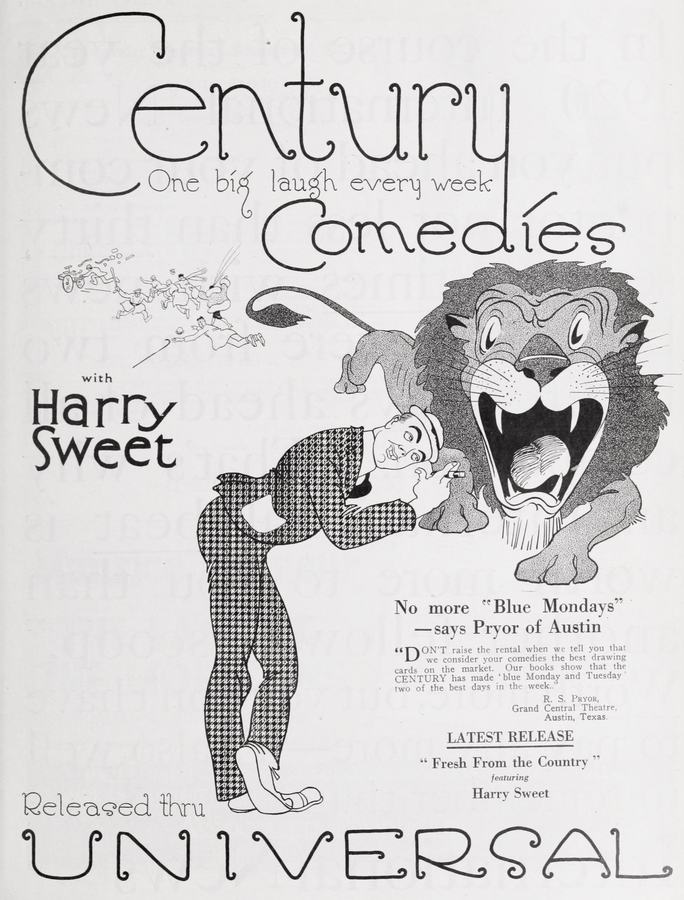
There is a razor-thin instant—caught in an iris shot that closes like a bruised eye—when Harry’s country smile still clings to his face even as the city’s first confidence man floats away with the wad of bills. The edit is so abrupt you almost hear celluloid skin being flayed. From that splice onward, Fresh from the Farm stops being a fish-out-of-water lark and mutates into a silent-era X-ray of a mind unraveling.
Cinematographer Frank Zucker bathes the pastoral flashbacks in over-exposed white glare so harsh the wheat stalks look like needles. Once the story relocates to the city, the image stock darkens to a sooty charcoal; intertitles shrink, their typefaces sharper—visual shorthand for a universe closing in. The contrast is not merely thematic, it is photochemical. The audience tastes emulsion as evidence.
Sweet, better known as a two-reel gagman, here stretches into feature-length pathos without abandoning his trampoline timing. Watch him test a chair in a fancy hotel lobby: his fingertips tap the velvet, retract, hover, then commit to the sit as though bracing for electrocution. It is slapstick slowed to the cadence of trauma. The performance is both noun and verb—every limb annotates the glossary of distrust.
He does not enter the city; the city enters him—an invasive species grafted onto a soul that once knew only the seasonal honesty of corn silk.
Buckingham, who also penned the acerbic marital farce Putting It Over, structures each sequence like a three-card monte game: foreground action distracts while the real con simmers in the deep background. The strategy pays off in the climactic department-store set piece where mannequins are mistaken for accomplices, and mirrors fracture Harry’s silhouette into a chorus of accusing selves.
Released months before the equally cynical Between the Acts, this film argues that suspicion is the only reliable coin once the agrarian calendar is replaced by the stopwatch of commerce. The city’s pedestrians do not merely brush past Harry—they collide with him, each impact a micro-loan of anxiety compounding at predatory interest.
Where The Sealed Envelope weaponizes the letter as plot device, Fresh from the Farm weaponizes the pocket—an emptying space that becomes a synecdoche for identity erosion. And while Simple Souls ultimately yearns for moral restoration, Buckingham’s script offers no such balm; the final shot freezes on Harry’s eyes darting toward the horizon, still scanning for the next trap.
Editor Ann Brody cuts on action, but the actions are increasingly trivial: a tipped hat, a dropped glove, a streetcar bell. The montage trains the viewer to flinch at banalities, achieving the same conditioned dread that Hitchcock would later patent. The average shot length shrinks from eight seconds to three by the final reel, a metronome of escalating panic.
Surviving prints lack the original musical cues, yet the vacuum proves serendipitous. Each rustle of the projector becomes the city’s white noise, each splice pop a gunshot. I recommend viewing it in a venue that allows ambient street sound to seep in; the accidental horns and sirens bleed through the century, turning the auditorium into an annex of Harry’s skull.
Women here read as either co-conspirators or fellow prey, never as sanctuary. Note the elevator girl whose mechanical smile never reaches her eyes—she recalibrates her grin each time the doors reopen, a Pavlovian cue that tightens Harry’s chest. In a scant 70 minutes the film sketches an entire economy of performed femininity sold by the quarter-second.
Though eclipsed by the barn-burning melodramas of the same season—The Branded Woman comes to mind—this sleeper prefigures the cynicism of 1970s New Hollywood. One can trace a crooked line from Harry’s darting eyes to Travis Bickle’s mohawked reflection, both men forging armor from suspicion until the metal fuses with skin.
The lone 35 mm nitrate positive languished in a Marseilles basement until 1998, when a flood nearly reduced it to chemical soup. The lab rescued only 83% of the original runtime; the remainder survives through production stills spliced into the gap. Far from feeling fragmentary, these frozen tableaux amplify the picture’s thesis—moments themselves can be pick-pocketed.
Stream it during a thunderstorm; the power cuts that occasionally plunge the room into darkness sync uncannily with the on-screen blackouts. Keep your back to the wall; you will feel the urge to monitor exits. Invite a friend, then spend the runtime distrusting their motives—thus enacting the film’s contagion in real time.
By the time the end card arrives, the word “Finis” resembles less a conclusion than a diagnosis. Harry has not learned; rather, the city has taught him to suspect lessons themselves. The last frame lingers so long it feels like a dare—an invitation to walk out into your own metropolis and wonder who is scripting the next scam, and whether your wallet is already gone.
For contrast, see how Redeeming Love opts for spiritual catharsis, or how Sahara externalizes peril onto sandstorms rather than human duplicity. But if you crave a silent time bomb that still ticks, Fresh from the Farm delivers its harvest of anxiety in perennial season.
IMDb 4.7
1932
Community
Log in to comment.