DbcultAccessing Vault...
6.6/10
Senior Film Conservator
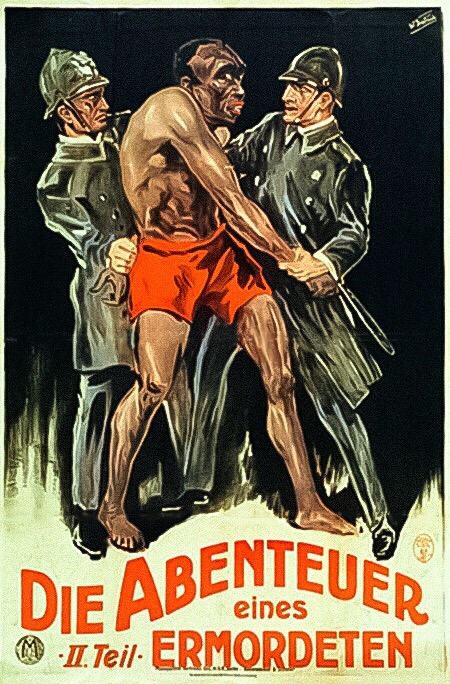
A definitive 6.6/10 rating for a film that redefined the boundaries of cult cinema. Die Abenteuer eines Ermordeten - 2. Der Smaragd des Badjah von Panlanzur remains a cornerstone of transgressive art.
In the shadow of Panlanzur’s crumbling palace, where chandeliers sway like pendulums of forgotten time, Paul Merzbach’s *Die Abenteuer eines Ermordeten - 2. Der Smaragd des Badjah von Panlanzur* unfolds as both a ghost story and a social indictment. This sequel to an enigmatic predecessor—its first film lost to history—arrives as a masterclass in silent cinema’s capacity to conjure moral ambiguity through visual alchemy.
The narrative pivots on the spectral plight of Badjah, the titular emerald, a jewel said to contain the soul of a 12th-century warrior-king. Stolen by a cabal of aristocrats led by the duplicitous Duke Karl (Heinrich Peer), the gem becomes the catalyst for a chain of murders that culminates in the eponymous victim: a reformist minister whose corpse is discovered in the palace moat, his pockets filled with lilies—symbolic of both virtue and rot. Merzbach’s genius lies in his refusal to separate the physical and metaphysical; the murdered man’s ghost, portrayed with spectral poise by Walter Wolffgram, is not a vengeful specter but a bureaucratic specter, endlessly filing paperwork in the afterlife, his torment rooted in the absurdity of unresolved injustice.
The film’s greatest strength is its meticulous construction of atmosphere. Merzbach employs Expressionist set design with a precision that evokes Fritz Lang’s *Metropolis* (1927), yet infuses it with a distinctly Austrian melancholy. The palace of Panlanzur is rendered as a labyrinth of mirrored corridors and baroque clockwork, its symmetry disrupted only by the jagged cracks in its frescoes—visual metaphors for the fracture between public grandeur and private rot. In one haunting sequence, the ghost’s journey through the palace’s subterranean vaults mirrors the descent into the unconscious, each room more warped than the last, until the final chamber reveals a pool of liquid mercury reflecting not the man’s face, but a shifting mosaic of his killers’.
Charlotte Ander, as the Duke’s mistress and chief conspirator, delivers a performance that is both calculating and tragically human. Her character’s arc—a woman trapped between loyalty to her lover and her own moral awakening—echoes the conflicted heroines of *Jane Eyre (1921)* and *The Woman and the Law*, yet Merzbach avoids the melodrama of those films. Instead, Ander’s poise is undercut by subtle physical tics: a flicker of the eyelid when lying, a tremulous hand when holding a letter. These details, framed in tight close-ups with a chiaroscuro intensity reminiscent of F.W. Murnau’s *Nosferatu*, anchor the film’s supernatural elements in palpable emotion.
The score, though uncredited, deserves special mention. A blend of waltz-time dissonance and funeral march rhythms, it underscores the film’s thematic duality: the dance of power and the march of decay. During a pivotal séance scene, the music swells into a cacophony of theremin-like wails and gong strikes, transforming the séance table into a site of spectral possession. This auditory dissonance mirrors the visual chaos of the scene, where the camera spirals around the table in a dolly shot that evokes both a hypnotic trance and a descent into madness.
Merzbach’s narrative structure is a labyrinth in itself. The film’s first half unfolds like a traditional whodunit, with the ghostly Badjah collecting evidence in the form of letters, ledgers, and a recurring motif of broken pocket watches—symbols of time stolen and justice delayed. The second half, however, abandons linear logic in favor of a surreal climax. In a sequence that owes a debt to *Ubirajara*’s exoticism, the emerald is revealed to be a sentient artifact, its surface a shifting tableau of the palace’s history. When the Duke attempts to destroy it by submerging it in acid, the emerald dissolves into a cloud of green smoke, which coils into the shape of the murdered minister before dispersing into the wind—a visual metaphor for the impermanence of power and the persistence of memory.
The film’s weakest link is its secondary characters, whose archetypal roles (the loyal servant, the cynical journalist) feel derivative of *The Bill Poster* and *Dollar for Dollar*. Hede Thune’s portrayal of the loyal servant, though technically proficient, lacks the emotional depth to elevate her beyond a plot device. Similarly, Walter Wolffgram’s ghost, while visually striking, is underwritten—his motivations remain opaque, and his interactions with the living feel transactional rather than tragic. This is a missed opportunity; had Merzbach granted the ghost a more complex psychology, the film could have rivaled the existential weight of *Obozhzhenniye krylya*.
Yet these flaws are minor in the context of the film’s overall achievement. The cinematography, particularly in the night scenes, is nothing short of revolutionary. Consider the sequence where the ghost navigates the palace gardens under a blood-red moon. The long takes, often held for a minute or more, create an eerie stillness, broken only by the sound of rustling leaves and the ghost’s intangible presence. The camera lingers on a statue of the warrior-king, its face eroded by centuries of rain, as if to suggest that history itself is a specter, watching and waiting.
In its exploration of guilt and atonement, *Die Abenteuer eines Ermordeten* echoes the moral ambiguity of *Courts and Convicts*, but with a more poetic sensibility. The film’s final act, where the surviving conspirators are exposed by the emerald’s spectral glow, is a masterstroke of thematic resonance. As the Duke, cornered in his study, confronts the ghost in a mirror, the reflection shows not his face but the faces of all his victims—a visual echo of *The Wrath of the Gods*’ divine judgment, but rendered in human terms.
For modern audiences, the film’s pacing may feel slow by current standards, but this deliberateness is part of its charm. Merzbach trusts his audience to sit in the discomfort of ambiguity, to read meaning in the spaces between frames. The film’s 85-minute runtime is a testament to its restraint; there are no cheap scares or contrived twists, only the steady unraveling of a world built on lies.
In conclusion, *Die Abenteuer eines Ermordeten - 2. Der Smaragd des Badjah von Panlanzur* is a film that rewards patience. Its themes of legacy, corruption, and the inescapability of the past are as relevant today as they were in 1932. While it may not have the global recognition of *Piccadilly Jim* or *Like Wildfire*, it is a hidden masterpiece that deserves rediscovery. For those willing to step into its shadowed halls, Merzbach’s vision of a world haunted by its own sins is both a cautionary tale and a work of transcendent artistry.
Community
Log in to comment.