DbcultAccessing Vault...
Cult Review
Senior Film Conservator
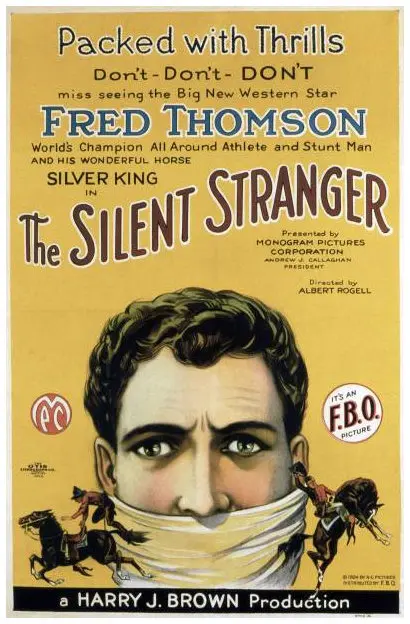
Reflecting on the golden age of the American Western, few figures loom as large yet remain as curiously overlooked by modern audiences as Fred Thomson. In his 1924 magnum opus, The Silent Stranger, Thomson delivers a performance that transcends the mere physicality of the genre, blending elements of domestic melodrama with the high-stakes intrigue of a political thriller.
The premise of The Silent Stranger is a fascinating subversion of the 'Strong Silent Type' archetype. While many Western heroes of the era, such as those found in The Bargain, relied on a rugged, uncommunicative stoicism, Jack Taylor’s silence is a calculated instrument of espionage. By feigning a sensory disability, Taylor occupies a liminal space in Valley City; he is a witness who is presumed incapable of testimony. This narrative device allows the film to explore themes of perception and the deceptive nature of appearances, a motif also cleverly handled in Blind Man's Holiday.
The cinematography, though constrained by the technical limitations of the mid-1920s, utilizes the vastness of the frontier to emphasize Taylor's isolation. When he arrives in Valley City, the camera lingers on the suspicious glances of the townsfolk, contrasting their vocal anxieties with Taylor’s serene, observant stillness. It is a masterclass in visual storytelling, where the lack of dialogue—inherent to the medium—is woven directly into the plot's DNA.
No Western is complete without a formidable antagonist, and in Law Sleeman and Dick Blackwell, The Silent Stranger provides a dual-layered threat. Frank Hagney’s portrayal of Blackwell is particularly chilling; he represents the 'suit-and-tie' villainy that would later become a staple of noir. Unlike the raw, uncivilized outlaws of The Halfbreed, Blackwell is a man of the system, using his political influence to mask his predatory instincts. This infusion of civic corruption elevates the film above the standard 'cattle rustler' narratives of the time, aligning it more closely with the sophisticated social critiques found in A Gentleman from Mississippi.
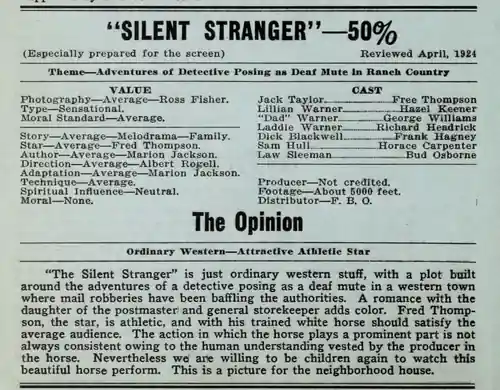
The threat to Dad Warner (played with a poignant vulnerability by George Nichols) serves as the emotional anchor. Warner isn't just losing a job; he is losing his dignity to a group of men who have commodified the very mail they were sworn to protect. This focus on the sanctity of the postal service—a lifeline in the 1920s—adds a layer of grounded realism that contrasts sharply with the more fantastical elements of contemporary films like Robinson Crusoe Hours.
We must discuss the co-star who often stole the spotlight from Thomson: Silver King the Horse. In the 1920s, the bond between a cowboy and his horse was more than a trope; it was a symbiotic relationship that audiences demanded. Silver King was not merely a mode of transport; he was an actor in his own right. His role in Taylor’s escape from Blackwell’s gang is choreographed with an athleticism that rivals the human performers. The intelligence displayed by the animal serves as a mirror to Taylor’s own hidden brilliance. While Nan of Music Mountain showcased the rugged beauty of the terrain, The Silent Stranger uses the terrain as a playground for Silver King’s stunts, cementing the horse's legacy as one of the era's greatest non-human stars.
The screenplay by Stuart Heisler and Marion Jackson is a lean, efficient piece of writing. There is no wasted motion. Every scene builds toward the eventual revelation of Taylor's true identity. The pacing reminds one of the rhythmic tension in The Whistle, where the silence of the lead character amplifies the surrounding noise of the conflict. Jackson, in particular, had a gift for writing strong female leads, and while Lillian Warner (Hazel Keener) begins as a damsel, her resilience in the face of Blackwell’s intimidation provides a necessary grit to the romantic subplot.
The film’s climax is a whirlwind of kinetic energy. The transition from the 'silent' Jack Taylor to the federal agent is handled with a flourish that must have left 1924 audiences cheering. It is a moment of catharsis that justifies the slow-burn suspense of the first two acts. This type of 'secret identity' reveal would go on to influence countless iterations of the Western hero, from the Lone Ranger to the more modern incarnations of the lawman.
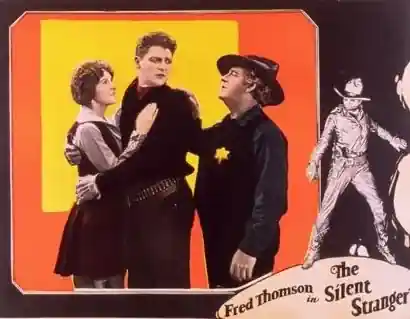
When placing The Silent Stranger within the broader context of Thomson’s filmography, it stands as a bridge between the innocent escapism of Her Five-Foot Highness and the rugged survivalism of The Alaskan. It lacks the saccharine sentimentality of Her First Kiss, opting instead for a more mature, almost cynical view of small-town politics. Even when compared to the whimsical The Little Fool, Thomson’s work here feels weightier, more intentional.
The film also shares a certain DNA with Devil McCare, particularly in its portrayal of a protagonist who must navigate a landscape where the law is being manipulated by those meant to uphold it. However, The Silent Stranger is unique in its commitment to the 'deaf-mute' ruse, a commitment that requires the actor to convey complex internal monologues through nothing but facial expressions and body language—a task Fred Thomson performs with aplomb.
As we look back at The Silent Stranger, we see a film that was ahead of its time in its blend of genres. It is a Western, yes, but it is also a procedural, a political commentary, and a romance. It avoids the pitfalls of being 'just another horse opera' by grounding its stakes in the very real fears of a changing America—fears of corruption, the loss of civil service, and the vulnerability of the innocent. Much like the protagonist in The Career of Katherine Bush, Jack Taylor is a character defined by his ambition and his ability to adapt to his surroundings, even if that adaptation requires him to surrender his voice.
In the final analysis, the film is a testament to the power of silent cinema to communicate profound truths without a single spoken word. It reminds us that sometimes, the most powerful man in the room is the one who says the least. Whether you are a fan of the high-octane action of In Bad or the more ethereal qualities of Golden Dreams, The Silent Stranger offers a rich, multi-textured experience that remains a vital piece of the cinematic puzzle.
A seminal work of the 1920s that proves Fred Thomson was far more than just a rider. He was a visionary who understood that the greatest weapon in any hero's arsenal is not his gun, but his mind. The Silent Stranger is a haunting, thrilling, and ultimately triumphant journey into the heart of the American West.
IMDb 6.2
1921
Community
Log in to comment.