DbcultAccessing Vault...
Cult Review
Senior Film Conservator
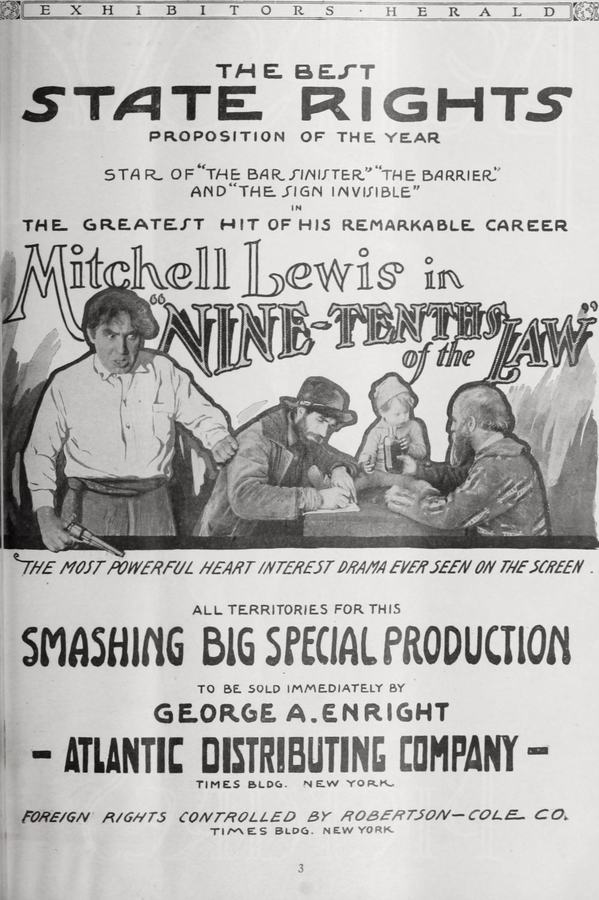
B. Reeves Eason’s Nine-Tenths of the Law emerges from the annals of early cinema as a stark, unvarnished testament to human frailty and resilience. Set against the raw, untamed backdrops of a logging frontier and the urban sprawl of Vancouver, the film’s narrative is a taut rope strung between two worlds—one of primal survival and the other of legalistic coldness. The story’s emotional core, Leneau’s struggle to reconcile his mourning with the burden of caring for an orphaned child, is rendered with a haunting simplicity that resonates across a century of cinematic evolution.
The film’s opening act is a masterclass in visual storytelling. The cabin of Leneau and his wife is depicted not merely as a shelter but as a tomb, its windows choked with snow, its hearth dim. When the couple’s infant is lost—a tragedy hinted at through fragmented, impressionistic shots of a mother’s trembling hands and a father’s silent stare—the film avoids melodrama. Instead, it immerses the audience in the quiet, suffocating weight of their loss. The bear trap, later a pivotal symbol, is introduced with chilling nonchalance, its jagged teeth gleaming in the morning sun as Little Roughneck’s small hand emerges. This is not a trap for animals but for the audience’s conscience.
Red Adair and his partner, grotesque figures of moral rot, are portrayed through exaggerated physical comedy in their drunken revelry, yet their depravity is never sanitized. Their abduction of Little Roughneck is executed with a callousness that contrasts sharply with the film’s earlier restraint. The child’s journey through the forest—winded, uncertain, yet unbroken—is a silent testament to survival instinct. When he falls into the trap, the scene’s composition is almost mathematical in its precision: the boy’s outstretched hand, the trap’s cruel geometry, the distant shadow of Leneau’s cabin. It is a moment of collision between fate and responsibility.
Leneau’s confrontation with Adair is a visceral, almost mythic clash. The fight choreography, though constrained by the era’s technical limitations, is brutal and authentic. Bloodied and desperate, Leneau’s resolve is not born of heroism but of a man clawing at the edges of his own despair. The revelation that Little Roughneck belongs to a Vancouver judge introduces a disquieting irony—the law, that supposed bastion of justice, is personified by a figure as distant and unfeeling as the forest’s encroaching wilderness.
Leneau’s decision to return the child is not framed as a moral triumph but as a reluctant surrender to duty. The journey to Vancouver is rendered in stark, almost dreamlike sequences. The city itself is a labyrinth of indifferent faces and towering architecture, a far cry from the organic chaos of the wilderness. Here, the film’s critique of societal structures becomes explicit. The judge, a cipher of bureaucratic detachment, is the antithesis of the primal, emotional worlds Leneau inhabits. This dissonance is exacerbated by the film’s use of chiaroscuro lighting in the courtroom scenes, where shadows seem to swallow the judge’s features, leaving only a mouth moving through legal jargon.
The film’s denouement is a tour de force of narrative audacity. Without betraying the twist, it suffices to say that Eason subverts every expectation the audience has been conditioned to hold. The final act is not merely a resolution but a philosophical reckoning, forcing viewers to question the very foundations of justice and paternal love. The editing here is frenetic, the score (what little remains from a lost original) a dissonant staccato that mirrors Leneau’s fractured psyche. This is a conclusion that demands a second viewing, its implications unraveling like a spider’s web in the mind.
For a work of its era, Nine-Tenths of the Law showcases an advanced understanding of visual narrative. The use of cross-cutting between Leneau’s forest and the Vancouver courtroom creates a metronomic tension, each location a counterpoint to the other. The film’s stock footage of logging operations and urban life is seamlessly integrated, a testament to Eason’s editorial acumen. Even the intertitle cards, typically a silent film’s crutch, are treated as visual elements, their fonts and placement echoing the film’s thematic concerns.
The performances, though constrained by the physicality required of silent film acting, are nuanced. Mitchell Lewis as Leneau embodies a stoic fragility, his gestures—clenched fists, averted glances—speaking volumes. The child actor, uncredited but present in the surviving footage, is a revelation. His wide-eyed innocence contrasts sharply with the adults’ hardened realities, a visual metaphor for the film’s central conflict.
Eason’s work here can be contextualized alongside other early American independents, though Nine-Tenths of the Law diverges sharply from the more sentimental fare of its contemporaries. Unlike Fighting Back, which leans heavily on moralistic tropes, this film embraces ambiguity. Its themes of parental loss and societal indifference resonate with the later works of D.W. Griffith, yet its bleakness is more akin to the Expressionist undertones of The Scarlet Car, though filtered through a distinctly American sensibility.
The film’s influence is subtle but undeniable. Its exploration of the individual’s struggle against impersonal systems prefigures the noir sensibility of the 1940s. The bear trap motif, a recurring symbol of entrapment, finds echoes in the labyrinthine narratives of later directors like Orson Welles. Even the film’s abrupt, unsentimental ending rejects the catharsis of classical Hollywood storytelling, aligning it with the modernist impulses of Hamlet (1917), albeit with a far grimmer tone.
What lingers after Nine-Tenths of the Law is not resolution but disquiet. The film resists the easy comfort of narrative symmetry, leaving its characters—and its audience—in a state of unresolved tension. Leneau’s final act is not a triumph but a truce with himself, a recognition that some questions are not meant to be answered. This is the true power of Eason’s work: it does not merely tell a story but invites the viewer to sit with the discomfort of ambiguity, much like the weight of snow on the cabin’s roof or the unyielding jaws of a bear trap.
In an age where cinema often seeks to reassure, Nine-Tenths of the Law dares to unsettle. Its legacy is not one of answers but of questions, etched into celluloid with a precision that defies time. For those willing to meet its gaze, the film remains a profound meditation on the fragile line between law and justice, grief and purpose.
IMDb —
1916
Community
Log in to comment.