DbcultAccessing Vault...
6/10
Senior Film Conservator
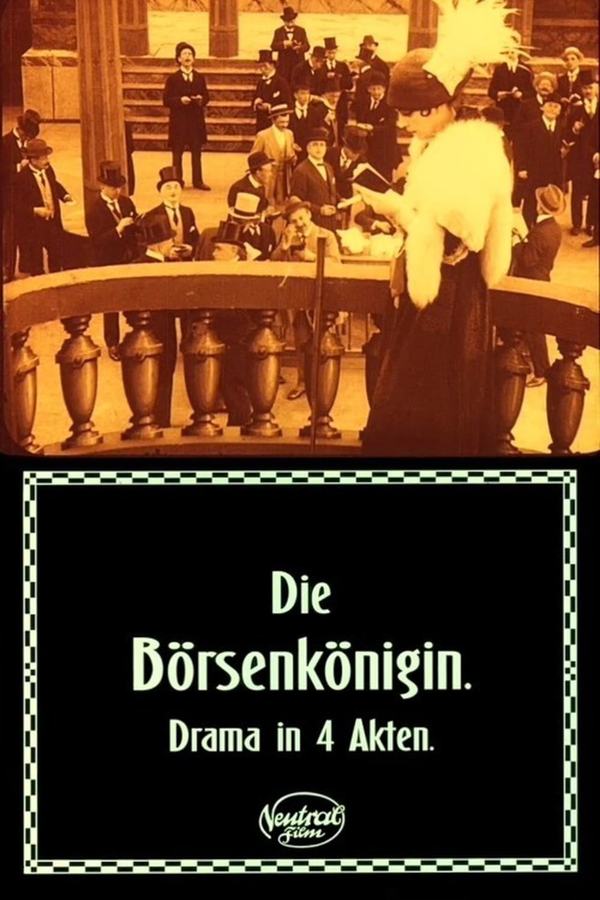
A definitive 6/10 rating for a film that redefined the boundaries of cult cinema. Die Börsenkönigin remains a cornerstone of transgressive art.
In Die Börsenkönigin, the silent screen becomes a crucible where the molten forces of desire and duty coalesce. Willy Kaiser-Heyl’s direction is a study in spatial poetry: Helene’s mining empire is framed as a labyrinth of shadows and machinery, its metallic sheen reflecting both her fortitude and fragility. The camera lingers not on the characters’ faces, but on the tools of their trade—the clack of a pickaxe, the hiss of steam valves—before pivoting to Helene’s face, her eyes hollowed by the weight of her unacknowledged inferiority complex. This is a film that understands capitalism as a theater of masks, and Asta Nielsen’s Helene wears hers with the elegance of a tragic queen.
The narrative’s brilliance is its refusal to villainize or sentimentalize. Lina, the object of the manager’s affection, is neither a cunning seductress nor a passive pawn. Her presence is a void that Helene’s world crumbles into, yet the film never explicates her motives. It is this ambiguity that elevates Die Börsenkönigin beyond mere melodrama. Compare this to The Seventh Noon, where the moral stakes are etched in clear moral binaries. Here, the conflict is existential—a clash of realms: the rationality of industrial progress against the irrationality of the heart.
"The mine owner’s world is built on the extraction of ore, but her soul is the richest vein of all, bled dry by neglect."
Asta Nielsen’s performance is a tour de force of physical storytelling. Her gestures—measured, deliberate—contrast with the frenetic energy of the mining operations she oversees. When the manager (Aruth Wartan) enters her domain, her posture stiffens like a tectonic plate under pressure, yet her eyes betray a maelstrom of emotions. This duality mirrors the silent film era itself, where technology constrained vocal expression but liberated the body as a vessel for narrative. Her final scene, where she watches Lina depart with the manager, is a masterclass in minimalism: the camera holds on her motionless face for an agonizing duration, the only movement a single tear tracing the path of a decade’s unspoken grief.
Consider the parallels with The Testing of Mildred Vane, where another woman’s power is undermined by patriarchal structures. Yet Helene’s tragedy is distinct: she is both the wielder and the victim of power, her authority undermined not by external forces but by her own capacity for love. The script by Edmund Edel, though rooted in early 20th-century sensibilities, anticipates the psychological complexity of later works like On Dangerous Ground, where urbanity and primal instinct collide.
The film’s visual language is steeped in industrial allegory. The mine is rendered as a living entity—its tunnels the arteries of a mechanical beast, its machinery a chorus of indifferent gods. When Helene walks through the mine, the camera mimics the rhythm of a heartbeat, each step echoing with the weight of her responsibility. This is juxtaposed with scenes of the manager and Lina, filmed in soft focus and golden light, their romance a fragile, almost ethereal counterpoint to the harsh realism of Helene’s world.
Compare this to El hombre de acero, where industry is a literal character. Here, the mine is a metaphor for Helene’s psyche—structured, controlled, yet susceptible to collapse. The film’s climax, where Helene’s emotional reservoir overflows, is staged like a mine implosion: slow, inevitable, and devastating in its inevitability. The sound of caving stone is replaced by the silence of her breaking composure, a technique that would later be refined in I topi grigi’s use of muffled anguish.
"To love in a world of transactions is to be the currency itself—valuable only when exchanged, worthless when hoarded."
Die Börsenkönigin occupies a unique space in early cinema history as a work that interrogates the human cost of industrial capitalism long before the New German Cinema would revisit such themes. Its exploration of unrequited desire as a form of economic alienation prefigures the narratives of Patria, where personal identity fractures under societal expectations. Yet unlike those later works, Die Börsenkönigin finds its power in restraint; it never overstates its themes, allowing the audience to infer the depth of Helene’s torment from the spaces between shots.
The film’s pacing, deliberate and almost glacial, has aged into a virtue. In an era where cinema often favors rapid cuts and overt dialogue, the slow build of Die Börsenkönigin invites contemplation. Consider how this aligns with the meditative structure of The On-the-Square Girl, yet distinguishes itself by its focus on internal rather than external conflict. The final act, in which Helene’s world unravels not with fireworks but with the quiet rusting of her resolve, is a testament to the film’s thematic coherence.
What makes Die Börsenkönigin endure is its ability to render the intangible tangible. The score, though lost to time, is presumably a ghostly presence in the editing rhythm, the silence itself conducting the emotional crescendos. The use of chiaroscuro in the mine scenes—Helene often framed in stark relief against the darkness—echoes the psychological chiaroscuro of her existence: a woman who commands the earth yet cannot command her own fate. This visual motif finds a parallel in The Breaker, where light and shadow delineate moral boundaries.
Ultimately, the film is a parable for any era where power and passion are at odds. Helene’s tragedy is not that she is defeated, but that she is outmaneuvered by forces beyond her control—both the caprices of the market and the illogical nature of love. In this, it resonates with the existential despair of I pesn ostalas nedopetoy, though its resolution is far more subdued. The final image of Helene alone in her office, the camera pulling back to reveal the vast, uncaring expanse of the mine, is a haunting epitaph to the modern soul’s struggle for agency.
IMDb 6.7
1930
Community
Log in to comment.