DbcultAccessing Vault...
Cult Review
Senior Film Conservator
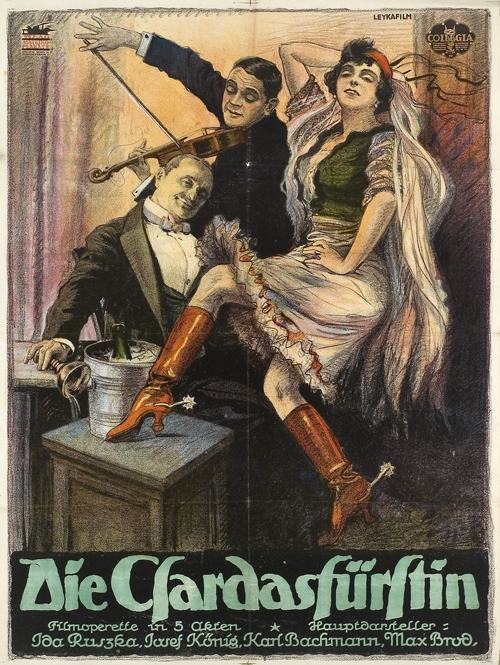
There's a peculiar magic in unearthing cinematic relics, especially those that predate the cacophony of synchronized sound. Die Czardasfürstin, the 1920 German silent film adaptation of Emmerich Kálmán's beloved operetta, is precisely such a treasure. It offers a fascinating glimpse into an era where grand romantic narratives were conveyed through the eloquent language of gesture, expression, and the subtle interplay of light and shadow. To truly appreciate its artistry, one must adjust their perception, allowing the visual poetry to unfurl without the crutch of dialogue, inviting a deeper, more introspective engagement with the characters' emotional landscapes.
The film, a vibrant testament to the enduring appeal of its source material, plunges us into a world teetering on the cusp of profound social change, yet still stubbornly clinging to its rigid hierarchies. At its heart lies the incandescent Sylva Varescu, portrayed with a compelling blend of vulnerability and fiery independence by Gusti Macha. Macha, with her expressive eyes and graceful physicality, embodies the 'Czardasfürstin' – the celebrated cabaret singer – with an authenticity that transcends the limitations of the silent medium. Her stage presence, even in its cinematic translation, must have been mesmerizing, a beacon of defiant passion against the staid backdrop of Viennese aristocracy. She is not merely a performer; she is an emblem of individual spirit, a woman whose talent and charisma threaten to upend established order.
The narrative pivots on the tempestuous romance between Sylva and Prince Edwin Ronald, brought to life by Karl Bachmann. Bachmann's Edwin is a study in internal conflict, torn between the passionate allure of Sylva and the suffocating weight of his noble lineage. His struggle is palpable, a silent scream against the expectations of his formidable parents, Prince Leopold Maria and Princess Anhilte, whose roles are filled by Josef König and Ida Russka respectively. Russka, in particular, delivers a performance that hints at a complex inner life beneath her regal exterior, a subtle foreshadowing of the film's climactic revelation. The societal chasm separating Sylva and Edwin is not just a plot device; it's a commentary on the inherent injustices of a world where love is often subservient to status and inherited privilege. This theme, of love battling against entrenched social barriers, resonates with the struggles depicted in films like His Robe of Honor, where personal integrity clashes with societal expectations, albeit in a different context of American legal drama. The silent film's ability to convey such profound societal critique without a single spoken word is a testament to the power of visual storytelling and the nuanced performances of its ensemble.
The initial promise of matrimony between Sylva and Edwin, made in the heady glow of their early passion, is swiftly undermined by the machinations of the princely household. The arranged engagement to Countess Stasi, portrayed by Susanne Bachrich with a delicate innocence, introduces a layer of tragic misunderstanding. Bachrich's Stasi is not a villain; rather, she is an unwitting pawn in a game of aristocratic chess, her naiveté making her all the more sympathetic. Sylva's subsequent decision to flee to America, believing herself betrayed, is rendered with a dramatic flair characteristic of the era, her farewell performance a heart-wrenching spectacle of defiance and despair. This dramatic exit, a common trope in early cinema, allowed for grand gestures and heightened emotional states, perfectly suited for the silent screen. The emotional intensity here, conveyed through exaggerated but effective pantomime, could be compared to the raw human drama explored in The Three of Us, where character emotions are central to the unfolding tragedy.
The second act, set against the opulent backdrop of Vienna, sees Sylva's calculated return, now disguised as 'Countess Káncsiánu' and accompanied by her jovial friend, Count Boni, played by Oskar Sachs. Sachs infuses Boni with a delightful blend of comedic timing and genuine loyalty, providing much-needed levity amidst the escalating romantic tension. His presence is a masterclass in silent film supporting roles, using subtle gestures and expressions to convey character and advance the plot. Sylva's intention to expose Edwin's perceived hypocrisy and the superficiality of his world drives much of the dramatic momentum. However, her carefully constructed facade begins to crack under the weight of rekindled emotions and the undeniable pull she still feels towards Edwin. The scene where Edwin confronts the 'Countess,' sensing her true identity, is charged with a powerful, unspoken longing, a testament to the actors' ability to convey complex emotional states without dialogue.
The film's denouement is a marvel of dramatic irony and social commentary. The revelation that Princess Anhilte herself was once a cabaret singer, a 'Czardasfürstin' in her youth, is a stroke of narrative genius. It shatters the very foundation of the aristocratic snobbery that has dictated Edwin's life and threatened to destroy his love. This twist, a potent critique of class hypocrisy, elevates the film beyond a mere romantic melodrama. It suggests that societal judgment is often born from forgetfulness or deliberate concealment of one's own origins. Max Brod, credited as a writer alongside Béla Jenbach and Emil Leyde, likely contributed to this sophisticated narrative structure, which, despite its operatic roots, carries a surprisingly modern social message. Such a revelation, forcing characters to confront their past and re-evaluate their present, can be seen in the dramatic impact of choices made in films like The Fatal Card, where hidden truths dramatically alter destinies.
The cinematography of Die Czardasfürstin, while perhaps not groundbreaking by later standards, effectively utilizes the visual language of early cinema. The use of elaborate sets, opulent costumes, and carefully choreographed crowd scenes immerses the viewer in the lavish world of the Austro-Hungarian elite and the vibrant energy of the cabaret. Lighting, though rudimentary compared to later eras, is employed to create mood and emphasize character emotions, with spotlights often isolating Sylva on stage, highlighting her star quality. The film's reliance on intertitles to convey dialogue and exposition is handled artfully, integrated seamlessly into the visual flow rather than feeling intrusive. This thoughtful integration allows the story to unfold with clarity, even for audiences unfamiliar with the operetta's intricacies.
Viewing Die Czardasfürstin today offers a unique window into the cultural landscape of 1920s Europe. It reflects a society grappling with the aftermath of a world war, yet still enchanted by the escapism of romance, music, and spectacle. The operetta itself was wildly popular, and its cinematic adaptation tapped into a widespread desire for grand narratives that could transport audiences away from the harsh realities of the post-war era. The film's production values, particularly its set design and costuming, speak to a period of burgeoning film industry sophistication, even in the silent era. It's a stark contrast to the rougher, documentary-style footage seen in contemporary works like The Capture of a Sea Elephant and Hunting Wild Game in the South Pacific Islands, showcasing the diverse applications of the moving image at the time.
Despite the passage of a century, Die Czardasfürstin retains a captivating charm. Its narrative, though rooted in the conventions of its time, explores universal themes: the intoxicating power of forbidden love, the suffocating grip of societal expectations, and the ultimate triumph of authenticity over pretense. The performances, particularly those of Gusti Macha and Karl Bachmann, manage to convey a depth of emotion that transcends the absence of spoken dialogue, relying instead on the subtle nuances of their craft. It reminds us that powerful storytelling doesn't require a complex soundscape; sometimes, the most profound emotions are best expressed in silence, allowing the audience's imagination to fill in the auditory gaps.
For modern viewers accustomed to rapid-fire dialogue and special effects, the pace of a silent film might require an initial adjustment. However, those willing to immerse themselves in its unique rhythm will be richly rewarded. It's a film that demands active participation, inviting the viewer to interpret gestures, expressions, and the emotional resonance of the musical accompaniment (which, though not part of the original film, is often added in modern screenings). This active engagement can be a refreshing departure from the passive consumption often associated with contemporary cinema. It harks back to an earlier form of cinematic experience, one where the audience played a more significant role in constructing the narrative's emotional meaning, similar to the audience's active role in understanding the social dilemmas presented in A Friend of the People.
The influence of operetta on early cinema, particularly European cinema, cannot be overstated. These adaptations brought popular stories, beloved characters, and established dramatic structures to the nascent film medium, helping to solidify its commercial viability and artistic potential. Die Czardasfürstin stands as a prime example of this synergy, translating the theatrical spectacle of the stage to the silver screen with considerable success. It’s an important piece in understanding the evolution of musical films, even if it is a silent precursor. One can draw parallels to the early narrative experiments seen in films like One Hundred Years Ago, which also sought to capture and present a story to a mass audience, albeit with different thematic concerns.
In conclusion, Die Czardasfürstin is more than just a historical curiosity; it is a compelling piece of silent cinema that offers a rich tapestry of romance, drama, and social commentary. Its ability to convey complex emotions and intricate plot points through purely visual means is a testament to the talent of its cast and crew, and the enduring power of its narrative. For anyone interested in the roots of cinematic storytelling, or simply in a beautifully rendered tale of love against all odds, this film is an essential viewing experience. It reminds us that some stories are so powerful, their melody so resonant, that they transcend the need for words, finding their voice in the universal language of the heart. The emotional journey it takes the audience on, even without spoken dialogue, is a testament to the skill of its creators, much like the profound impact of films such as The Awakening of Ruth, which also explored deep emotional transformations through silent performance.
The artistry of Béla Jenbach and Emil Leyde, the original writers, shines through even in this silent translation, proving the timeless quality of their creation. Their understanding of human nature and societal folly is as relevant today as it was a century ago. This film, though a product of its time, speaks to enduring truths about ambition, sacrifice, and the unwavering pursuit of happiness, making it a truly remarkable cinematic artifact.
IMDb —
1921
Community
Log in to comment.