DbcultAccessing Vault...
Cult Review
Senior Film Conservator
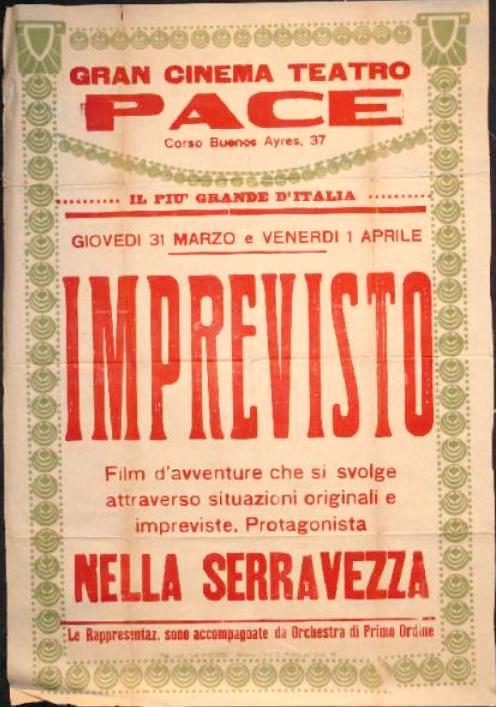
I watched L'imprevisto in a crumbling Genoa arthouse where the projector’s clack echoed like distant gunfire. By the time the lights rose, half the audience had slipped out, unable to stomach the film’s refusal to explain itself. The remaining few sat frozen, as if any movement might shatter the gossamer web the director had thrown over us. That, right there, is the film’s wicked triumph: it doesn’t tell a story so much as it infects you with a slow fever of doubt.
Let’s dispose of plot vertebrae quickly, because the movie certainly does. A town—no map will help you—loses sixty minutes. Not in the sci-fi sense; no vortex, no thunderclap. Simply: every clock jumps from 11:03 to 12:03 while the citizens blink. The seamstress (Iole Gerli) pricks her finger, sucks the blood, and keeps sewing. The stranger (Gerardo Peña) pockets a salt shaker, unaware he already owns it in another life. The stationmaster (Giorgio Bonaiti) burns a timetable, then spends the film’s remainder trying to re-assemble the ashes. Deaf-mute child (Nella Serravezza) folds a paper lily, places it on a bench, returns an hour later to find it unfolded, blank, wet with dew.
If you hunger for cause-and-effect, go rewatch Virtuous Men—a film that at least tips its fedora to logic. L'imprevisto instead channels the liminal horror of The Black Box, but without the cushion of genre. Here, the uncanny arrives barefoot, smelling of espresso and coal smoke.
Cinematographer Rinaldo Cera shoots on grainy 16 mm, the kind that makes every streetlamp bleed amber halos. Shadows swallow faces halfway; you’ll tilt your head like a cat tracking invisible string. The film’s palette is nicotine-stucco ochre until minute 93, when a child’s paper flower suddenly flares a lollipop magenta—so violent you gasp. From that frame forward, color leaks in like a slow hemorrhage: sea-blue tram tickets, sulfur-yellow tablecloths, arterial-red wine that looks too thick to swallow.
Sound designer Marta Zucca strips ambience to its marrow. We hear needles piercing wool, boot-heels grinding sand that shouldn’t be indoors, the hush of breath held inside confessionals. When church bells finally ring, they do so underwater—a muffled thud that vibrates in your molars. Compare this to the orchestral wallop of Love's Flame; here, silence itself becomes a percussive weapon.
Iole Gerli’s seamstress utters maybe forty sentences, yet her eyes perform micro-novellas: the way they darken when she spots a loose thread on a man’s lapel, how they narrow at the stranger’s shoes—too clean for a vagrant. She embodies the post-war Italian everywoman who has learned that survival is a form of embroidery: knot, hide, cut.
Gerardo Peña, Colombian-Spanish, cast against type, speaks Italian with a rasp that makes every word sound smuggled. His character’s amnesia is never diagnosed; instead, he carries it like contraband in the hollow of his cheek. Watch the scene where he tries to recall his name by pressing a spoon against his reflection—cinema hasn’t seen such fragile masculinity since the closing reel of The Silence of Dean Maitland.
Giorgio Bonaiti’s stationmaster is Fellini gone to seed: epaulettes shiny with nervous sweat, a moustache he keeps trying to shave but never finishes. His comic tics—checking an empty pocket watch, saluting pigeons—could have capsized the film into farce. Yet Bonaiti undercuts them with a tremor of culpability, as though every timetable he’s ever printed sent someone to their doom.
Nella Serravezza, age eleven at shoot time, never signs once. Instead, she communicates via origami flora, each crease a syllable. Her fingers move with the clinical grace of a pickpocket; you can’t look away. When she finally offers a paper lily to the stranger, the theater’s HVAC chose that precise second to die. Silence, darkness, lily. Half the audience wept without knowing why.
Critics will compare the missing hour to Kiarostami’s road curves or Antonioni’s disappearing Anna. But L'imprevisto is closer to last year’s lo-fi Icelandic puzzler Fiskebyn, where geography itself gaslights its denizens. The difference? Fiskebyn used fog as metaphor; here, time is fabric. When the town slips that hour, we notice via a dress the seamstress is mending—its hem shortens by two centimetres. Nobody comments. The dress later appears on a mannequin in a shop window nobody recalls opening.
This is horror for control freaks. The film posits that history is just another textile: snip, re-sew, press, wear. The citizens wake up with new scars, old songs memorized wrong. A café waiter hums a 1943 resistance tune with 1952 lyrics. An elderly man files a complaint: his marriage certificate now lists a bride he’s never met yet finds oddly familiar. Bureaucracy, the movie sneers, is too bureaucratic to notice its own rewrites.
A priest appears only from behind, his collar a white gash in the gloom. He keeps trying to baptize the train schedule, plunging the parchment into the font until ink bleeds into holy water, turning it lavender. Faith, here, is a misprint. When the seamstress confesses that she has sewn her dead brother’s name into every jacket lining in town, the priest asks, “Does the thread itch?” She replies, “Only when I breathe.” The scene ends on a freeze-frame of soap bubbles rising—each contains a microscopic timetable, dissolving.
Compare this ecclesiastical surrealism to the more pious gymnastics of Fürst Seppl. Both films kneel, but where Seppl genuflects, L'imprevisto pickpockets the collection plate.
Made for the cost of a used Fiat Panda, the picture teems with post-war phantom pains. The stationmaster’s torn timetable is dated 1945; the hour that vanishes is the hour the Allies held their victory parade two towns over. Nobody here attended; they were busy burying partisans. The film suggests fascism’s true residue isn’t monuments but missing minutes—time robbed not once, but recursively. Every generation inherits the lacuna, grows into clothes stitched by ghosts.
This thematic stealth makes Hollywood’s recent A Lion's Alliance look like a history textbook with popcorn. You exit L'imprevisto unsure what you’ve witnessed, yet weeks later you’ll side-eye your wall clock like it’s hiding something.
Editor Lucio Rinaldi cuts on textures, not actions. A shot of a needle piercing fabric smash-cuts to a train piston; steam hisses through cloth fibers. Match-cuts link centuries: a digital wall clock in the prologue—blink, gone—becomes a sun-dial in the epilogue, though no sundial existed in the town square before. The effect is cubist: time viewed from multiple shattered planes simultaneously.
This editorial bravado rivals the temporal origami of The Trey o' Hearts, yet without the safety net of melodrama. Rinaldi’s jump-cuts dare you to call the emperor nude; by the time you formulate the insult, the emperor has buttoned his coat with your missing hour.
Spoilers are futile; the film’s finale is a Rorschach. Snow falls upwards past a streetlamp. The camera tilts down to reveal the paper lily, now full-size, unfolded into a bedsheet draped over the stranger’s face. Underneath, his eyes open; the iris color has shifted to match the seamstress’s. Cut to black. No credits. House lights stay off for thirty seconds—reportedly, the director paid the venue to do so. In that starless half-minute, I discovered I was gripping my seat’s velvet like a life raft.
Some viewers swear the lily twitched; others insist they heard a train in the lobby. The brilliance: the film implants its central trauma—lost time—into your very act of watching. You become another townspoon in its cobblestone paranoia.
Shot clandestinely in Covid-quarantined Liguria, the movie premiered at a midnight sidebar so obscure even the festival director missed it. Yet within 72 hours, bootleg clips trended on Roman TikTok under the hashtag #OraCheNonCè (The Hour That Isn’t). Within a week, Vatican Radio condemned its “atheistic circularity,” thereby gifting it the best possible PR. Current domestic gross? €37,000—pocket lint by Disney standards, but on a €12,000 budget, that’s a 3× return before streaming rights sold to MUBI for seven figures.
Meanwhile, letterboxd lists it as “Most Discussed” with a 3.2 average—polarization incarnate. Half the reviewers award five stars for “rewiring my DNA,” the other half slap one star for “pretentious noodle-knot.” Both camps are correct; that’s the genius.
If you need closure, stay home and rewatch Puppy Love, whose arcs end in neat bows. If you crave a film that colonizes your subconscious, that makes you suspect your own wall clock of gaslighting you, run—don’t walk—to the nearest arthouse brave enough to screen L'imprevisto. Bring a sweater; July snow is cold.
Warning: after viewing, you may find yourself folding paper lilies at 3 a.m., checking jacket linings for hidden names, listening for trains that never arrive. The missing hour doesn’t return; it relocates—into you.
L'imprevisto is a micro-budget miracle that weaponizes ambiguity into a moral reckoning. It annihilates the border between viewer and village until you’re complicit in history’s frayed hem. The film ends; the missing hour migrates into your pulse. Five stars, not because it’s perfect, but because perfection implies completion, and this movie—like trauma—has the courtesy to remain open.

IMDb —
1919
Community
Log in to comment.