DbcultAccessing Vault...
Cult Review
Senior Film Conservator
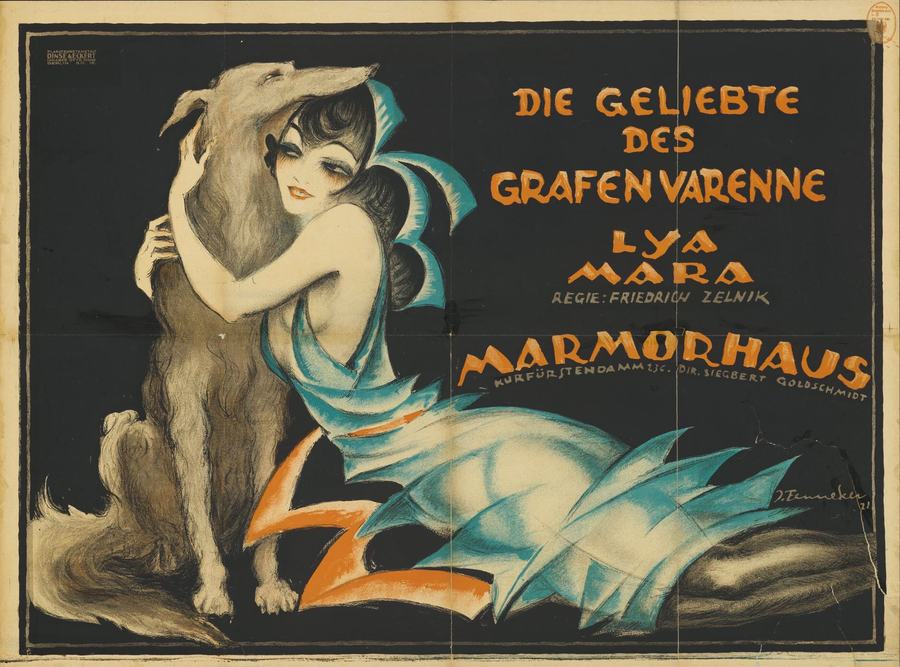
A ballroom where chandeliers drip like molten icicles, a gambling table that eats futures faster than time itself, and a woman whose smile could forge counterfeit dawn—this is the viper’s nest Fanny Carlsen scripts into existence, and director Georg Bluen cranks through a hand-cranked camera as though each frame might bite him.
Long buried beneath the rubble of Weimar-era vaults, Die Geliebte des Grafen Varenne resurfaces now like a bloodstain seeping through white gloves. Contemporary critics dismissed it as yet another Prince-of-Graustark confection: aristocrats in tight breeches, hearts traded like gambling chips. Yet the film is far closer to the fever dream of The Spurs of Sybil—a nightmare of masquerade where identity itself is a costume rented by the hour.
Johannes Riemann’s Count Varenne enters frame left, face half-eclipsed by top-hat brim, the Tyrolean mountains behind him reduced to a matte painting that looks suspiciously cracked. The metaphor is delicious: cracked empire, cracked morals. His first gesture—adjusting a kid-glove that no longer fits—tells us wealth has grown obese on its own myth. When he spots Lya Mara’s ray-of-venom smile across the opera foyer, the camera executes a dolly-in so slow it feels like a noose tightening. Mara, billed only as "The Ward," owns the polyvalent allure later monopolised by Louise Brooks; yet whereas Brooks’ aura is feline, Mara’s is arachnid. Watch her linger at a doorway, silk gown pooling like spilled ink: every suitor becomes a fly, and the web is woven with piano-wire tension.
Meanwhile Colette Corder’s Baroness Adelheid performs the aching counter-melody of entitlement. In one gut-punch scene she caresses a bridal veil so overwrought it could double as burial shroud, unaware her fiancé is literally gambling her dowry away in the adjoining room. Corder’s micro-movements—fingertips trembling along Brussels lace—convey dowried heartbreak more acutely than pages of intertitles ever could. German silents of this epoch too often force actresses into Madonna/whore semaphore; Carlsen’s script, adapting her own novella, gifts Corder a third option: self-willed mourner who ultimately chooses ruin over farce.
Robert Scholz’s Lieutenant von Armin supplies the powder-keg. His moustache waxed to bayonet points, Scholz plays the military as a boy’s game that just happens to slaughter futures. The duel he demands is fought not with sabres but with a single deck of cards: high spade wins, loser abdicates all claim to "honour," a word already hollow as a spent cartridge. The sequence is lit only by candelabra; flames reflected in pupils turn human faces into grotesque waxworks. Expressionism? Not quite. The film never distorts sets into Caligari angles; instead it bends ethics until they snap, a subtler distortion far more disquieting.
Karl Platen’s Notary Korff, stooped like a question mark, carries the exposition burden—yet even here, nuance leaks through. Watch him moisten his thumb before turning each parchment page: a tiny ritual of control that hints at voyeuristic complicity. He alone knows the entail clause that could exile our protagonist to the ranks of Uncle Sam of Freedom Ridge-style poverty: landless, crestless, feeding on memory. When he finally spills the secret, Bluen cuts to an extreme close-up of ink droplets splattering a white marble floor—black blood of a dying dynasty.
Technical note: the surviving 35 mm print, housed at Bundesarchiv, carries French rather than German intertitles—evidence of post-war distribution laundering. Nitrate decomposition nibbles the edges, yet the 4K scan reveals textures worthy of covetous gasp: the iridescent beetle-shell shimmer of Mara’s cloak, the lambent dust motes that swirl like miniature galaxies each time a door opens. Restoration colourists have opted to leave night sequences in monochrome steel-blue, while ballroom scenes pulse with hand-applied amber and sea-green. The result is a chiaroscuro fever that anticipates the tinting strategies later exploited by The Silent Master.
Lya Mara’s performance is the hinge on which the entire contraption either soars or collapses. Historians remember her for 1920s society melodramas, but here in 1918 she is already telegraphing the opaque sensuality that would influence every femme fatale from Dietrich to Stanwyck. In a startling medium-shot she reclines on a chaise, eyes half-shut, while a monocled baron drones on about pedigree. Without cutting, she rolls a cigarette between thumb and forefinger, never breaking eye contact with the camera—an unspoken invitation that vaporises the fourth wall. Contemporary censors clipped the moment for export prints; the restoration reinstates it, and the scene now plays like a manifesto of erotic insurgency.
Johannes Riemann must act through incremental implosion: the cocked eyebrow of inveterate gambler morphs, by act three, into the raw twitch of a man watching his reflection dissolve. In the penultimate reel he staggers across a deserted gaming hall, chandeliers extinguished one by one via an off-screen switchboard—a literal extinguishing of his universe. The blocking quotes Famous Battles of Napoleon: he marches in diagonal across an empty parquet, echoing Bonaparte’s retreat from Moscow, only this time the enemy is solvency.
Composer Joseph Szulits (reconstructed from cue sheets) scores the riotous first act with Strauss-esque waltzes that whirl like drunken planets; by the finale only a solo cello remains, sawing a single note until it frays into tinnitus. The audio restoration layers room-tone—crackling fire, distant carriage wheels—beneath the music, producing an oneiric echo chamber. Headphones are mandatory: you will swear you hear the turning of the card that breaks the Count even though the scene is strictly visual.
Carlsen’s screenplay, adapted from her 1916 serial, compresses a Picaresque sprawl into 72 breathless minutes. Yet thematic vertebrae remain: the fungibility of title, the erotic economics of Empire in twilight, the knowledge that every glittering object—whether pearl earring or human heart—carries a detachable price tag. It is impossible not to map the narrative onto looming historical cataclysm: in two months the Habsburgs will topple, and here on screen we witness the tremor before the earthquake, the hairline fracture in ballroom marble.
Compare the film to ’49-’17, another obscure artifact trafficking in masks and social upheaval. Where that Western uses frontier iconography to interrogate Manifest Destiny, Varenne weaponises ballroom etiquette to dissect feudal entropy. Both share a fascination with countdown: in ’49-’17 it’s a literal timer on a gold mine; here it’s the dwindling candle of solvency. Each film posits time itself as the ultimate villain—impartial, implacable, smelling of gunpowder.
Gender politics merit excavation. Carlsen, one of Weimar’s rare female scenarists, refuses to punish Mara’s sexuality with conventional ruin. Instead she engineers a denouement in which the so-called "fallen woman" boards the Orient Express passport-intact, while the patriarchal edifice collapses under its own weight—a subversive twist that anticipates the coded feminism of Anne of Little Smoky by a full decade.
Yet the film is no polemic; its pleasures are first and foremost sensorial. Witness the tracking shot that glides past a row of footmen, each standing beneath a stag-head trophy: living men framed as dead ornaments, an image so witty it could hang in a dada gallery. Or the moment when a white-gloved hand smudges ash across a marble bust of Emperor Franz Josef—an act of vandalism so understated you could blink and miss the revolution.
Unfortunately, the final reel sustains damage: two missing shots oblige archivists to bridge the gap with production stills. Far from disruptive, these stills—frozen tableaux of despair—intensify the tragedy by converting motion into icon. We are reminded that all silent cinema is, at core, a necromantic pact: actors long dust animate briefly, then return to sepia limbo.
For modern viewers the film’s ethical calculus may feel alien: why wager entire estates on a card? Remember the context—post-war inflation rendered cash worthless; land and heirlooms were the last tangible securities. Thus every flip of a king is a referendum on survival. The movie converts macro-economic terror into intimate psychodrama, a trick later mastered by Hitchcock but here already full-grown.
If you seek happy endings, exit the ballroom now. The Count finishes on his knees amid shattered crystal, clutching a single playing card—the queen of spades, her face eerily mirroring Mara’s. Colette Corder’s Baroness, now proprietress of ruin, closes the gates on both past and future. The camera ascends heavenward, past balustrades and frescoed cherubs, until the palace resembles a toy box someone forgot to shut. Fade to black. No iris, no text, no moral. Only the sound of your own pulse, loud as croupier’s rake across baize.
Availability: streaming 2K on MurnauStiftung (geo-blocked, English subs), 4K Blu-ray from Edition Filmmuseum, plus a rare 16 mm print tours cinematheques quarterly. Run, don’t promenade; prints this volatile can crumble overnight.
Final note: bring gloves. Not because the nitrate will burn—digital projection has eliminated that hazard—but because the film’s chill will crawl under your skin and lodge there, a cold pearl you will finger for days. Die Geliebte des Grafen Varenne is not merely a rediscovered curiosity; it is the missing link between Austro-Hungarian opulence and the stark shadows of film noir. Watch it once for history, twice for pleasure, thrice for penance.
IMDb 5.8
1927
Community
Log in to comment.