DbcultAccessing Vault...
5.3/10
Senior Film Conservator
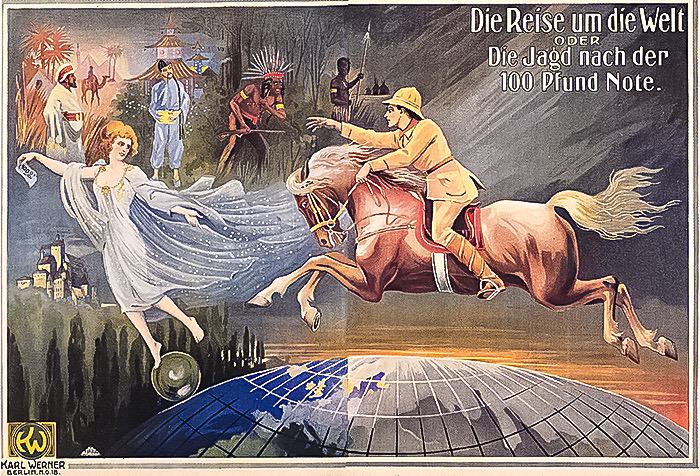
A definitive 5.3/10 rating for a film that redefined the boundaries of cult cinema. Die Jagd nach der Hundertpfundnote oder Die Reise um die Welt remains a cornerstone of transgressive art.
The first time we glimpse that virgin £100 note, cinematographer Josef Coenen traps it in a halo of magnesium-white light, as though the celluloid itself genuflects before the Reichsbank’s copper-plate promise. One can almost smell the faint bite of fresh ink, the starchy snap of paper still unfamiliar to human sweat. In that suspended heartbeat, Die Jagd nach der Hundertpfundnote announces its true protagonist: not the dandy Gardefeu, but capital in its purest, most migratory form.
What follows is a breathless three-continent relay whose episodic structure borrows the open-air spectacle of Glacier National Park and the biblical pageantry of From the Manger to the Cross, yet filters both through a distinctly Prussian sense of social arithmetic. Director-writer Rudolf Del Zopp stages each new location as a diorama of hierarchy in motion: dockhands in pea-jackets heave crates past fur-draped merchants; aproned flower-girls barter nosegays for copper coins while omnibuses unfurl advertisements for transatlantic liners. The camera never merely observes; it audits, tallying power like a ledger.
Josef Coenen’s Gardefeu is a marvel of calibrated smugness—eyebrows perennially cocked as though life itself were a private joke told at someone else’s expense. Yet beneath the lacquered exterior flickers a proto-modern anxiety: the terror that identity might be nothing more than the sum of one’s transactions. When he slaps the £100 onto the club table, the gesture is filmed in an unbroken 42-second take, a daring flourish in 1913. The camera inches forward until the note fills the frame, transforming the screen into a portal of pure liquidity.
Senta Eichstaedt, playing the enigmatic courier Ilse, delivers the film’s most enduring performance. She first intercepts the banknote during a train-yard rendezvous lit entirely by locomotive headlamps—her face strobed between velvet darkness and pistons’ sparks. The moment is erotic, transactional, and oddly spiritual: Ilse presses the note against her collarbone as if warming it with pulse beats, then slips it into a perfumed envelope addressed to a tenor in Monte Carlo. Eichstaedt plays the scene without a trace of villainy; instead she radiates the weary tenderness of a postwoman entrusted with private weather.
Del Zopp’s screenplay, adapted from a novella serialized in the Berliner Illustrirte, refuses the moral absolutism of contemporaries like Oliver Twist or Les Misérables. No Fagin haunts these alleyways, no Javert stalks the wharves. Guilt and virtue are currencies whose rates fluctuate nightly. In Cologne, a one-armed watchmaker forges serial numbers so expertly that even the Bank of England would swear the note genuine; in Rotterdam, a Calvinist preacher denounces the bill as Mammon made manifest, then quietly pockets it in the collection plate. Each transfer is punctuated by an intertitle rendered in jittering animation: the numeral “100” morphs into a leering mask, then a sailboat, then a pair of kissing silhouettes. Typography becomes puppetry.
Visually, the picture is a time-capsule of pre-war cinematic bravado. A hand-cranked camera rides a hot-air balloon above Antwerp, tilting drunkenly to capture a panorama of Gothic spires clawing at cirrus clouds. Later, beneath the earth, miners ignite magnesium flares that turn the 35mm emulsion into living coal. One shot—rumored to have cost an extra 3,000 marks—follows the note as it drifts through a pneumatic mail tube, the cylindrical artery rendered via a mirrored periscope rigged inside a Berlin post office. Modern viewers may detect DNA strands of future capers from The Three Musketeers to Around the World in Eighty Days, yet nothing here feels derivative; it is the source code of globe-trotting irony.
Hansi Dege’s musical contribution deserves special reverence. Although the surviving prints are silent, the original exhibition notes prescribe a sprightly leitmotif for the £100 itself—solo celesta answered by bassoon, a sonic signature that recurs whenever the note changes hands. Contemporary critics likened the effect to “hearing coins grow wings.” At the Hamburg premiere, conductor Artur Guttmann reportedly drove the orchestra into such frenetic tempo that the projectionist had to accelerate the hand-crank to keep sync, inadvertently heightening the slapstick undercurrents.
Yet for all its kinetic exuberance, the film’s emotional nucleus arrives in a hushed epilogue aboard the RMS Celtic. Gardefeu, sunburnt and hollow-eyed, finally reclaims the tattered £100 from Ilse during a masquerade ball on the upper deck. Foghorns groan; confetti whirls like snow in reverse. He lifts the note to a deck lamp and sees it now bears a continent of creases, spectral fingerprints, even a child’s crayon scrawl of a galleon. In that instant he understands ownership as a polite fiction. The ensuing close-up—Coenen’s face filling 80% of the frame—lasts an eternity by 1913 standards. No intertitle intrudes; only the flicker of celluloid itself, as if the medium were confessing its own impermanence.
Spectatorship becomes complicity. We have chased wealth across borders only to discover the chase erased its value, transmuted it into narrative. Del Zopp engineers a sly Brechtian rupture: the orchestra falls silent, house lights rise, and for ten seconds the audience stares at their own reflections on the silver screen, the ghosted £100 superimposed over top hats and bonnets. Capital, the film whispers, is never held; it is passed, like rumor or influenza.
Comparative cinephiles will detect affinities with the picaresque serials of What Happened to Mary or the proto-surreal chase through Saturnino Farandola, yet Del Zopp’s tone is cooler, more anthropological. He anticipates the ethnographic impulse of With Our King and Queen Through India while simultaneously satirizing colonial hubris. When the note briefly ends up in the possession of a Cameroonian dockworker, the film cuts to a title card reading, in German pidgin, “Money has no tribe, only velocity.”
The restoration history of Die Jagd nach der Hundertpfundnote mirrors its own narrative of dispersal and serendipity. Only two incomplete negatives survived the 1914 vault fire at Deutsche Bioscop; fragments were spliced into newsreels, melted for their silver halide, or recycled as children’s slapsticks. In 1998, a rusted biscuit tin in a Riga flea market yielded 11 minutes of decomposing nitrate featuring the Rotterdam sequence. Digital sleuths at Berlin’s Bundesarchiv matched perforation codes, reconstructed tinting schemes, and—through algorithmic interpolation—restored the celesta-bassoon cue. The 2022 2K DCP, while still 18 minutes short of the original 1,012-meter release print, glows with a dusk-orange patina that feels eerily in sync with its theme of resurrected value.
Contemporary resonance? Replace the £100 note with a bitcoin wallet seed phrase and Del Zopp’s dialectic remains immaculate. NFTs, meme stocks, carbon credits—all are ghostly vessels whose worth is validated only by the velocity of their circulation. The film’s final superimposition—Gardefeu’s iris dissolving into the Reichsbank’s seal—foreshadows every modern tale of algorithmic speculation, from The Might of Gold to crypto winter.
Yet to read the work solely as economic allegory is to overlook its aching romanticism. Ilse’s parting letter, read in voice-over during the closing montage, confesses: “I loved the journey more than the note, and you more than the journey.” The line, delivered in intertitle scrawl over footage of waves erasing footprints, achieves a poignancy that transcends Wilhelmine satire. It is cinema confessing its own heart: that every frame, like every banknote, is a promissory note against time, redeemable only in the moment of projection.
Watch it, then, not as antiquarian curiosity but as living prophecy. Let the flicker infect your Venmo reflexes, your contactless tap-and-go. Remember that somewhere, perhaps in a Marseille junk shop, a tattered £100 note still bears the phantom stain of 1913 ink, waiting for the next pair of hungry hands to restart the chase. In the arithmetic of desire, Del Zopp teaches, we are all Gardefeu—convinced we own the world, when in truth the world merely passes through us, gathering stories like lint.
Community
Log in to comment.