DbcultAccessing Vault...
Cult Review
Senior Film Conservator
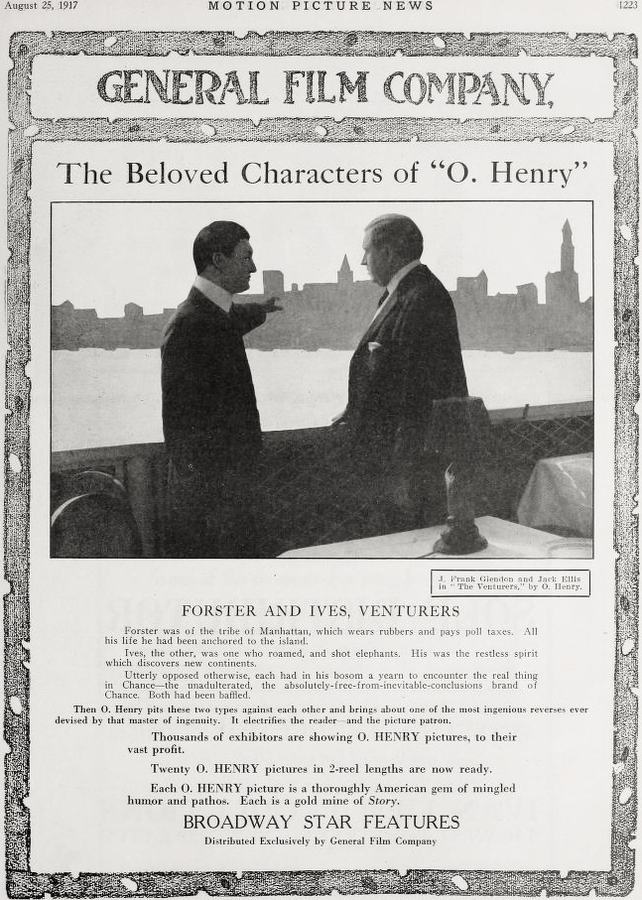
In the annals of early cinema, few narratives capture the human condition with the poignant irony and subtle wit of O. Henry quite like "The Venturers." This cinematic adaptation, born from the masterful pen of O. Henry and brought to life through the screenplay by William B. Courtney, is more than just a simple story; it's a philosophical inquiry into the very nature of adventure, the elusive pursuit of the unconventional, and the surprising transformations wrought by connection. It asks us to reconsider what truly constitutes a 'venturer' and an 'adventurer,' stripping away superficial definitions to reveal deeper truths about longing and contentment. From its opening frames, the film sets a stage that feels both specific to its bustling New York setting and universally resonant, exploring themes that continue to echo through modern storytelling. It's a testament to the enduring power of classic narratives that explore the internal landscapes of their characters as much as their external journeys.
At the heart of "The Venturers" lies a fascinating dichotomy embodied by its two central male characters, portrayed with understated nuance by Jack Ellis and J. Frank Glendon. Ellis plays the 'venturer,' a man whose spirit chafes against the mundane rhythms of urban existence. His world is confined by city limits, yet his mind teems with visions of distant lands and thrilling exploits. He is the armchair explorer, the dreamer who yearns for the grand narrative of adventure but has never taken the first step beyond his comfort zone. His longing is palpable, a quiet desperation for something more, something extraordinary that he believes lies just beyond his grasp. This character serves as a mirror for anyone who has ever felt trapped by routine, fantasizing about a life less ordinary.
In stark contrast, Glendon embodies the 'adventurer,' a man who has traversed the globe, witnessed its wonders, and plumbed its depths – only to return with a profound sense of disillusionment. For him, every exotic locale, every daring escapade, has ultimately dissolved into the same monotonous tapestry of human experience. He is the cynic, the weary traveler who has seen too much and found it all wanting. His weariness isn't born of exhaustion but of a deeper spiritual ennui, a conviction that the 'unconventional' is merely a fleeting illusion. This character challenges the very notion of what adventure truly means, suggesting that external novelty often masks an internal sameness. Their initial meeting on a bustling New York street is a masterful stroke of narrative design, bringing together these two antithetical perspectives on life's grand journey. It's a setup that immediately promises a clash of philosophies, a collision of worldviews that is ripe for O. Henry's signature ironic touch.
Their initial encounter is steeped in the kind of delightful irony O. Henry perfected. Both men, despite their divergent experiences and outlooks, find themselves in a remarkably similar predicament: seeking something beyond the ordinary, yet utterly out of luck. The scene where they dine together, with a mere two cents between them, is a powerful visual metaphor for their shared spiritual bankruptcy, despite their differing journeys. It's a moment that could easily descend into pathos, yet the film, much like O. Henry's prose, imbues it with a certain wry humor. They are men adrift, not necessarily destitute in the material sense – as evidenced by their hotel credit – but certainly in their quest for meaning and excitement. The expectation is that this shared hardship, this mutual yearning for the 'unconventional,' will spark some grand adventure. Yet, and here lies the genius of the narrative, "nothing happened." This deliberate anti-climax is not a failure of storytelling but a clever subversion of audience expectations, setting the stage for a different kind of adventure entirely. It forces us to look beyond the superficial trappings of what we define as exciting or eventful.
The narrative truly pivots with the introduction of the "feminine influence," a character portrayed by Agnes Ayres with a compelling blend of sweetness and grounded practicality. She is the antithesis of the 'incalculable' that the adventurer still secretly craves. Her world is defined by the stability and warmth of an "irrevocably a household," a domestic sphere that, to the restless soul, might initially seem stifling. Yet, it is precisely this rootedness that proves to be the ultimate catalyst. Ayres's performance here is crucial; she embodies not just a romantic interest but a profound shift in perspective. Her presence challenges the adventurer's jaded worldview, forcing him to confront the possibility that true fulfillment might not lie in endless pursuit but in profound connection. For the venturer, she represents the concrete possibility of a different kind of life, one where the 'adventure' is found not in exotic locales but in the shared journey of human relationship. This aspect of the story resonates with other contemporary films exploring domesticity and choice, such as All for a Husband, though "The Venturers" approaches it with a more nuanced, philosophical bent.
O. Henry's genius, and by extension, the film's enduring strength, lies in its masterful exploration of the fluidity of terms like 'adventure' and 'monotony.' The initial premise sets up a conventional understanding: adventure is external, exotic; monotony is internal, urban. However, the narrative meticulously deconstructs this binary. The adventurer, despite his global escapades, finds only monotony, highlighting that true adventure is not merely a change of scenery but a change of perception. Conversely, the venturer, confined by geography, possesses an adventurous spirit that merely lacks an outlet. The film suggests that the 'unconventional' isn't found by blindly chasing novelty, but often by re-evaluating what we already have or what we've previously dismissed. This thematic depth elevates "The Venturers" beyond a simple romance, making it a contemplative piece on human desire and the search for meaning. It subtly critiques the romanticized notions of escape prevalent in popular culture, pushing viewers to consider where true excitement and fulfillment reside. This exploration of personal evolution and the redefinition of one's purpose finds echoes in films like When We Were Twenty-One, which similarly delves into formative life changes and shifting perspectives.
The climax of "The Venturers" is pure O. Henry: a sudden, ironic reversal that redefines both protagonists. Love, often seen as a settling force, paradoxically transforms the city-bound venturer into an adventurer. His newfound connection provides the impetus, the courage, and the purpose he needed to finally embark on his own journey, not necessarily across oceans, but into the unknown territory of a committed relationship and perhaps a life of shared discovery. He discovers that the greatest adventure might not be a solo quest but a partnership. Simultaneously, love settles the restless adventurer, offering him the profound 'incalculable' he had sought in vain across continents. The quiet intimacy of shared life, the unpredictable joys and challenges of domesticity, become his new frontier. He finds that the true 'adventure' was not in escaping the mundane, but in finding profound meaning within it. This dual transformation is a powerful statement on the nature of human connection and its capacity to reshape our deepest desires. It's a testament to the film's insight that true adventure isn't always found in the grand gesture, but often in the quiet courage of commitment.
The success of "The Venturers" hinges significantly on the nuanced performances of its lead cast. Jack Ellis, as the initial venturer, skillfully conveys a yearning that is both universal and deeply personal. His quiet desperation and eventual blossoming into a man of action are portrayed with a subtle grace that avoids caricature. One truly believes in his transformation, feeling the weight of his unfulfilled desires and the lightness of his eventual liberation. J. Frank Glendon, as the jaded adventurer, delivers a performance rich in world-weariness and intellectual cynicism. His portrayal isn't overtly dramatic, but rather a slow burn of disillusionment that gradually yields to a quiet acceptance and eventual contentment. The internal struggle he conveys, the battle between his ingrained restlessness and the burgeoning pull of stability, is compelling. Agnes Ayres, as the feminine influence, provides the grounding element. She is not merely a plot device but a character imbued with a gentle strength and an appealing sincerity that makes her impact on the two men entirely believable. Her presence feels authentic, a beacon of grounded reality amidst their philosophical wanderings. The interplay between these three actors, guided by O. Henry’s masterful characterizations, creates a tapestry of human emotion that feels remarkably contemporary despite the film’s age. The narrative, adapted by William B. Courtney, retains the sharp, observational quality of O. Henry's original work, ensuring that the thematic complexities are conveyed with clarity and emotional resonance.
O. Henry's influence on storytelling, particularly his penchant for ironic twists and deep dives into the human psyche, is unmistakably present in "The Venturers." The film serves as a superb example of how his literary style translated effectively to the screen in the early days of cinema. His narratives often explored the unexpected turns of fate and the hidden motivations beneath seemingly ordinary lives, a characteristic that makes his work perennially adaptable. The structure of the film, with its careful setup of contrasting characters and its eventual, surprising resolution, is a masterclass in narrative economy and emotional impact. It doesn't rely on grand spectacles or elaborate action sequences, but rather on the internal journey of its characters and the profound shift in their understanding of life. This focus on character-driven drama, with its philosophical undertones, sets it apart from more action-oriented adventure films of the era, such as The Spoilers or even the more exotic locales of The Hindu Nemesis. Instead, its adventure is one of the soul, a voyage of self-discovery catalyzed by external circumstances and internal shifts. This subtle yet profound storytelling is a hallmark of O. Henry's genius.
Seen through the lens of its historical context, "The Venturers" offers fascinating insights into early 20th-century societal norms and aspirations. It speaks to a time when rigid class structures and urban expansion fueled both dreams of escape and the desire for stable domesticity. The film subtly critiques the superficial allure of constant motion and the perceived glamour of the 'adventurer' lifestyle, suggesting that true contentment might be found closer to home. It also reflects a burgeoning interest in psychological depth in storytelling, moving beyond simplistic heroics to explore the complexities of human motivation. Its message, however, transcends its era. The questions it poses about what constitutes a fulfilling life, the pursuit of happiness, and the transformative power of human connection remain profoundly relevant today. In an age where digital nomads seek constant novelty and others crave stability, the film's central irony continues to resonate, reminding us that perspective often dictates our experience of the world. Much like the poignant turns in The Final Curtain, which explores life's ultimate ironies, "The Venturers" delivers a timeless reflection on fate and personal growth.
The film's exploration of domesticity as a form of adventure is particularly prescient. In a world increasingly valuing external achievements, the narrative subtly champions the profound, often challenging, journey of building a life with another person. This isn't about settling for less; it's about discovering a different, perhaps more meaningful, kind of 'incalculable' within the confines of a shared existence. It suggests that the greatest adventures are often those we embark upon within ourselves and with those we choose to love. This nuanced perspective on romance and personal growth makes it a compelling watch even today, offering a refreshing counter-narrative to the more conventional romantic dramas of its time, such as Love Aflame, which might focus more on overt passion than subtle transformation.
Ultimately, "The Venturers" stands as a captivating piece of cinematic history, a faithful and insightful adaptation of O. Henry’s distinctive voice. It’s a film that masterfully plays with our expectations, unraveling the conventional definitions of adventure and contentment. Through its wonderfully drawn characters and their intertwined destinies, it delivers a profound message: that true adventure is less about geographical displacement and more about internal transformation, and that the most exhilarating 'incalculable' might just be found in the quiet courage of connection and commitment. It’s a film that reminds us to look beyond the obvious, to question our preconceived notions, and to recognize the extraordinary in the seemingly ordinary moments of life. A truly enriching experience for anyone who appreciates thoughtful storytelling and the subtle ironies of the human heart.
IMDb 8
1920
Community
Log in to comment.