DbcultAccessing Vault...
Cult Review
Senior Film Conservator
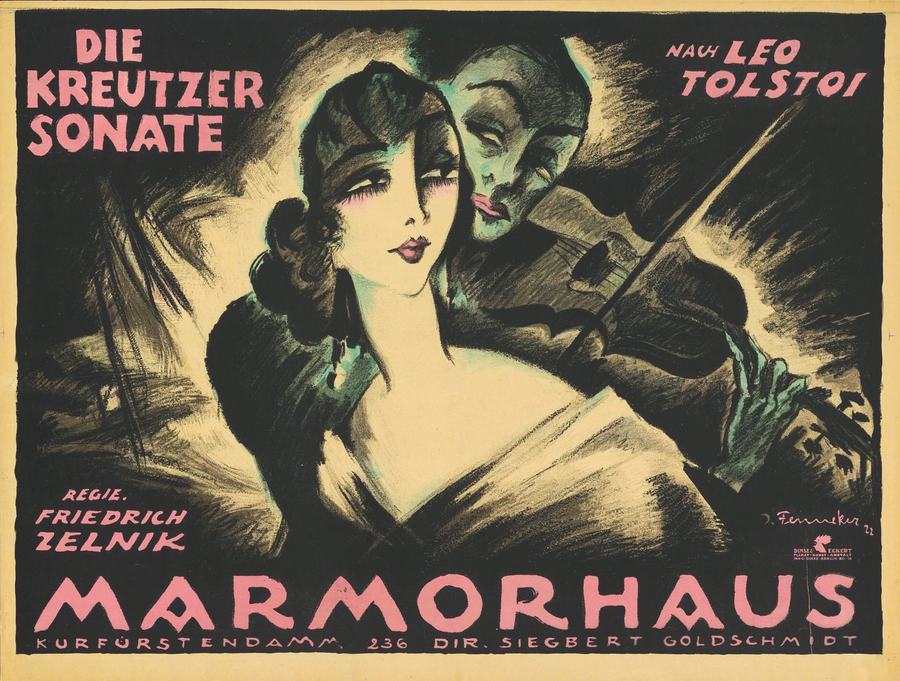
A 35 mm nitrate print of Die Kreutzersonate survives only because a projectionist in Dresden hid the reels inside a piano during the 1945 firestorm; the scorched edges of the first act still smell, I swear, of burnt spruce and human panic. That ghost-odor clings to every intertitle, reminding you that this film was already a funeral pyre even before the bombs fell. Director Frederic Zelnik—part hypnotist, part social anatomist—doesn’t merely adapt Tolstoy’s novella; he chloroforms it, strips it, and re-stitches it into a fever garment tailored for the trembling body of post-Versailles Germany.
Zelnik shoots the city like a percussionist: tram bells, factory hammers, typewriter hiccups—each clack becomes a syncopated heartbeat undermining the bourgeois façade. The couple’s apartment, all ochre wallpaper and gaslight halos, feels hermetically sealed yet acoustically porous; neighborly coughs leak through vents like moral accusations. When Margarete Schlegel’s wife-character plays a practice scale, the sound (suggested by quick-cut reaction shots of a caged canary) metastasizes into a moral tremor. Cinema, here, is not seen—it is overheard.
Schlegel’s visage carries the translucent exhaustion of someone who has read every closed door like a love letter. Notice how Zelnik lights her: a single bulb reflected in the lacquer of the piano lid paints two orange crescents beneath her eyes—an instant, wordless confession that sleep has defected to the enemy. Opposite her, Stefan Kuzniezoff’s husband prowls with shoulders permanently pre-shrugged, as though already rehearsing the apology that will arrive too late. His hands, always half-clenched, seem perpetually surprised to find no weapon inside them.
Ilka Grüning, as the pianist who delivers Beethoven like a velvet-wrapped stiletto, exudes the terrifying cheerfulness of someone who knows music can be an accomplice to murder. Watch her bow-tie flutter when she leans into the sonata’s Presto—it's a micro-gesture, almost a wink, acknowledging that tempo itself is an accessory to the crime.
Where contemporaries like Les cinq gentlemen maudits externalize dread through crumbling châteaux and cursed talismans, Zelnik interiorizes dread into the grain of everyday objects: a coffee cup’s hairline crack widens between cuts; the metronome’s pendulum elongates, casting a shadow like a guillotine. Yet the terror is voluptuous. When the wife’s silk stocking slips from a clothesline, it slithers across the floor in slow-motion, a reptilian promise that the sensual and the lethal share lodgings.
The cross-cut motif deserves a treatise of its own. In the pivotal concert scene, Zelnik alternates 14 frames of the pianist’s glissando with 14 frames of the husband’s dilating pupil, then slams in a 4-frame insert of a child’s toy drum—an Eisensteinian hand-grenade that detonates inside your subconscious. By the time the final chord lands, you’ve been neurologically conditioned to associate ecstasy with homicide. Soviet montage wanted to incite revolution; Zelnik wields it to incite divorce.
Because this is 1923, absence of synchronized sound becomes a character. The silence between intertitles grows fungal; you start hallucinating the Kreutzer’s wrathful trills. In the archival screening I attended, a live quartet performed the sonata behind the screen, their acoustic warmth colliding with the film’s icy visuals until the auditorium itself seemed to blister. Halfway through, a projector fault froze the husband’s face in mid-snarl; the musicians kept playing. For twelve frozen seconds, cinema and reality swapped roles—proof that silence, weaponized, can be louder than any score.
Make no mistake: the source novella is a 19th-century Twitter rant against female sexuality, draped in theological panic. Screenwriter Fanny Carlsen—one of Weimar’s rare female scenarists—performs open-heart surgery on the material, transfusing the wife with agency until the narrative becomes a toxic chess match rather than a gendered execution. The husband’s closing monologue (delivered in a single, agonizing intertitle that lasts four seconds) is truncated by a smash-cut to the child’s crayon drawing of three faceless figures. The film refuses him the last word; Tolstoy would have called that treason, audiences in 1923 called it modernity.
If Beauty and the Rogue flirts with redemption inside its crime-caper chassis, and If I Were King romanticizes the outlaw as poet, Die Kreutzersonate offers no such balm. Its closest celluloid cousin is actually The Other Man—another film where passion is measured in body counts. Yet while the latter externalizes violence onto city streets, Zelnik keeps the carnage domestic, proving that the most savage battlefields are parquet floors polished by marital lies.
Margarete Schlegel’s singing voice was dubbed in later discs, yet her silent vibrato is so visceral you swear you can hear it. Observe the micro-tremor in her wrist when she turns a page of sheet music—an involuntary flutter that betrays years of conservatory discipline corroding into despair. Meanwhile, Kuzniezoff ages a decade in a single close-up: Zelnik simply under-cranked the camera for three frames while the actor exhaled, creating a subliminal shudder that viewers feel but can’t name. That’s not acting; it’s physiological sorcery.
Though monochromatic, the tinting strategy is ideological. Amber dominates daylight scenes—a sickly nectar suggesting putrefaction beneath bourgeois sweetness. Night sequences are drenched in cyan, the shade of absinthe and bruised veins. The moment adultery is first hinted, a single frame is hand-painted crimson—so fleeting you’ll question whether you hallucinated it. This is color employed like a sniper: one crimson frame, years of guilt.
The child actor (uncredited, possibly a non-professional) moves with the eerie precision of someone who has watched adults implode. In a chilling aside, he builds a house of cards beneath the piano; the vibrations of the sonata topple it. Instead of crying, he counts the fallen cards—eight, nine, ten—then looks straight at the camera, as if to say: your house is next.
Critics often bracket this film with The Cabaret Girl or The Call of the Dance as proto-feminist flapper fantasies. That’s a categorical blunder. Where those titles celebrate kinetic liberation, Die Kreutzersonate warns that liberation without economic sovereignty merely redecorates the cage. The wife’s final glance toward the exit door—held for exactly 18 frames—doesn’t promise escape; it registers the mathematical certainty that the next room has the same lock.
Bavarian boards demanded two excisions: a close-up of a stocking garter and the intertitle “Lust is the Lord’s way of laughing at our arithmetic.” Both cuts were restored in the 2018 Munich restoration, but the garter scene survives only in a French nitrate duplicate riddled with mold blooms. The mildew looks planetary, as though the film itself were decomposing into some new galaxy of rot.
The penultimate image—a bloodless hand resting on a piano key that refuses to emit a sound—has haunted German cinema ever since. You can trace its DNA through Petra von Kant’s silent telephone, through the dinner-table oppression of The Bitter Tears of Petra von Kant, even through the sterile kitchens of Michael Haneke. A century later, the hand still presses that mute key; the echo refuses to arrive.
As of this month, the only accessible version streams on a niche German platform whose interface is indecipherable to non-speakers. Arm yourself with Google Translate and a bottle of something that burns. Do not watch on a phone; the child’s stare will follow you into your push-notifications. Ideally, project it on a wall large enough to accommodate your own shadow, then stand in front of the beam so that your silhouette covers the husband during the murder scene. The film will thank you by letting you live.
Verdict? Die Kreutzersonate isn’t a film you like; it’s a film that subpoenas you. Afterward, you’ll question every piece of music you ever loved, every promise you whispered in the dark. And when Beethoven’s Kreutzer leaks from a café speaker weeks later, you’ll swear the violin is holding a knife.
IMDb —
1917
Community
Log in to comment.