DbcultAccessing Vault...
Cult Review
Senior Film Conservator
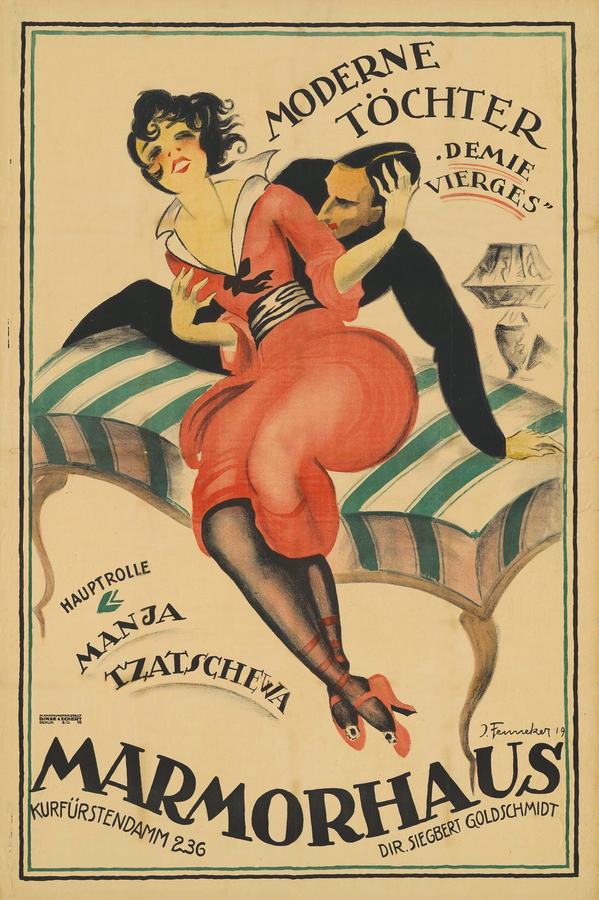
In the shimmering, often tumultuous dawn of the 20th century, cinema emerged not merely as a novelty but as a potent mirror reflecting society's seismic shifts. Among the myriad narratives vying for attention, a particular German silent film, Moderne Töchter, stands out as a remarkably prescient and profoundly engaging exploration of the burgeoning feminist spirit. Penned by the insightful Margarete-Maria Langen, this cinematic offering is far more than a simple melodrama; it is a meticulous dissection of societal expectations, personal aspiration, and the courageous, often lonely, path to self-determination for women in an era teetering on the brink of radical change.
The film’s genius lies in its dualistic narrative, presenting two sisters as archetypes of the era’s conflicting ideologies. Helene, portrayed with a captivating blend of fiery independence and vulnerable introspection by Tzwetta Tzatschewa, is the embodiment of the 'modern daughter'. Her spirit refuses to be confined by the domestic strictures that society, and indeed her own parents, deem appropriate. Tzatschewa’s performance is a masterclass in silent film acting, conveying volumes with a mere glance, a subtle shift in posture, or the eloquent tremor of a hand. One can almost hear the unuttered pleas for freedom, the silent screams against convention, emanating from her expressive face.
Her artistic pursuits, initially dismissed as mere flights of fancy by the patriarchal figures in her life – particularly the stern industrialist Herr von Graven, played with chilling gravitas by Max Laurence – become her sanctuary and her weapon. Laurence, with his imposing presence and unyielding gaze, perfectly encapsulates the entrenched conservatism that sought to suppress any deviation from the established order. His performance provides a stark, formidable counterpoint to Helene’s burgeoning liberation, making their every interaction a tense, symbolic battleground.
In stark contrast to Helene’s rebellious spirit, her elder sister, Clara, essayed by Olga Engl, initially embraces the traditional path. Engl, a seasoned actress, brings a nuanced vulnerability to Clara, depicting a woman who seeks security and societal approval through marriage to Dr. Ernst Wagner, played by the suave yet subtly sinister Meinhart Maur. Maur’s portrayal is particularly effective; he embodies the insidious charm of a man who outwardly conforms to societal ideals of respectability but inwardly harbors a controlling, almost suffocating, possessiveness. His smile, often plastered on his face, rarely reaches his eyes, hinting at the emotional manipulation beneath the surface of his supposedly benevolent intentions.
Clara’s journey is perhaps the more tragic, or at least the more cautionary. Her initial contentment with domesticity gradually erodes as the gilded cage of her conventional life reveals its true, suffocating nature. Engl masterfully conveys this slow-burn disillusionment, her once hopeful eyes dimming with each passing scene, her shoulders slumping under the invisible weight of unfulfilled expectations. This narrative arc provides a powerful counterpoint to Helene's struggle, demonstrating that conformity, too, can be a form of imprisonment. The film implicitly asks: Is it better to fight for freedom and face societal censure, or to accept an outwardly comfortable life that hollows out the soul?
The ensemble cast surrounding Helene and Clara is equally compelling, forming a rich tapestry that grounds the film in its historical context. Margarete Kupfer and Fritz Hartwig, as the sisters' parents, deliver performances that resonate with an authentic struggle between love for their daughters and adherence to deeply ingrained societal norms. Kupfer, in particular, portrays a mother torn between her desire for her daughters’ happiness and her fear of societal judgment, her internal conflict palpable in her restrained gestures and worried expressions. Hartwig’s father figure, initially stern and unyielding, undergoes a subtle, almost imperceptible transformation, hinting at a grudging respect for Helene’s tenacity.
Rudolf Lettinger's portrayal of Paul Richter, the forward-thinking journalist, is a beacon of progressive thought. Lettinger imbues Richter with an intellectual charisma and genuine empathy, making him a credible advocate for women's rights and artistic freedom. His scenes with Helene are charged with an intellectual spark, suggesting a partnership founded on mutual respect and shared ideals rather than mere romantic infatuation. This nuanced depiction of a male ally is refreshing and progressive for its time, avoiding the simplistic trope of a 'savior' figure.
Even smaller roles, such as those filled by Tzwetta Tzatschewa's bohemian artist friends or Karl Falkenberg's more conservative male acquaintances, contribute to the film’s rich social commentary, illustrating the diverse attitudes prevalent in society. The film’s ability to populate its world with such a variety of well-defined characters, each serving to highlight a different facet of the central theme, is a testament to Langen's astute writing and the cast's collective talent.
Moderne Töchter, while firmly rooted in its historical context, possesses a thematic resonance that transcends its era. The struggle for individual identity, the tension between personal ambition and societal expectation, and the quest for authentic self-expression are universal themes that continue to resonate with contemporary audiences. The film's exploration of female agency, specifically, places it in a lineage of cinematic works that challenge patriarchal norms. One might draw parallels to the raw emotionality found in films like Human Clay, which similarly delves into the arduous journey of self-discovery amidst societal judgment, or the more overt social critique present in The Church and the Woman, though Moderne Töchter approaches its subject with a more intimate, character-driven focus.
The narrative’s refusal to offer simplistic resolutions is one of its greatest strengths. Helene’s triumph is not without its costs, and Clara’s disillusionment, while painful, is presented as a catalyst for potential, albeit belated, self-awareness. This nuanced approach avoids didacticism, allowing the audience to grapple with the complexities of the characters' choices and their consequences. The film suggests that true modernity is not merely about outward rebellion, but about an internal shift in perspective, a re-evaluation of one's own desires and values.
The visual language of the film, characteristic of the silent era, is employed with considerable skill. The cinematography, though lacking the elaborate flourishes of later German Expressionist works like Pest in Florenz, is effective in conveying mood and character. Close-ups are used judiciously to highlight emotional states, while wider shots establish the oppressive grandeur of traditional settings versus the chaotic, liberating energy of bohemian spaces. The interplay of light and shadow, though perhaps not as starkly stylized as some of its contemporaries, subtly underscores the internal conflicts faced by the characters. The costumes, too, are more than mere period dressing; they are visual signifiers of the characters' allegiances – the restrictive corsetry of convention versus the looser, more functional attire of burgeoning independence.
Moderne Töchter, through its thoughtful narrative and compelling performances, contributed significantly to the evolving discourse on women's roles in society. It predates, yet resonates with, the spirit of films like A Daughter of Eve, which also explored the challenges faced by women seeking agency. Its influence, though perhaps not as overtly documented as some canonical works, can be felt in the subsequent waves of cinema that dared to challenge the status quo. The film serves as a powerful reminder that the fight for equality and self-determination is a perennial one, fought across generations and cultures.
The film's exploration of romantic relationships is also noteworthy. While love interests exist, they are not presented as the sole determinant of the protagonists' happiness. Helene's connection with Paul Richter is depicted as a partnership of equals, founded on intellectual and ideological alignment, rather than a conventional romance where the woman's identity is subsumed by her partner's. This progressive portrayal is a stark contrast to many films of the era, where a woman's ultimate fulfillment was almost invariably tied to marriage and domestic bliss. Even Clara's journey, while initially conforming to this trope, ultimately subverts it by exposing the hollowness of a marriage devoid of true connection and respect.
The film's ending, while not entirely devoid of hope, is imbued with a sense of realism that prevents it from descending into saccharine sentimentality. It acknowledges that societal change is a gradual, often arduous process, and that individual victories, while significant, do not erase the broader challenges. This grounded approach ensures the film’s message remains potent and credible. It forces the audience to confront the lingering questions of what true freedom entails and the sacrifices it often demands.
In conclusion, Moderne Töchter is a cinematic jewel from the silent era, a film that speaks volumes without uttering a single word. Margarete-Maria Langen's script, brought to life by a stellar cast including the unforgettable Tzwetta Tzatschewa, Max Laurence, Meinhart Maur, Margarete Kupfer, Fritz Hartwig, Olga Engl, Rudolf Lettinger, and Karl Falkenberg, offers a nuanced, powerful commentary on the evolving role of women in society. It is a work that deserves rediscovery, not just as a historical artifact, but as a vibrant, relevant piece of art that continues to provoke thought and inspire reflection on the enduring quest for liberation. It stands as a testament to the power of early cinema to not only entertain but to challenge, to question, and to illuminate the human condition with profound insight. For those interested in the social currents shaping the early 20th century and the burgeoning women's movement, Moderne Töchter is an indispensable viewing experience, a silent roar for change that echoes across the decades.
IMDb —
1921
Community
Log in to comment.