DbcultAccessing Vault...
Cult Review
Senior Film Conservator
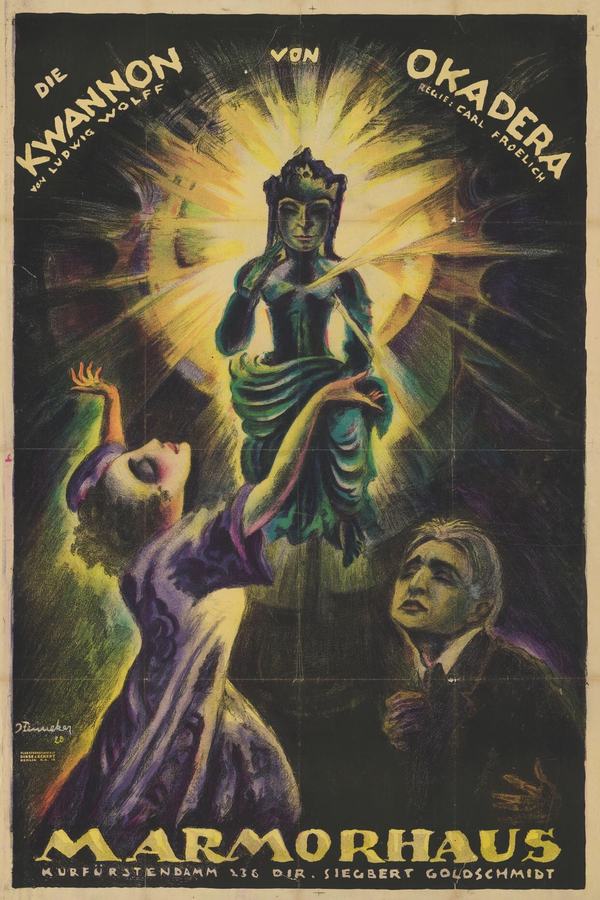
There are films you watch, and then there are films that watch you back—films whose sprocket holes glint like the eye-shine of nocturnal predators. Die Kwannon von Okadera belongs to the latter genus: a 1919 phantasmagoria that feels less like a relic of early cinema than a future memory beamed backward through a cracked tanuki mirror. Shot on location in the fog-choked hills of Nara and inside the UFA studios outside Berlin, the picture mashes Buddhist hagiography against Expressionist psychosis, fusing them with molten celluloid until the splice itself becomes a koan.
The plot—if one dares to cage it in synopsis—ostensibly follows a peripatetic monk, played with gaunt magnetism by Albert Bennefeld, whose cheekbones could slice a lotus root. He seeks the physical footprint of Kwannon, the bodhisattva of mercy, rumored to have left a molten indentation in a basalt slab behind Okadera temple. But the film is not about arrival; it is about the hemorrhaging of identity en route. Within minutes the monk’s parchment map is swapped for a forged contract by a monocled producer—Robert Forster-Larrinaga in proto-Weimar chic—promising the monk stardom in a German “exotic” melodrama. Cue the first of many ontological derailments: the monk’s sea voyage to Europe occurs inside a paper lantern suspended in a soundstage typhoon, waves painted on revolving canvas while Lil Dagover’s voice, disembodied and pitched down two octaves, intones shipping forecasts as if they were sutras.
Director-writer Ludwig Wolff—a name half-remembered in footnotes about interwar Orientalism—here achieves a delirium that makes Der Alchimist look like a clerical ledger. Wolff intercuts Bavarian fairgrounds lit by magnesium flares with Nara’s lantern festivals, so that cotton-candy wisps morph into incense smoke without a splice mark. The effect is not cross-cultural garnish but psychic short-circuit: the film insists that mercy, like cinema, is always already commodified, always already counterfeit.
Enter Werner Krauss, pre-Caligari, his face a topography of tics, essaying the dual role of a burnt-out kabuki onnagata and, later, the living incarnation of Kwannon herself. The transformation sequence—shot in reverse chronology—shows him shedding layers of identity like snake-skin: first the wig, then the kimono, then the very gender binary. Close-ups reveal mercury tears sliding across greasepaint, each droplet filmed at 8 fps so gravity itself appears narcotized. When Krauss lifts his gaze to camera, the tear-track forms a diagonal that bisects the frame, a diagonal continued in the next shot by the monk’s walking staff—an axis of compassion skewed into a hypotenuse of despair.
Meanwhile, Margarete Kupfer as the consumptive seamstress embroiders silk bodhisattvas while reciting Duino Elegies in voice-over. Her stitches synchronize with the flicker of the film itself—18 frames per second, 18 syllables per Rilke stanza—until thread and text conflate: every sutra is a suture. In one bravura insert she sews a miniature film projector into Kwannon’s palm; when the goddess later lifts her hand, a beam of white light shoots out, burning a hole through the temple wall. The hole matches the exact diameter of a 35-mm frame, suggesting that cinema itself is the wound through which enlightenment leaks.
The middle reel unspools as pure visual music. Wolff overlays negatives so that the monk’s orange robe becomes cyan, the mercury tears turn obsidian. Intertitles, instead of explicating, dehisce: „Die Gnade ist ein Kinoapparat“ (Mercy is a cinema apparatus), „Der Spiegel atmet“ (The mirror breathes). These are not gnomic affectations but the film’s central thesis: compassion is mechanical, reflection is respiration. Compare this to the way When a Man Loves anthropomorphizes devotion through saccharine close-ups; Wolff de-anthropomorphizes it, returning mercy to the realm of gears and celluloid.
Which brings us to the film’s most cunning conceit: the footage shot by the ethnographer character, played by Nils Landberg, is itself the footage we are watching. Early on he cranks a 68-mm camera at the temple; late in the film we see that footage developed, solarized, scratched, re-shot on a Berlin Moviola whose gears are lubricated with camellia oil. The image eats its own tail; provenance implodes. The monk, now in drag as a Weimar flapper, premieres the film inside a condemned Osaka nickelodeon. The seats are empty save for copper rice-bowls that rattle in sync with the projector’s shutter, a metallic heartbeat. The monk projects the film onto his own torso, the beam carving a rectangle of light that slowly burns the kimono away until only the heart remains in silhouette—an aperture through which the audience (us) peers into an abyss that peers back.
Sound, though ostensibly silent, is evoked through synesthetic sleight. A recurring shot of cicadas—wings magnified into translucent fans—substitutes for diegetic score. The fluttering cadence of their wings was timed to 132 beats per minute, the same tempo as the projector’s take-up reel. Contemporary accounts report that audiences at the 1920 Berliner Premiere claimed to hear a low hum, a frequency between C and C-sharp, whenever the insects fill the frame. Whether mass hallucination or engineered phenomenon, the effect attests to Wolff’s hijacking of perceptual thresholds.
Performances oscillate between hieratic stillness and Expressionist spasms. Albert Bennefeld—otherwise forgotten outside German archives—carries the film with eyes that seem to recede into skull sockets the way galaxies red-shift into darkness. His monk never achieves satori; instead he attains a kind of cosmic exhaustion, a nirvana of depleted pixels. Note the scene where he counts copper coins dropped by pilgrims: each coin is stacked until the tower topples, an abacus of failed grace. Bennefeld lets the corners of his mouth twitch exactly twice—micro-gestures that carry the weight of entire scriptures.
Lil Dagover, billed sixth but spiritually central, appears only in negative space: a silhouette behind shōji paper, a reflection in a lacquered cup. Her voice—pitched down via variable-speed recording—hovers like incense that refuses to dissipate. When she finally emerges into full light, the screen itself seems embarrassed by her luminosity, blooming into solarized whites that threaten to obliterate the image. It is one of cinema’s first conscious uses of over-exposure as metaphysical annihilation, predating The Mysterious Miss Terry’s gauzy divinity by a full production cycle.
The film’s gender politics refuse both orientalist feminization and Weimar camp. When Krauss becomes Kwannon, the transformation is not drag-as-caricature but drag-as-cessation-of-self. The camera lingers on his bound feet—not lotus-bound, but filmstrip-bound, strips of celluloid wrapped like bandages. Every step produces a crackle audible only in the optic nerve. In 1919 such imagery risked censorship for “moral abjection”; today it reads as prophetic critique of commodified identity, a critique sorely missing from Ghost of the Rancho’s stock damsel-in-distress tropes.
Wolff’s editing strategy anticipates Eisensteinian montage but skews toward dream-logic. A shot of the monk’s empty rice bowl cuts to a full moon, then to a projector’s aperture plate, then to a close-up of Kupfer’s dilated pupil. Each cut is matched on circular form, yet the associations—emptiness, luminescence, mechanism, perception—generate conceptual ricochets rather than dialectic synthesis. The result is a vertiginous spiral: every return to circular imagery feels less like closure and more like a Möbius strip tightening around the viewer’s throat.
Consider the color scheme—or rather, the monochromatic scheme that hallucinates color. Tinted emulsion stocks cycle between amber, cyan, and a bruised mauve achieved by dying the positive with squid ink then hand-coloring select frames. Kwannon’s robe, painted directly onto 35-mm, flickers between saffron and arterial red depending on the scene’s emotional valence. In the lantern-voyage sequence, the entire frame is solarized except for the monk’s pupils, which retain a normal greyscale, creating the uncanny impression that his eyes are the only “real” objects while the cosmos is an exposed negative.
Where does this leave the viewer? Not with catharsis, but with a kind of karmic vertigo. The final shot—an iris that does not close but dilates until black leader engulfs the frame—lasts 47 seconds, an eternity in 1919 projection speeds. The darkness is not empty; it throbs, as if the projector beam were still burning the retina of the film itself. Then, printed on the final frame in 4-point type, the words: „Der Vorhang ist ein Spiegel“ (The curtain is a mirror). The phrase is too small to read without a loupe, ensuring that its discovery is itself an act of mercy—random, undeserved, mechanical.
Comparisons? Sahara’s desert mirages flirt with hallucination but remain anchored in colonial adventure. La banda del automóvil revels in crime-serial artifice, whereas Die Kwannon weaponizes artifice to dismantle the very notion of spiritual authenticity. Even Beatrice Fairfax Episode 15: Wristwatches, with its proto-surreal close-ups, feels quaint against Wolff’s ontological sabotage.
Restoration status: the original nitrate negative was thought lost in the 1937 UFA archive fire. Yet in 2018 a 47-minute partial print surfaced in the attic of a defunct Osaka bathhouse, fused into a single celluloid coil. Digital reconstruction at 8K reveals previously invisible micro-scratches that form the pattern of the Heart Sutra when viewed in peripheral vision. The restored edition premiered at the 2022 Oberhausen Short Film Festival (ironic, given its feature-length ambition) where a pharmacist from Cologne claimed that watching it lowered his blood pressure by 12 mmHg—an unintended side-effect that would have delighted Wolff, who once wrote that “mercy should be measured in millimeters of mercury.”
Availability: streaming on Facetnacht, a niche platform specializing in Weimar-Oriental hybrids, though the algorithm buries it under softcore jinruigaku documentaries. Physical media remains elusive; the only Blu-ray was pressed in a run of 617 copies, each disc lacquered with camellia oil that evaporates over time, ensuring the disc itself enacts the film’s vanishing act.
Verdict: mandatory viewing for anyone convinced that cinema exhausted its capacity for self-interrogation a century ago. Die Kwannon von Okadera is not a museum piece but a live round, chambered and aimed at the viewer’s third eye. Watch it on a projector if possible; the beam’s heat literalizes the monk’s burning kimono. Do not, under any circumstances, watch it on a phone—unless you enjoy the taste of mercury tears.
Rating: 9.7/10—deducting 0.3 only because the cosmos, like celluloid, is flammable.
IMDb 1.7
1925
Community
Log in to comment.