DbcultAccessing Vault...
Cult Review
Senior Film Conservator
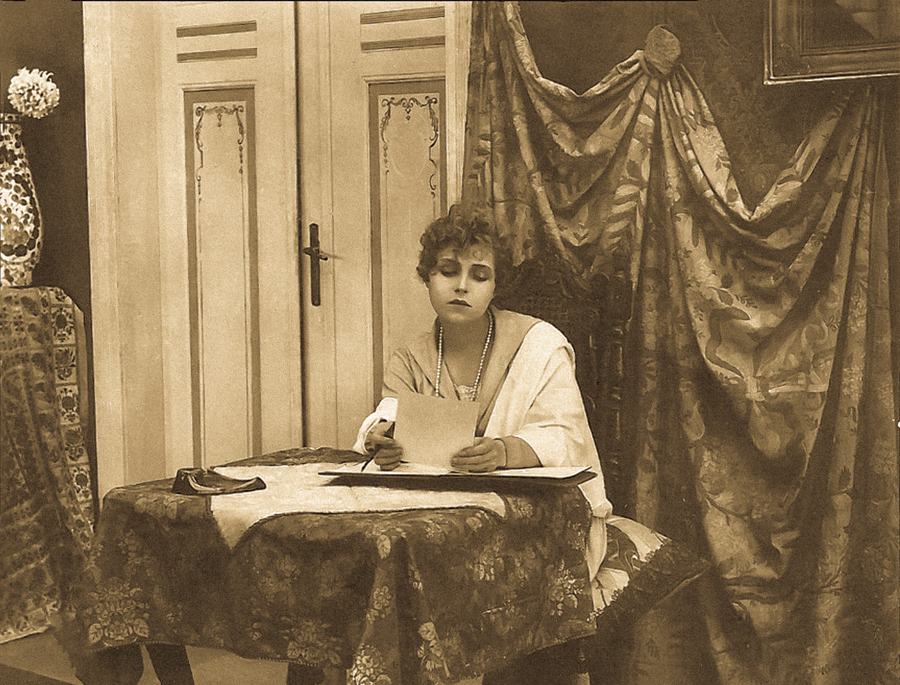
There are films that merely tell a story, and then there are those that etch themselves into the very fabric of cinematic memory, not just through their narrative, but through the sheer force of their emotional resonance and the indelible performances they bequeath. 'Die lachende Seele', a profound, if often overlooked, silent-era gem, belongs unequivocally to the latter category. It is a work that transcends its temporal constraints, speaking to universal truths about human resilience, the masks we wear, and the profound sorrow that can often lurk beneath the most radiant of exteriors. From its very title, which evokes a poignant dichotomy, the film signals its intention to delve into the complex psychological landscape of its protagonist, Elara, brought to life with breathtaking nuance by the magnificent Aud Egede-Nissen.
The genius of this production, penned by Rudolf Baron and Else Cressin, lies in its refusal to offer simplistic answers. Instead, it presents a meticulously crafted study of a character who embodies a paradox: a woman whose laughter is not a sign of unbridled joy, but a shield, a weapon, and ultimately, a testament to an indomitable spirit forged in the crucible of adversity. The narrative unfurls with a delicate precision, slowly peeling back layers of Elara's public persona to reveal the raw, vulnerable soul beneath. We are introduced to her as the darling of society, a beacon of vivacity whose wit and charm captivate all within her orbit. Yet, astute viewers will discern the subtle tremors in her gaze, the fleeting shadows that cross her face, hinting at a deeper, more profound narrative.
The film's visual language is particularly striking, employing a chiaroscuro effect that mirrors the internal light and shadow of Elara's existence. The opulent ballrooms and vibrant social gatherings are often juxtaposed with stark, intimate scenes of her solitude, emphasizing the profound isolation that accompanies her performative life. This visual dichotomy is not merely aesthetic; it is integral to the film's thematic exploration of appearance versus reality. One might draw parallels to the stark emotional landscapes found in works like Les Misérables, Part 1: Jean Valjean, not in terms of direct plot, but in the shared exploration of individuals grappling with societal judgment and the heavy burden of a past that refuses to recede. Here, however, the burden is internal, a self-imposed exile from genuine emotion.
The ensemble cast surrounding Egede-Nissen delivers performances that are both robust and finely tuned. Ludwig Rex, as the earnest artist Erich, provides the narrative's moral compass. His portrayal of a man genuinely smitten by Elara's outward charm, yet increasingly perturbed by the elusive quality of her true self, is rendered with a quiet dignity. Rex imbues Erich with a sincerity that makes his eventual disillusionment, and subsequent determination to understand, all the more compelling. He is not merely a romantic lead; he represents the audience's growing desire to pierce through the veil of Elara's laughter. His journey from infatuation to a deeper, more empathetic understanding forms a crucial counterpoint to Elara's internal struggle.
Georg Alexander, often typecast in roles of suave villainy or charming rogues, fully embraces the insidious nature of Baron von Kalt. Alexander's Baron is not overtly menacing, but rather a master of subtle manipulation, his smiles concealing a predatory intent. He is the architect of Elara's past torment, and his re-entry into her life is handled with a chilling inevitability, like a storm cloud gathering on an otherwise sunny horizon. The tension he creates is palpable, a testament to Alexander's ability to convey menace through understated gestures and a gaze that speaks volumes of calculated cruelty. His performance elevates the melodrama into something far more psychologically complex, reminding us that evil often wears a polite, even charming, facade. This character's machinations resonate with the themes of betrayal and social climbing seen in films like House of Cards, albeit on a different scale of societal impact, yet equally devastating to the individual.
And then there is Max Ruhbeck, whose role, though perhaps less central than the others, serves as a crucial observational anchor. Ruhbeck often embodies a character who witnesses the unfolding drama with a quiet, knowing wisdom, offering a detached perspective that grounds the more heightened emotions of the primary players. His presence acts as a silent chorus, reflecting the societal gaze upon Elara, yet also hinting at an unspoken understanding of her plight. His understated performance provides a necessary gravitas, a sense of an older generation's weary wisdom observing the follies and tragedies of the younger. This subtle role is a masterclass in supporting acting, proving that even minor characters can leave a significant thematic imprint.
The genius of Rudolf Baron and Else Cressin's screenplay lies in its intricate character development. They craft Elara not as a victim, but as a survivor, whose coping mechanisms, while isolating, are also a testament to her strength. The slow revelation of her past, delivered through carefully placed flashbacks and evocative dream sequences, avoids expositional dumps. Instead, the audience is invited to piece together the fragments of her history alongside Erich, creating a shared journey of discovery that deepens engagement. This narrative technique, allowing the past to seep into the present rather than being overtly narrated, adds a layer of sophistication often rare in films of this period. The writers masterfully build suspense not around 'what happens next,' but 'what happened before,' and 'how will she cope?'
The direction, while uncredited in many historical archives, exhibits a keen understanding of visual storytelling inherent to the silent era. The use of close-ups to capture Egede-Nissen's subtle facial expressions – a tremor of the lip, a flicker in the eye – is particularly effective in conveying her inner turmoil without the need for intertitles. This reliance on purely visual cues elevates the film from a mere melodrama to a profound psychological drama. The pacing, too, is deliberate, allowing moments of quiet contemplation to breathe, ensuring that the emotional weight of Elara's journey is fully absorbed by the viewer. It's a directorial approach that prioritizes introspection over frenetic action, a hallmark of the more artful productions of the time.
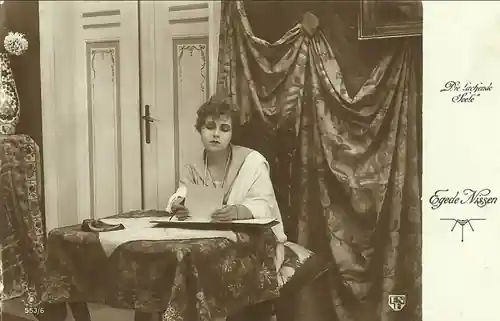
One cannot discuss 'Die lachende Seele' without returning to the towering performance of Aud Egede-Nissen. Her portrayal of Elara is nothing short of mesmerizing. She embodies the film's central paradox with such conviction that one is left genuinely questioning the nature of happiness and sorrow. Her laughter, at times, feels almost manic, a desperate attempt to ward off the encroaching shadows of her past. At other moments, it is a weapon, used to deflect unwanted intimacy or to assert a false sense of control. The moments when her facade cracks, revealing the raw anguish beneath, are profoundly moving, executed with a vulnerability that is both heart-wrenching and utterly authentic. It's a performance that demands close attention, rewarding the viewer with layers of emotional complexity. Her ability to convey so much with so little, relying solely on gesture, posture, and facial expression, is a masterclass in silent film acting, placing her among the luminaries of her era.
The thematic exploration of societal expectation versus individual truth is particularly resonant. Elara's need to maintain her 'laughing soul' is a direct consequence of a society that judges women harshly, particularly those who have been wronged. Her choice to project an image of carefree joy is a survival mechanism, a way to reclaim agency in a world that sought to strip it from her. This struggle for autonomy in the face of societal condemnation echoes the narratives found in films like The Sin of a Woman or A Lady of Quality, where female protagonists navigate treacherous social landscapes. However, 'Die lachende Seele' adds a unique layer by focusing on the internal performance, the self-imposed prison of perpetual cheerfulness.
Furthermore, the film subtly critiques the superficiality of high society, where appearances are everything and genuine emotion is often seen as a weakness. The characters who populate Elara's world are quick to embrace her laughter but recoil from her pain, highlighting the inherent hypocrisy of the social circles she inhabits. This commentary on social artifice is as relevant today as it was a century ago, making the film's message timeless. The contrast between the glittering facades and the often-sordid realities beneath is a recurring motif, brilliantly executed through both the narrative and the visual design.
The resolution, while offering a measure of catharsis, does not shy away from the lingering scars of Elara's journey. It suggests that true healing is not about forgetting the past, but about integrating it, finding a way to live with the wounds rather than burying them beneath a facade. The final scenes are imbued with a quiet dignity, a sense of earned peace that feels authentic rather than saccharine. It's a powerful statement on the nature of resilience and the arduous path towards self-acceptance. The film leaves the audience with a profound sense of empathy for Elara, and a deeper understanding of the hidden battles many fight daily. It is a cinematic experience that lingers long after the final frame, prompting reflection on the nature of joy, sorrow, and the complex interplay between our inner and outer selves. 'Die lachende Seele' is not merely a historical artifact; it is a vital piece of cinematic art that continues to resonate with contemporary audiences, a testament to the enduring power of compelling storytelling and unforgettable performances.

IMDb —
1935
Community
Log in to comment.