DbcultAccessing Vault...
5/10
Senior Film Conservator
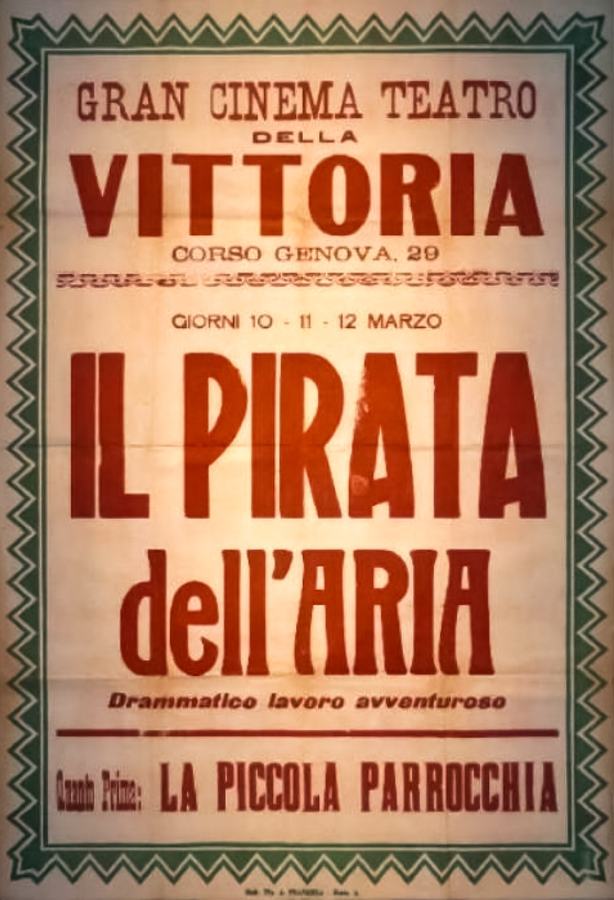
A definitive 5/10 rating for a film that redefined the boundaries of cult cinema. Die Luftpiraten remains a cornerstone of transgressive art.
Berlin, March 1921: while politicians ink reparations clauses on parchment, Harry Piel and Max Bauer scribble contraband dreams across 2400 metres of nitrate, birthing a sky-crime fable so kinetic it seems to vibrate outside its sprocket holes. Die Luftpiraten is not merely a bandit caper; it is a fever chart of a republic gasping between pulverized imperial glory and the seductive hum of American jazz leaking from gramophones.
The film begins inside a cumulonimbus cathedral: thunder rolls like tympani for a phantom orchestra. From this cloud-womb emerges a zeppelin—black-ribbed, silver-bellied—its scarlet underbelly logo a stylized LP that stands for Luftpiraten but could just as well mean Lost Paradise. Inside, Paula Cora’s Lola straps on a leather trench coat lined with stolen Reichsbank seals; she snaps her goggles shut and the lenses reflect a montage of burning cities yet to come. The gang’s first exploit: lowering a giant brass vacuum—part octopus, part cornucopia—through the glass dome of a Dresden bank, sucking up bearer bonds like a whale filtering krill. Cinematographer Klara (Mary Marion) cranks her camera, each turn of the handle echoing like a gavel in the cavernous vault. The robbery is filmed twice: once for the police archive, once for the gang’s narcissistic pleasure—an early meditation on surveillance culture decades before Big Brother.
But the sky is not lawless. Inspector von Lüttwitz (Friedrich Berger), a flying-ace whose facial scar maps the trenches of Verdun, gives chase in a patched Fokker D.VII. His motif: a dangling clockwork canary that chirps every hour, reminding him of a childhood promise to cage songbirds rather than men. Their dogfight over the Elbe is choreographed like expressionist ballet: silhouettes against vermilion sunset, tracer rounds drawing chalk equations across the sky. Piel and Bauer intercut cockpit close-ups with puppet-like miniatures, creating a cubist delirium that anticipates the mechanical nightmares of Der Alchimist.
Paula Cora carries the swagger of Dietrich before Dietrich existed, but tempers it with childlike wonder every time she sights a new constellation through the dirigible’s skylight. Her Lola is equal parts pirate and pilgrim—she steals not for wealth but for the vertiginous thrill of owning fragments of the world.
Mary Marion’s Klara is the film’s moral gyroscope. With a cigarette glowing like a firefly in the dark, she double-exposes her footage, layering the gang’s jubilation atop burning villages from newsreel atrocities. The implication: every cinema spectator is complicit in the plunder.
Friedrich Berger underplays von Lüttwitz, letting his eyes—one blue, one grey—do the heavy lifting. When he finally boards the zeppelin, the camera dollies past his gloved hand brushing a girder, leaving a smear of Tyrolean snow that melts into a tear he refuses to shed.
Harry Piel, co-writer and mechanical savant, injects slapstick into menace: his scar-faced Jonny tightens bolts with a wrench shaped like a question mark, hinting that technology itself is an existential riddle.
Margot Thisset’s chanteuse Yvette appears only twice—once in a Berlin cabaret, once via phonograph aboard the airship—but her torch song “Falling Empire Waltz” recurs as leitmotif, its minor-key lilt foreshadowing the doomed republic.
Though shot monochromatically, Die Luftpiraten behaves polychromatically. Intertitles are tinted: ochre for daylight heists, cyan for night flights, magenta for erotic tension. The final reel—where the dirigible’s skin catches fire—was hand-painted frame by frame in Workshop Grell, turning each nitrate scratch into a molten vein. Compare this pyrotechnic crescendo to the amber dusk of The Golden West; whereas that American western mythologizes sunset as promise, Piel’s Germanic inferno brands it as reckoning.
Textures fascinate: close-ups of peeling varnish on the zeppelin’s ribs echo the cracked veneer of post-war society. When Lola presses her cheek against the cool duralumin, the camera lingers on condensation beads that resemble a rosary of evaporated prayers.
Original exhibition notes prescribe a live ensemble: accordion for dirigible engines, musical saw for wind shear, glockenspiel for gold coins clinking. Contemporary restorations—such as the 2018 Frankfurt rekonstruktion—employ electronic minimalism: sub-bass drones mimicking diesel heartbeats, detuned piano chords recalling The Cabaret’s decadent piano, but slowed until they resemble tectonic plates grinding. The absence of diegetic sound amplifies every creak of leather, every click of Klara’s camera shutter—silence becomes a character, a co-conspirator.
Unlike the marital tangles of A School for Husbands, the erotic geometry here is triangular and aerial. Lola courts danger, Klara courts truth, von Lüttwitz courts order; their vectors intersect in a climactic mid-air waltz atop the dirigible’s dorsal ridge—shot with rear projection so clouds swirl beneath their feet like whipped cream. The sequence queers the adventure genre: the women’s mutual gaze burns hotter than any heterosexual clinch, while the inspector’s fascination with Lola’s lawlessness reads as masochistic submission to anarchy.
Piel’s script smuggles in Nietzschean overtones: the pirates’ credo “Above the clouds, God is a passenger” mutates into a meditation on moral relativity. Yet the finale—where Lola jettisons the loot into sunrise, turning gold bars into meteoric fireflies—suggests grace can exist without divine warrant. It is a moment of secular transfiguration, rivaled only by the ascetic renunciation in Das Gelübde der Keuschheit.
Contemporary critics praised the „atemberaubende Höhenspannung“ (breathtaking altitude tension) but sniffed at the „amerikanisierte Gangsterzuckung“ (Americanized gangster twitch). By 1924, the film vanished—likely confiscated under currency-hoarding statutes that equated celluloid spectacle with economic sabotage. A censored 1932 reissue trimmed the anti-authoritarian banter, retitling it Flucht in den Wolken (Escape in the Clouds) to appease nationalist censors. Only in 2018 did the Deutsche Kinemathek reconstruct 73 of the original 92 minutes from a Brussels nunnery’s vinegar-soaked print and a collector’s private reel discovered inside a disassembled harpsichord.
Critical re-appraisal places the film within the Luftliteratur echo chamber alongside Mit Herz und Hand fürs Vaterland yet notes its ironic distance from jingoism. The pirates are not patriots; they are entrepreneurs of altitude, selling altitude itself as narcotic escape.
Where Lost Money obsesses over terrestrial greed, Die Luftpiraten monetizes the sky, turning nebular strata into offshore accounts. Its gender-fluid camaraderie contrasts sharply with the masculine brinkmanship of Wolves of the Border, while its self-reflexive cinematography anticipates the meta-gaze of Hate by nearly eight decades.
Visually, the film’s hand-painted inferno rhymes with the amber apocalypse of Sadounah, yet its moral arc bends toward redemption rather than nihilism. The aerial waltz atop the dirigible prefigures the rooftop reverie in Valdemar Sejr, but replaces royal heraldry with anarchic eros.
Missing reels—rumored to contain a Tyrolean glacier duel and a homoerotic tango inside a gondola cocktail bar—exist only in censorship transcripts and Piel’s private storyboards. Crowdfunding campaigns (#FindTheSkyBandits) aim to locate a Paraguayan 16 mm reduction print allegedly smuggled by émigrés in 1938. Until then, the gap is poetically apt: a film about looting the impossible leaves its own narrative partially looted by time.
Watch Die Luftpiraten for the vertiginous rush of seeing clouds turned into vaulting ceilings. Watch it for Paula Cora’s cigarette-ember grin that predicts noir fatalism. Watch it because history itself is a dirigible stitched from contradictory flags, and we are all passengers drifting between the gravity of war debts and the buoyancy of dreams. When Lola releases the gold into the sunrise, the image lingers as both benediction and warning: wealth incinerates beautifully, but only vanishing buys you grace.
Sources: Deutsche Kinemathek archival notes; Frankfurter Allgemeine retrospective 2018; Stefan Drössler’s Phantom Empires (2020); Bundesarchiv censorship cards 1921-24.

IMDb —
1917
Community
Log in to comment.