DbcultAccessing Vault...
Cult Review
Senior Film Conservator
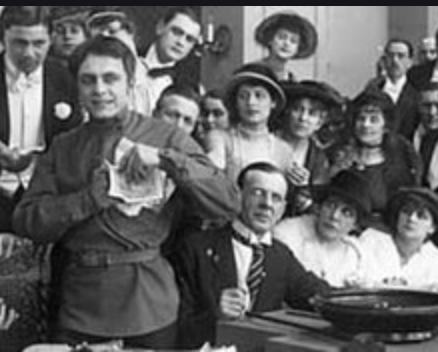
There are films that merely tell a story, and then there are those that immerse you in a world, a psychological landscape so vivid it feels etched into your very being. Henrik Galeen's 1921 masterpiece, Die rollende Kugel, undoubtedly belongs to the latter category. It is a silent symphony of despair, an unflinching gaze into the abyss of financial ruin and the corrosive effect it has on the human spirit. Drawing from the thematic wellsprings often associated with Fyodor Dostoevsky, whose name graces the writing credits alongside Galeen, this picture isn't just a historical artifact; it's a timeless meditation on the fragility of status, the illusion of control, and the relentless pursuit of dignity in the face of utter desolation.
From its opening frames, Die rollende Kugel establishes a mood of impending doom, a creeping dread that seeps into every meticulously crafted set piece and every expressive gesture. The narrative centers on The General, portrayed with a profound sense of world-weary gravitas by Ernst Hofmann. He is not merely a character but a symbol, a crumbling edifice of aristocratic pride and military honor, now besieged by the most ignominious of foes: insurmountable debt. His property, the very foundation of his family's lineage and social standing, has been mortgaged to the shrewd and seemingly indifferent Frenchman, Marquis de Grillet, a role that Georg H. Schnell imbues with a chilling blend of urbanity and predatory calculation. This isn't just about money; it's about the erosion of identity, the public humiliation of a man whose life has been defined by his position, now reduced to a pawn in another's game.
Hofmann's portrayal of The General is nothing short of masterful. He conveys a myriad of complex emotions without uttering a single word, relying solely on his posture, his eyes, and the subtle shifts in his facial expressions. We see the weight of his burdens in the slump of his shoulders, the desperate flicker of hope in his gaze when a temporary reprieve seems possible, and the crushing resignation when all avenues appear closed. It's a performance that speaks volumes about the silent suffering of a man trapped by circumstances of his own making, yet also a victim of a larger, unforgiving economic system. His pride, once a shield, now becomes a torment, preventing him from seeking genuine help, forcing him instead down paths of increasing desperation.
The film brilliantly captures the psychological landscape of a household teetering on the precipice. The General's debt isn't an isolated problem; it's a malignant force that infects every corner of his family's existence. The stifling atmosphere of impending ruin hangs heavy, palpable in the strained interactions, the unspoken anxieties, and the forced gaiety that only thinly veils a pervasive despair. Galeen, as director, excels at translating these internal states into visual metaphors. The grandeur of the General's home, once a bastion of security, now feels like a gilded cage, its opulent furnishings serving as a cruel reminder of what is being lost, piece by agonizing piece.
Marquis de Grillet, played by Georg H. Schnell, is not a mustache-twirling villain, but something far more insidious. He represents an external, almost impersonal force of capitalism, a man who sees property and people as mere assets and liabilities. His French nationality, in the context of post-WWI Germany, adds another layer of tension, hinting at broader societal anxieties about foreign influence and economic vulnerability. Schnell's performance is understated yet potent, his calm demeanor and calculating gaze making him a truly formidable antagonist. He embodies the cold, unyielding logic of finance, a stark contrast to The General's more emotional, honor-bound worldview. The dynamic between these two men forms the central conflict, a clash not just of personalities, but of entire worldviews.
The ripple effects of this central conflict extend to the other members of The General's household. Olga Limburg, Martha Angerstein-Licho, and Rudolf Biebrach, though given less screen time than Hofmann, each contribute significantly to the film's emotional tapestry. Limburg, perhaps as The General's wife or daughter, conveys the quiet strength and enduring pain of a woman watching her family crumble. Her performance speaks to the often-unseen burdens borne by women in such circumstances, forced to navigate social expectations while grappling with profound personal loss. Angerstein-Licho and Biebrach, in their respective roles, further illustrate the diverse ways individuals react to shared adversity – some with defiance, others with quiet desperation, and still others perhaps with a misguided sense of hope or denial.
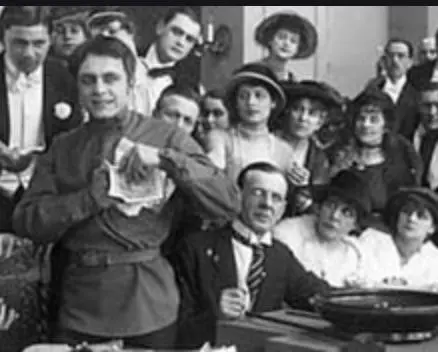
Henrik Galeen's directorial acumen is on full display throughout Die rollende Kugel. His command of visual storytelling, essential in the silent era, is exceptional. He uses stark contrasts of light and shadow, characteristic of German Expressionism, to heighten the drama and reflect the characters' inner turmoil. The framing of shots often emphasizes the isolation of characters, even when surrounded by others, underscoring their individual struggles. The pacing is deliberate, allowing moments of tension to build organically, drawing the audience into the characters' mounting anxiety. This isn't a film that relies on rapid-fire edits; instead, it trusts in the power of sustained gazes, symbolic gestures, and meticulously composed tableaux to convey its profound message.
The influence of Fyodor Dostoevsky, credited as a writer, is palpable, even if Galeen’s adaptation takes liberties or focuses on specific aspects. Dostoevsky was a master of psychological realism, exploring themes of moral decay, the corrupting influence of money, the torment of debt, and the desperate acts individuals commit under extreme pressure. While Die rollende Kugel doesn't explicitly delve into the philosophical or religious debates often found in Dostoevsky's novels, it certainly captures the suffocating atmosphere of financial entrapment and the erosion of human dignity that are hallmarks of his work. One can almost feel the echoes of characters from The Gambler or Crime and Punishment in the General's spiraling predicament, where every decision carries immense, often tragic, consequences.
The film resonates with a profound sense of human vulnerability. It speaks to the universal fear of losing everything, of having one's identity stripped away by forces beyond control. The General's struggle for true nobility, not just in title but in spirit, becomes the central tragic arc. How does one maintain honor when every material possession, every social standing, is being systematically dismantled? This question lingers long after the final fade to black.
In its depiction of a man caught in an inescapable bind, Die rollende Kugel finds thematic kinship with other silent era dramas. Consider, for instance, The Man Trap, which often explored characters ensnared by circumstances, whether criminal or social. The General's situation is a different kind of trap, one woven from financial obligations and societal expectations, yet no less constricting. The silent, almost visceral pain of his predicament also brings to mind films like Elnémult harangok (Silent Bells), where unspoken burdens and the quiet despair of a community or individual become the true protagonists. The silence of Die rollende Kugel is not an absence of sound, but a canvas for the amplification of internal anguish.
The film’s exploration of financial hardship and the desperate measures it engenders also draws parallels with more contemporary narratives, even if their stylistic approaches differ wildly. Think of the raw struggle depicted in The Italian, where an immigrant's efforts to provide for his family collide with harsh economic realities, leading to desperate choices. While one is a grand general and the other a humble bootblack, the underlying human struggle against an unforgiving system remains strikingly similar. The slow, dawning realization of the General’s family about their true peril, the gradual stripping away of illusions, echoes the painful awakenings seen in films like The Awakening of Helena Ritchie, where a character's comfortable world crumbles to reveal a harsher truth. These comparisons aren't about direct plot similarities, but about shared thematic DNA, about the universal human response to crisis and the shattering of comfortable realities.
Ultimately, Die rollende Kugel is a masterclass in atmospheric filmmaking and profound character study. It delves into the human cost of debt, the crushing weight of societal expectations, and the agonizing process of watching one's world collapse. Ernst Hofmann's General is a figure of tragic grandeur, a man who carries the weight of his entire lineage on his slumped shoulders. Galeen’s direction ensures that this silent drama speaks volumes, its visual poetry conveying a narrative of loss and desperate survival that remains profoundly moving a century later. It's a testament to the power of early cinema to explore complex human emotions with an artistry that transcends the spoken word, leaving an indelible mark on the viewer's consciousness.

IMDb 6.5
1919
Community
Log in to comment.