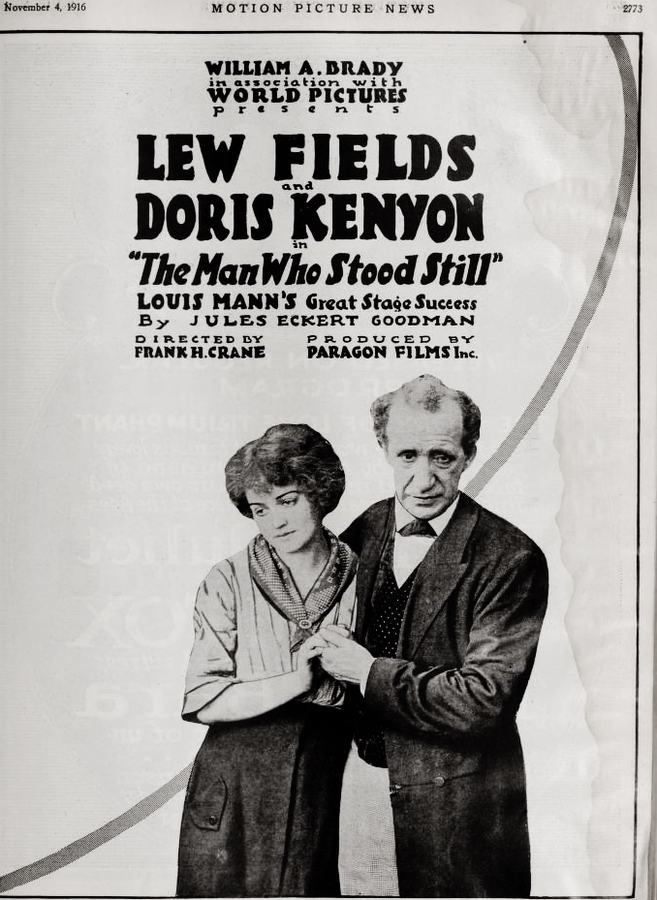
In the annals of early cinema, where moral parables often held sway and human drama unfolded with an almost theatrical earnestness, 'The Man Who Stood Still' emerges as a particularly poignant artifact. It's a narrative that, despite its seemingly straightforward plot, delves into the intricate tapestry of family loyalty, the perilous allure of superficial charm, and the relentless march of time against the backdrop of an unchanging heart. This film, a testament to the storytelling sensibilities of its era, offers not just a glimpse into a bygone world, but a universal exploration of human fallibility and the enduring quest for redemption.
Our protagonist, Kraus, is a figure of profound, almost tragic, innocence. His small jewelry shop on the east side of New York, described as 'typical of that locality thirty years ago,' is more than just a place of commerce; it's a sanctuary from the accelerating pace of modernity. While his competitors adapt, innovate, and expand, Kraus remains rooted, a living embodiment of the film's title. His 'kindly old soul' prioritizes the warmth of his domestic sphere – the immaculate rooms overseen by Katie, his motherly housekeeper, and the tender upbringing of his daughter, Marie – over the ruthless exigencies of business. This deliberate choice, while painting him as a man of admirable character, simultaneously casts him as an anachronism, a gentle soul destined to be buffeted by forces he neither comprehends nor anticipates. His very goodness becomes a vulnerability, a blind spot in a world increasingly governed by ambition and expediency.
The narrative deftly establishes the foundational hopes of Kraus and his kindred spirit, Spiegel. These two old Germans, bound by decades of friendship and shared values, meticulously orchestrate a future for their children, Marie and Fred. Their pinochle games, ostensibly social gatherings, are in fact carefully constructed pretexts, designed to foster a romantic connection between the young pair. It’s a classic parental aspiration, a desire to cement legacies and ensure happiness through tradition and familiarity. Fred, indeed, approaches Marie with a sincerity that is both palpable and endearing, representing the steady, reliable affection that forms the bedrock of a stable future. However, the film immediately introduces a crucial element of dramatic irony: the elders, in their well-meaning blindness, fail to perceive that Marie’s heart has already strayed, captured by a far more volatile, yet undeniably captivating, force.
Marie’s burgeoning affections are directed towards Frank MacPherson, a 'worthless young "sport"' and, crucially, the son of Kraus's 'keenest competitor.' This detail is not incidental; it injects a potent layer of class conflict and business rivalry into the personal drama. Frank represents everything Kraus is not: modern, flashy, perhaps even morally ambiguous, but undeniably appealing to a young woman yearning for excitement beyond the confines of her father’s quaint world. Her choice is a rebellion, a declaration of independence from the pre-ordained path, and a poignant illustration of youthful infatuation’s power to eclipse prudence. The film masterfully sets up this clash between generations, between tradition and modernity, and between genuine affection and superficial allure.
The turning point, the dramatic fulcrum upon which the entire narrative pivots, arrives with Marie’s eighteenth birthday. In a gesture of pure paternal devotion, Kraus closes his shop, embarking on a joyous picnic to the Jersey shore with Marie, Katie, and the Spiegels. This idyllic scene, brimming with the simple pleasures of family togetherness, is brutally interrupted by Frank’s arrival. His clandestine summons of Marie from the midst of her family’s gaiety is a symbolic act of severance, pulling her away from her roots and into his deceptive orbit. The ensuing confession from Marie, revealing her 'delicate condition,' is met not with compassion, but with Frank's callous dismissal of it as 'rotten luck.' This moment is a stark revelation of his true character, stripping away the veneer of charm to expose a craven, self-serving core. His subsequent orchestration of a mock marriage is an act of profound cruelty, a calculated manipulation that seals Marie’s tragic fate and sets her on a path of immense suffering.
The note Marie dispatches to her father, delivered by a young boy back to the picnic, is a narrative device of shattering impact. It transforms a day of celebration into one of abject sorrow, plunging Kraus into a grief so profound it becomes almost a physical entity. The film then meticulously charts the parallel descents of father and daughter. Kraus, consumed by his loss, neglects his business entirely, allowing poverty and want to stalk his once-secure existence. The once-proud jeweler is reduced to accepting a position in the store of a former salesman, a devastating blow to his dignity, and forced to seek shelter with the benevolent Spiegels. This trajectory is a powerful commentary on the fragility of economic stability and the devastating ripple effects of personal tragedy on one’s material circumstances.
Simultaneously, Marie’s journey mirrors her father’s decline, albeit in a far more brutal fashion. Abandoned by Frank with their baby, she is dispossessed from her squalid room, cast out into an unforgiving world. Her aimless wandering, a metaphor for her lost direction and shattered innocence, leads to a fortuitous, almost divinely orchestrated, encounter with Fred. It is a moment of narrative grace, offering a glimmer of hope amidst the bleakness. Fred, ever the steadfast and honorable suitor, persuades her to return with him, where his sister Alice provides much-needed comfort and sanctuary. This reunion with Fred, the man her father had originally chosen for her, subtly hints at the redemptive power of true, unwavering affection, contrasting sharply with Frank’s fleeting and destructive passion.
The film’s resolution, orchestrated by the shrewd and compassionate Spiegels, is a testament to the enduring power of family and community. Their 'shrewd means' to bring father and daughter back together speak to a wisdom born of experience and a deep understanding of human nature. The reconciliation is further facilitated by an unexpected ally: MacPherson, Frank’s own father, who, having turned against his son, becomes the instrument of Frank’s reckoning. This plot point is particularly satisfying, demonstrating that even those who embody competitive spirit can possess a moral compass, and that justice, however belated, often finds a way. The final scene, with Kraus cradling his grandchild, is a powerful visual metaphor for healing and renewal. His anger melts away in the face of this innocent life, and the 'glances he detects between Fred and Marie' signal the potential for his 'fondest hopes' to finally be realized. It is a conclusion that, while perhaps somewhat idealized, offers a deeply satisfying emotional catharsis, affirming the triumph of love, loyalty, and forgiveness over betrayal and hardship.
The thematic richness of
'The Man Who Stood Still' resonates deeply. It's a profound exploration of parental expectation versus individual autonomy. Kraus's static nature isn't just about his business; it's about his inability to adapt to his daughter's independent spirit, a common struggle across generations. Marie's initial rebellion, fueled by a desire for excitement and perhaps a misguided sense of romantic liberation, ultimately leads to profound suffering. This narrative arc mirrors the cautionary tales prevalent in many melodramas of the era, where female agency, when exercised outside societal norms, often resulted in dire consequences. Films like
The Sacrifice of Pauline or
A Woman's Triumph often explored similar themes of women making difficult choices and facing societal ostracism or personal ruin, only to find redemption through hardship.
The film also provides a subtle but potent commentary on economic vulnerability. Kraus's decline, from a respected shop owner to an employee of his former salesman, is not merely a plot device; it underscores the precariousness of life in an era without robust social safety nets. His personal tragedy directly precipitates his financial ruin, illustrating how intertwined personal and economic fortunes could be. This aspect finds echoes in other films of social realism from the period, which frequently depicted the harsh realities of poverty and class disparity. The contrast between Kraus’s old-world values and MacPherson Sr.’s competitive drive also speaks to the changing face of American business at the turn of the century, where the gentle artisan was increasingly supplanted by the aggressive entrepreneur.
From a character study perspective, the portrayals are archetypal yet effective. Kraus, as the titular 'man who stood still,' is a figure of endearing stubbornness and profound paternal love. His journey from blissful ignorance to heart-wrenching despair, and finally to a gentle acceptance, forms the emotional backbone of the film. Marie's transformation from naive romantic to hardened survivor and then to a woman capable of renewed hope is compelling. Fred, often overshadowed, emerges as the quiet hero, representing unwavering loyalty and true love – a stark contrast to Frank’s fleeting, destructive passion. Frank, while a clear antagonist, serves a crucial narrative function in exposing the dangers of unchecked desire and moral bankruptcy. His eventual comeuppance, instigated by his own father, avoids a simplistic villain-gets-punished trope, instead suggesting a more complex, intergenerational reckoning.
The film's pacing, typical of early dramatic works, allows for a deliberate unfolding of events, building emotional tension through character reactions and unfolding consequences rather than rapid-fire plot twists. The narrative relies heavily on dramatic irony, allowing the audience to witness Marie’s fateful choices with a sense of impending doom, while the innocent Kraus remains oblivious. This technique amplifies the emotional impact of his eventual discovery and subsequent suffering. The visual language, even without the benefit of sound, would have conveyed much through the actors' expressions and body language, emphasizing the stark contrasts between joy and sorrow, innocence and deceit.
In its essence, 'The Man Who Stood Still' is a powerful morality play, but one imbued with genuine human feeling. It explores the painful lessons learned through experience, the redemptive power of forgiveness, and the enduring strength of familial bonds. The final image of Kraus, holding his grandchild, observing the tender glances between Marie and Fred, suggests a cyclical narrative of hope renewed. It’s a testament to the idea that even after immense suffering and profound loss, life finds a way to mend, and love, in its truest form, can triumph over adversity. It reminds us that while some may stand still, life, with all its joys and sorrows, continues its relentless forward march, always offering the possibility of a new beginning. The film's message, that true happiness lies not in fleeting passions or material wealth, but in the steadfastness of family and genuine affection, remains as relevant today as it was in the bustling, rapidly changing world of a century ago. It’s a quiet triumph, a poignant reminder of cinema’s capacity to reflect the timeless struggles and triumphs of the human spirit.