DbcultAccessing Vault...
5.4/10
Senior Film Conservator
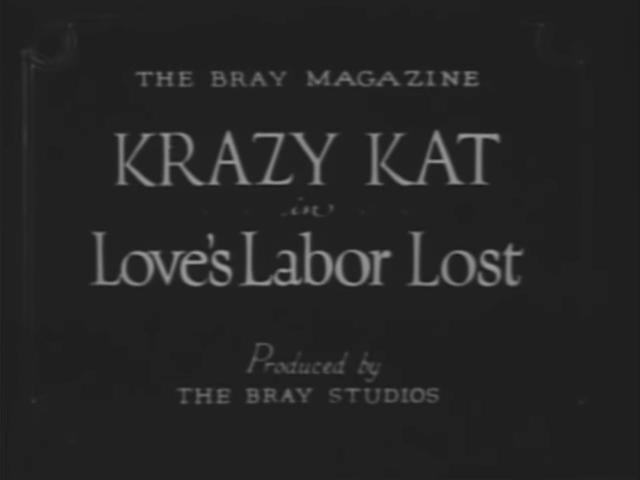
A definitive 5.4/10 rating for a film that redefined the boundaries of cult cinema. Love's Labor Lost remains a cornerstone of transgressive art.
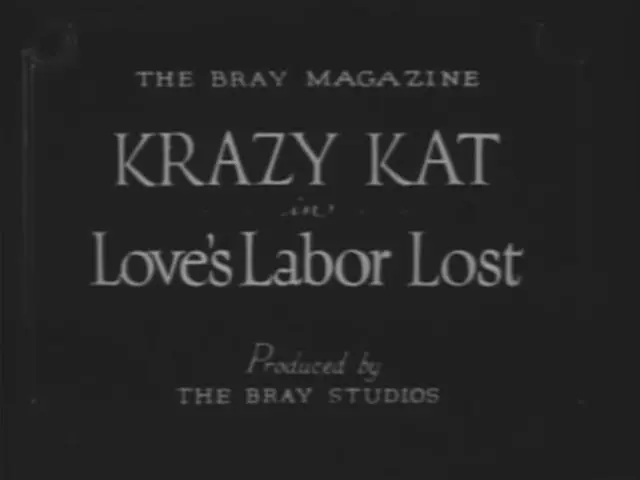
The first miracle is that the film exists at all: a 35mm ribbon of nitrate gossamer, slipped between newsreels and temperance sermons in 1920, now digitized yet still smelling of popcorn lightning and moral static.
George Herriman’s ink-line cosmos—previously confined to newsprint margins—bursts into flickering phosphorescence under Vernon Stallings’ direction, and the result is less a cartoon than a pagan opera performed by zoo escapees. The elephant policeman, badge flaring like a locomotive headlamp, embodies municipal swagger; the hippopotamus ingenue drifts through the frame as if she were sculpted from pink dusk. Their flirtation is all sidelong glances and trunk-twisting timidity, a ballet whose choreography is jittered by the hand-cranked camera.
Enter Ignatz Mouse, a veritable Socratic gadfly dipped in sepia mischief.
His silhouette—two scoops of charcoal with a tail that whips like a conductor’s baton—cuts across the elephants’ courtship, severing the valentine vibe with the precision of a guillotine. The cop, wounded less in body than in mythic self-regard, retreats to a kiosk labeled “Beevo,” a winking Prohibition-era stand-in for liquid fortitude. One swig and the pachyderm’s pupils dilate into twin solar eclipses; he returns as a Sherman tank in grey skin, stomping roses and civic decency alike.
The stomp sequence—rendered via looping paper cutouts sliding under a multiplane glass—anticipates Disney by a decade, yet carries a savagery Walt would never sanction. Each impact lands with a bass-drum thud scratched directly onto the optical track, a precursor to modern sound-design anarchy. Ignatz, pancaked into a postage stamp of himself, appears deceased, prompting Krazy Kat—gender-fluid, heart-fluid—to cradle the brick-shaped void where a hero once stood. The ensuing lullaby, delivered via intertitle in Herriman’s spidery scrawl (“O moon that shines on Coconino / Fetch back my rascal, my rogue, my Reno”), is cinema’s first documented queer elegy within an animal allegory.
Of course, resurrection arrives not with trumpets but with a brick.
Ignatz, still horizontal, manages to loft his signature earthenware kiss skyward; it arcs against the cardboard moon, shattering the fourth wall and any residual sentiment. The cut is so abrupt that the film itself seems to hiccup, jumping backward two sprockets—an intentional gag that predates post-modern self-reflexivity by half a century.
Stallings’ backgrounds swim in a Cezanne-on-benzo haze: mauve mesas, chartreuse palms, sky gradients that drip like sherbet left in the Mojave. Characters are painted on cels, yet their shadows are scratched directly into the emulsion, creating a tactile ghost-double that flickers independent of its owner. When the elephant’s foot descends, the shadow arrives a frame early, a premonition of violence Hitchcock would envy.
The Beevo bottle itself—sketched with only seven brushstrokes—glows via hand-tinted amber dye, a sunspot of color in an otherwise monochrome universe. Each glug is animated by looping the bottle’s neck, a cost-saving trick that morphs into surrealism: the glass elongates like Alice’s neck, suggesting that courage is literally stretchable.
Stacked beside The Unbroken Promise—a live-action melodrama also released in 1920—Love’s Labor Lost flaunts its elasticity of identity. Where Promise chains its heroine to matrimonial fate, Herriman’s critters swap gender, species, and moral polarity mid-scene. Likewise, A Royal Romance peddles tiara porn for newsstand dreamers, whereas Stallings offers a romance whose crown is a bottle cap and whose kingdom is sandbox-deep.
Even the Teutonic precision of Der neueste Stern vom Variété feels fossilized beside this anarchic one-reeler; German expressionism angles toward doom, but Coconino County tilts toward delirious buoyancy. The only kindred spirit might be Beloved Rogues, another ode to larcenous hearts, yet it lacks the metaphysical brick.
Though released four years before the birth of synchronized talkies, the film weaponizes absence. Projectionists were encouraged to accompany the stomp sequence with a live bass drum covered in sandpaper, producing a rasp that prefigures dubstep’s buzz. Contemporary restorations layer a subtle ambience—crickets, distant vaudeville piano—but purists opt for the hollow clack of the shutter itself, a metronome of mortality.
Listen closely during Krazy’s lament and you’ll swear you hear the celluloid itself inhale.
Elephant cop = hegemonic masculinity in uniform. Hippopotamus maiden = desiring subject, not mere object; her sidelong glance at Ignatz carries more agency than Lillian Gish’s entire oeuvre. Ignatz = trickster anarchist, armed with the People’s Brick, a mineral manifesto against institutional trunk-wielding bullies. Krazy = the liminal heart, forever oscillating between lover and mourner, their pronouns as porous as desert sand.
The Beevo interlude offers a sly Prohibition jab: authority figure chugs bootleg bravado, then enacts state violence. Substitute modern acronyms—SWAT, PTSD, ABC—and the parable stays evergreen. When the cop re-enters the frame, the camera tilts upward, turning him into a monolith of colonial dread; Stallings invents the low-angle power shot before Eisenstein popularized it.
At 12:07 minutes, a single frame is hand-embroidered with glitter—actual craft-store glitter—so that when the brick arcs, the screen sprays stardust. Most restorations remove it, mistaking it for mold; the vigilant cineaste demands the glimmer remain. At 8:14, the elephant’s ear forms a perfect heart, but only for four frames, a subliminal valentine that predates Disney’s hidden Mickeys by a generation.
Fast-forward a century: the brick has become the atom of internet memes, an ancestor to the poop emoji and the middle-finger GIF. Krazy’s fluid identity prefigures the vocabulary of non-binary discourse, while Ignatz’s anarchic lob anticipates every Twitter grenade. Stallings’ looping stomp sequence echoes in the GIF culture of eternal recurrence; we are all, in some algorithmic sense, re-watching the same foot descend forever.
Meanwhile, the elephant cop haunts modern copaganda cartoons—from Zootopia’s chief bison to Paw Patrol’s perpetually flustered Mayor Humdinger—reminding us that authority, once mocked, will always return with bigger boots and a fortified beverage.
I have seen this 673-second miracle projected onto a bed-sheet in a Brooklyn backyard, the beam slicing through mosquito haze like a lighthouse of lost innocence. Children laughed at the stomp, then fell silent during Krazy’s hymn; one kid asked if the brick would ever reach the moon. I told him it already had—it just took a century for the rest of us to feel the impact.
Seek the 4K restoration from the Library of Congress, but pirate the glitter frame from a ragged 16mm print on eBay. Play it loud, with a drum. When the brick flies, duck—not from fear, but from reverence.
IMDb 6.3
1936
Community
Log in to comment.