DbcultAccessing Vault...
Cult Review
Senior Film Conservator
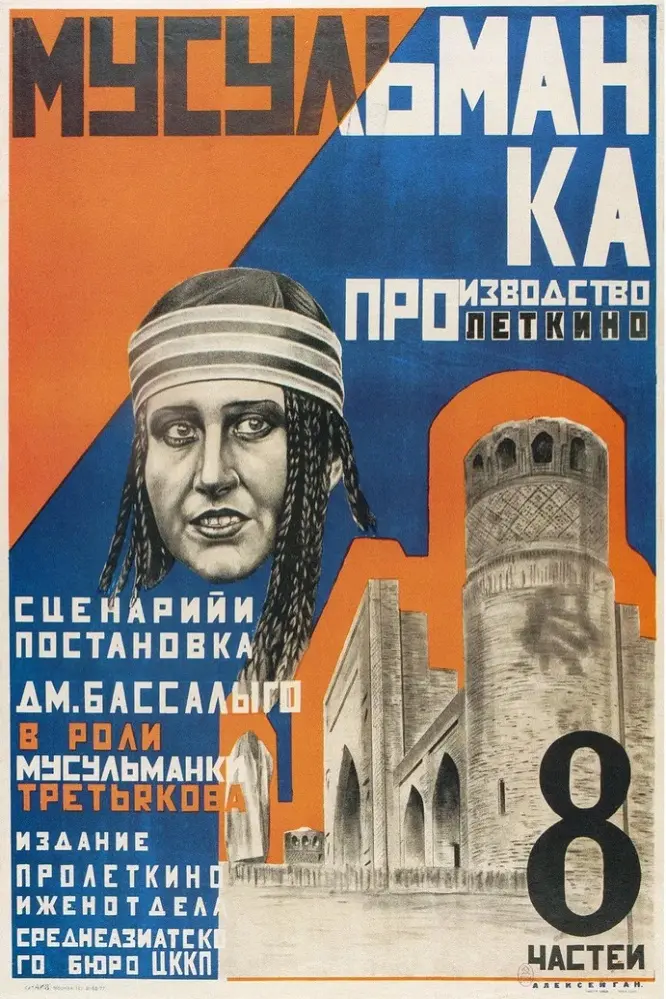
The cinematic history of the 1920s is often viewed through the lens of the avant-garde experiments in Moscow or the burgeoning glamour of Hollywood, yet some of the most socially transformative works emerged from the periphery of the Soviet empire. Musulmanka (The Muslim Woman), directed by the prolific yet under-discussed Dmitri Bassalygo, stands as a haunting phantom in this landscape—a film that exists now only in the testimonials of historians and the surviving stills of its production.
In the mid-1920s, the Soviet project in Central Asia was not merely an administrative takeover but a psychological and sociological crusade. The 'Hujum'—the campaign to unveil women and dismantle the traditional family structures—found its most potent weapon in the moving image. Musulmanka was a direct product of this zeitgeist. Unlike the more abstract explorations of class found in A Tüz, Bassalygo’s work was grounded in a gritty, localized realism that sought to expose the 'barbarism' of the old world. The film doesn't just depict a girl in trouble; it maps the cartography of a revolution happening within the female psyche.
The casting of Olga Tretyakova and Sayat Alieva suggests a deliberate attempt to blend established dramatic talent with local authenticity. While many Western films of the era, such as Bella Donna, utilized exoticism for mere aesthetic thrill, Musulmanka leveraged its setting to provoke a visceral discomfort. The central conflict—the sale of Sagadat to Ahmet-bay—is presented not as a romantic tragedy, but as a transaction of human capital. It mirrors the domestic entrapment seen in Humility, yet elevates the stakes by tethering the protagonist's fate to the birth of a new nation.
The most striking narrative beat remains the father’s decision to lock Sagadat in a closet. In the visual language of the 1920s, space was everything. While The Man Worthwhile might use expansive landscapes to denote moral freedom, Musulmanka utilizes the claustrophobia of the home. This 'closet' is not merely a room; it is the physical manifestation of the Sharia-based domesticity the Soviets sought to annihilate. The darkness within that space represents the 'backwardness' of the past, making her eventual escape with Umar feel less like a romantic flight and more like a jailbreak from history itself.
Critical Note: The absence of the actual film reels is a profound loss for ethnographic cinema. We are forced to reconstruct the visual rhythm of the film through Bassalygo’s other works, which often featured a stark, high-contrast lighting style that would have made the Central Asian sun feel both illuminating and oppressive.
The character of Umar, portrayed by Aleksandr Polyakov, represents the idealized Soviet man—supportive, enlightened, and secondary to the woman's own awakening. This inversion of the 'damsel in distress' trope is vital. In many contemporary American films, like The Ne'er-Do-Well, the male hero is the sun around which the plot orbits. In Musulmanka, Umar is the key that turns the lock, but Sagadat is the one who must walk through the door. Their relationship is framed through the lens of comradeship rather than the stifling 'distilled love' of bourgeois melodrama found in Distilled Love.
The film’s conclusion, featuring Sagadat’s departure for Moscow, serves as the ultimate ideological payoff. Moscow, in the 1920s Soviet cinema, was often depicted as a celestial city of steel and glass, a stark contrast to the mud-brick reality of the provinces. By choosing education over marriage, Sagadat achieves a form of immortality that transcends the biological destiny her father intended for her. This ending echoes the transformative journeys found in Man and His Soul, yet it carries a much heavier political weight. She is not just saving her soul; she is reclaiming her intellect from centuries of erasure.
Comparing this to Forbidden Paths, we see a divergence in how 'taboo' subjects are handled. Where Western cinema often punished the transgressive woman, Soviet cinema of this era celebrated her, provided her transgression was directed against the 'old ways.' Sagadat is a pioneer of what we might call 'state-sponsored rebellion.'
Though we cannot analyze the montage of Musulmanka, the involvement of writers like Dmitri Bassalygo suggests a narrative structure that was likely lean and propulsive. The film was produced during a period of intense experimentation with 'Kino-Eye' and the Kuleshov effect. One can imagine the cross-cutting between Sagadat’s tearful face in the dark closet and the vibrant, chaotic energy of a local Soviet meeting. This juxtaposition would have been far more effective than the theatrical staging of Pyotr Velikiy or the static beauty of Inspiration.
The cast, including Nikolay Belyaev and Vsevolod Massino, were stalwarts of an era that demanded a specific type of performance—one that was expressive enough for the silent screen but grounded enough to feel like 'Agit-Prop.' The film’s failure to survive into the modern era is a tragedy of nitrate decay and historical upheaval. It leaves a void in the history of Central Asian representation, much like the missing pieces of a puzzle that would explain the rapid social shifts of the 1930s.
Musulmanka is a reminder that cinema has always been a battleground. It wasn't just entertainment; it was a blueprint for a new way of being. While films like Bride of Vengeance or Alias Ladyfingers played with genre tropes of crime and romance, Bassalygo was playing with the very fabric of social reality. Sagadat’s journey from the closet to the classroom is the quintessential Soviet myth, a secular hagiography that still resonates in the way we discuss liberation today.
Even as a lost work, its influence can be felt in the subsequent 'Easterns' of the 1960s and 70s. It established the template for the 'liberated woman of the East,' a trope that would be revisited and refined for decades. To study Musulmanka is to study the power of the image to break chains—even if those images have long since turned to dust. It remains a vital chapter in the history of the gaze, the veil, and the screen.
IMDb 5.3
1923
Community
Log in to comment.