DbcultAccessing Vault...
5.8/10
Senior Film Conservator
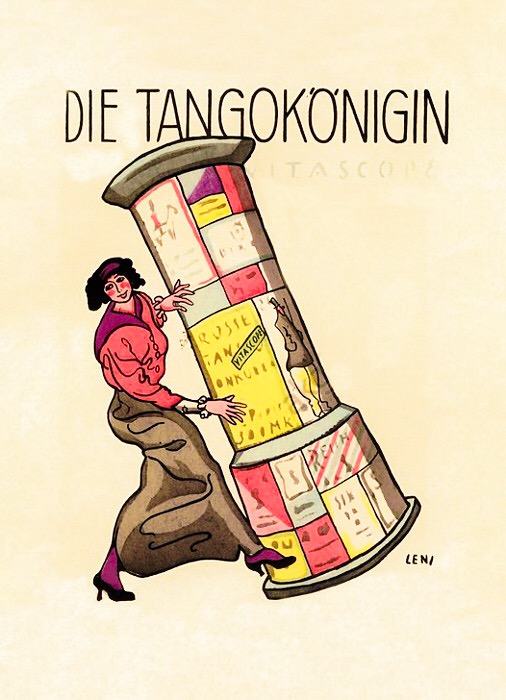
A definitive 5.8/10 rating for a film that redefined the boundaries of cult cinema. Die Tangokönigin remains a cornerstone of transgressive art.
Gaslight flickers, violins scrape, and a woman’s hip disobeys the laws of physics—welcome to Die Tangokönigin, the 1913 German one-reeler that punches so far above its weight it leaves bruises on the moon. Clocking in at a brisk fourteen minutes, this celluloid cigarette burn feels like stumbling into a fin-de-siècle fever dream where every frame has been marinated in absinthe and lit with phosphorus.
There is no hand-holding intertitle babbling “Our story begins…”—the film drops you mid-cigarillo exhale inside a cabaret where chandeliers drip like iced entrails. Weisse, credited only as “Die Tänzerin,” slinks onstage in a dress stitched from midnight and obsidian bugle beads. Her tango is not the polite ballroom shuffle your great-aunt learned in 1986; it is a predatory negotiation, each staccato step a threat, each backward lean a question: how much of your soul are you willing to mortgage for one more glance?
Halfway through the first dance a white rose lands at her feet, its petals dipped in carmine. Attached is a calling card bearing the wax seal of Prince Erich von H—, heir to a duchy so bankrupt it trades in rumors rather than rent. From here the narrative fractures into shards: a clandestine rendezvous inside a hothouse where orchids grow like tumors; a midnight carriage ride that turns into a kidnapping; an anarchist pamphlet folded into her satin garter; a child—possibly hers, possibly the prince’s bastard—who materializes in doorways only when the film’s sprocket holes hiccup. The director, anonymous in surviving records, lets these fragments collide rather than cohere, trusting the viewer to stitch meaning from after-images.
Shot entirely inside a Berlin studio that smells of wet copper and horse glue, Die Tangokönigin nevertheless stages continental exotica through sheer chutzpah. Backdrops are painted in Expressionist angles—walls tilt like guilty verdicts, shadows elongate until they strangle the set. The camera, deprived of lateral tracking, becomes a voyeuristic contortionist: it peers through balustrades, snakes under furniture, even mounts a trapeze for the climactic danse macabre. Tinting alternates between toxic amber and cyanotic blue, so that skin tones oscillate between jaundice and hypothermia. The effect is less “color” than emotional weather.
Compare this to the pastoral postcard hues of Glacier National Park or the biblical monochrome sobriety of From the Manger to the Cross, both released the same year. Where those films embalm reality, Die Tangokönigin sets reality on fire and warms its hands over the blaze.
Weisse, usually relegated to decorative ingénues in German military farces, here detonates her screen persona. She refuses to “act” seduction; she interrogates it. Watch her eyes in the medium-close shot where the prince confesses love: the pupils dilate not with tenderness but with compound interest. Her mouth forms the ghost of a smile, then retreats, as though the idea of joy were an obsolete currency. She is both Circe and reluctant Penelope, weaving her tapestry each night only to unravel it by dawn.
Silent-film acting often ages into mime-on-melodrama; Weisse’s performance feels eerily contemporary. The micro-gestures—the way her knuckles whiten around a champagne flute, the fractional hesitation before she stamps out a cigarette—presage the granular naturalism we associate with Dreyer’s Passion of Joan or Falconetti’s tremulous saint. In a just timeline, Weisse would have stormed into 1920s Expressionist horror; instead she vanished into provincial theater, making this surviving print a single amber-trapped mosquito of what might have been.
No musical cue sheets survive, so each modern screening becomes a séance where accompanists gamble their souls. I first saw it at the Bonn Silent Days festival with a klezmer trio who mistook it for bittersweet schmaltz; the tango became a hesitant waltz, defanging the film. A year later in Buenos Aires a lone bandoneón player leaned into dissonance, letting reeds squeal like rusted gates—suddenly the images bled, the audience held its collective breath as though fearing tuberculosis. The takeaway: Die Tangokönigin is a parasite; it appropriates the host music and mutates accordingly.
Beneath the ostrich-feather sensuality lies a scalding critique of Wilhelmine gender economics. The prince’s court is a showroom of interchangeable debutantes priced by lineage; our dancer, merchandise without pedigree, inflates her value through manufactured scarcity. She weaponizes the male gaze, turns it into a currency, then bankrupts the treasury. When the prince offers marriage, she counters with a demand for sovereign rights over her future children—an astonishment in 1913, when Imperial law still coded wives as legal minors. The film never lectures; it simply lets the patriarchs sputter like broken cuckoo clocks.
Compare this proto-feminist sting to the sacrificial motherhood of Les Misérables or the saintly endurance of The Life of the Jews of Palestine. Those narratives reward female suffering with heavenly redemption; Die Tangokönigin proposes that suffering is deductible only if itemized on your own ledger.
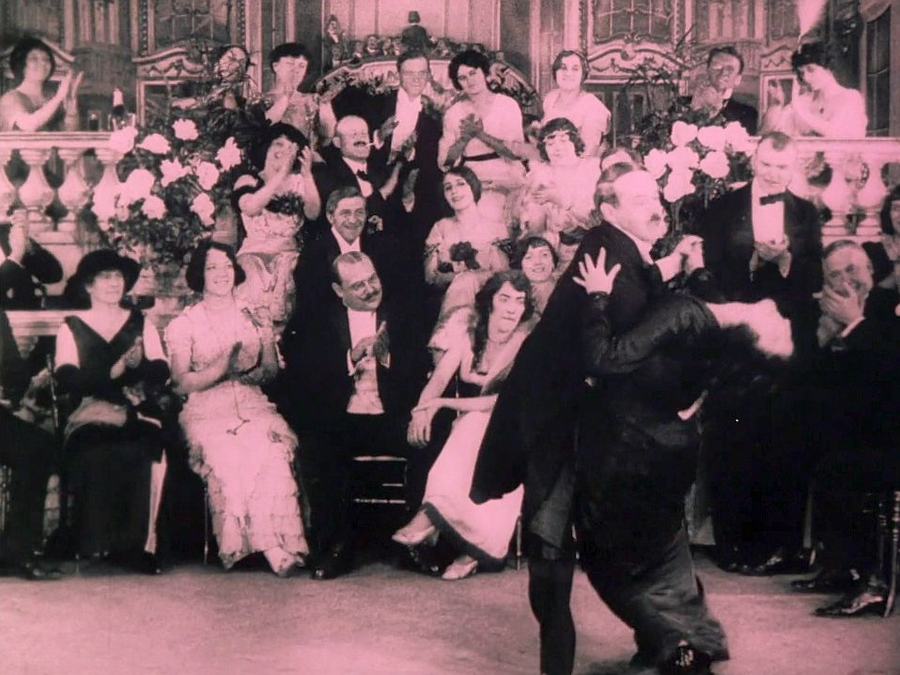
Most silents of the era bow to moral bookkeeping: the harlot must perish, the virgin must wed. Here the final shot is a literal aperture of ambiguity. The chandelier crashes; the screen floods white—overexposure so severe it feels like a nuclear baptism. When the light recedes we see the dancer’s silhouette still whirling amid debris, but the film itself is flammable nitrate catching fire, the image devouring itself. Is she dead? Transcendent? The question hangs like a guillotine blade that never drops.
This self-immolation anticipates the ontological pranks of later avant-garde cinema—think Persona’s ruptured reel or Inland Empire’s digital melt. Yet it arises here not from postmodern cleverness but from fiscal desperation: the production ran out of print stock, slapped together an ending that literalizes the medium’s ephemerality. Art born of poverty often hums louder than art born of grant money.
The only extant copy was salvaged from a bombed-out Frankfurt basement in 1946, fused into a single charcoal briquette. Restorers at Bundesarchiv bathed the roll in a cocktail of glycerin and ethanol, teasing apart frames with dental tools. Roughly 8% of the runtime remains conjectural; missing scenes are represented by still production photos overlaid with scrolling text in period typeface. Rather than dampen immersion, these lacunae amplify the film’s ghostliness—like kissing a lover through gauze.
Digital scans reveal previously invisible details: the child accordionist wears a jacket fastened with safety pins shaped like tiny skulls; the prince’s signet ring bears a crest of Medusa clutching her own severed head. In 4K you can almost taste the copper of stage blood, the salt of dancer sweat crystallizing into miniature chandeliers.
Fast-forward a decade and you can spot Die Tangokönigin’s genetic material pirouetting through cinema history. Pabst’s Pandora’s Box lifts the cabaret-as-shark-tank mise-en-scene; von Sternberg’s Blue Angel borrows the humiliation of male authority via lingerie-clad mockery. Even Hitchcock’s Vertigo recycles the notion of erotic obsession as architectural free-fall—San Francisco’s bell tower is just this film’s collapsing proscenium stretched skyward.
Yet no successor dares the same nihilistic grace note. Hollywood’s Production Code would neuter the ending into rehabilitative marriage or punitive death. Only in the prelapsarian teens of German film could a heroine pirouette into self-annihilation and call it happy ever after.
As of this month the restored 2K DCP is touring arthouse venues under the banner “Weimar Before Weimar.” If it lands within hitchhiking distance, sell plasma for a ticket. Demand a live bandoneón or, failing that, a minimal prepared-piano setup—no syrupy string quartet, please. Refuse any screening that dares to run it at unsound 24fps; the original was hand-cranked at closer to 20, and that languor is the difference between seduction and assault.
For home viewing, the Bundesarchiv Blu-ray offers both German and newly translated English intertitles, plus a 40-page booklet dense enough to choke a scholar. Be warned: once you’ve squinted at the HD still of Weisse’s dilated pupil filling the entire 16:9 frame, domestic dramas in pastel palettes will taste like oatmeal gone cold.
Great art often arrives disguised as trash, then moults into prophecy. Die Tangokönigin is a cigarette burn in the silk glove of cinema history: small, lethal, impossible to unpick without leaving a scar. It argues, subliminally, that to survive as a woman in a market that commodifies skin you must become arsonist and phoenix in one—ignite yourself, rise from the embers, and never, ever apologize for the smoke that gets in their eyes.
That the film itself nearly perished in real flames is a perverse confirmation of its own thesis. Art that threatens the ledger seldom gets retirement funds. But here we are, a century later, still inhaling its phantom smoke, still tapping our toes to a tango whose rhythm is the heartbeat of a woman who would rather obliterate the dance floor than be led. In that refusal echoes the secret anthem of every artist who ever dared to swivel a hip at the gatekeepers of the world: watch me vanish, and try—just try—to forget the shape I left scorched onto your retina.
IMDb —
1927
Community
Log in to comment.