DbcultAccessing Vault...
6.5/10
Senior Film Conservator

A definitive 6.5/10 rating for a film that redefined the boundaries of cult cinema. Die Teufelsanbeter remains a cornerstone of transgressive art.
A reel unfurls like singed parchment: Die Teufelsanbeter is less a story than a contagion—German Expressionism’s spores colonizing the lungs of every viewer naive enough to inhale. Forget the tidy triptych of act-structure; here narrative is a skewed triptych of hysteria, heresy, and hallucination, bolted together with iron nails pried from a burnt cathedral. Meinhart Maur’s Count Orrik—note the k, a linguistic stutter suggesting both oracle and erratic—haunts the frame with cheekbones sharp enough to slice the nitrate itself; he embodies the twilight aristocracy, bankrupt of soul yet over-leveraged in damnation futures.
Gustav Kirchberg’s monk, a cassock-clad Jeremiah, drags a reliquary stuffed not with saints’ bones but with scrawled manifestos indicting heaven for criminal negligence. His eyes—one milky, one burning—recall the bifurcated cosmos of Sturm, yet where that film’s tempest was meteorological, here the storm is entirely soteriological. Each time Kirchberg mutters "Gott ist tot" the intertitle flickers like a dying candle, as though even the typography fears excommunication.
Fred Immler’s mercenary, stinking of gunpowder and tavern wax, provides the film’s sole anchor to corporeal reality—until he bargains his shadow for a wineskin of infernal schnapps and promptly dissolves into silhouette. The effect, achieved through double-exposure and hand-scratched mattes, predates the phantom coachmen of Souls on the Road by three years, proving that poverty of budget can mother opulence of imagination.
Carl de Vogt’s consumptive painter deserves cine-posterity for the scene in which he frescoes a chapel vault with demonic grotesques while arterial blood drips from his lips onto the pigments—crimson turning crimson—an auto-sacramental palette that makes the rose-tinted romance of The Belle of New York look like a child’s watercolor smear. Watch how director Marie Luise Droop isolates his palette in monochrome: the reds register as luminous charcoal, proving that color can be synesthetic even in black-and-white.
Ilja Dubrowski’s violin performance—shot almost entirely on a derelict rope bridge strung above a fog-choked gorge—serves as the film’s nervous system. The score, reconstructed in 2019 from a fire-blotted piano suite, is a twelve-tone migraine that anticipates Schoenberg’s Variations by months. Each pizzicato feels like a vertebra snapping; each legato like arterial plaque sluicing through a dying archduke.

And then there’s Bela Lugosi—billed sixth, yet magnetizing every photon. His Satan lounges on a basalt throne upholstered in human scalps, delivering epigrams that slither between beatitude and bile. When he rasps "Die Hölle ist nur ein Spiegel, in dem das Paradies seinen Schatten erblickt" the subtitle card seems to perspire. Compare his languid menace to the dime-store villainy of The Brand; here evil is not a deed but a décor, a velvet-lined exile where sinners queue to pay admission.
Cinematographer Tronier Funder lenses Carpathian hamlets as if they were carved from onyx and regret. Rooftops tilt at neurotic angles; chimneys exhale not smoke but confession. The camera crawls through catacombs like a penitent worm, occasionally arresting itself for tableaux that evoke vanitas still-lifes: a cracked hourglass oozing mercury, a child’s skull stuffed with withered hawthorn, a Latin Bible hollowed out to nestle a straight-razor. These images detonate in the mind long after the film’s infamous mirror climax, where the pilgrims discover that the altar-stone is a two-way glass: behind it, their own corpses in varied states of putrefaction, each corpse clutching a different forged map to paradise. Salvation, the film sneers, is cartography for suckers.
Structure-wise, Die Teufelsanbeter opts for a spiral rather than arc. Narrative beats recur with slight mutations—an early scene of a bell tolling inside a flooded crypt reappears near the finale, only now the bell is inverted and functions as a baptismal font for a newborn goat with human eyes. Such Möbius-loop storytelling anticipates the ontological pranks of The Page Mystery yet arrives without modernist winks; it’s deadly earnest, almost liturgical.
Gender politics simmer beneath the sulphur. The only principal female, a nameless waif played by an uncredited actress credited in some prints as „Erna die Stumme“, functions as the pilgrims’ perceived conduit to grace. They project onto her virginal iconography, yet she spends the bulk of the film mute, clutching a rag-doll stitched from priestly vestments. When she finally speaks—one intertitle, white letters trembling on black—it is to denounce not Satan but the pilgrims themselves: „Ihr sucht den Teufel, weil ihr eurem Spiegelbild nicht ins Auge sehen könnt.“ The line detonates like a grenade inside the film’s patriarchal scaffolding, foreshadowing feminist reckonings that wouldn’t surface in German cinema until the 1970s.
Religious hysteria seeps into every splice. The film’s theology is a fever-dream of gnostic heresy: Satan not as antipode but as middle-management, a cosmic bureaucrat processing damnation requisitions stamped by heaven itself. This paradoxical cosmology aligns the film with Carl Theodor Dreyer’s later Day of Wrath, yet Droop and May arrive there first, via smoke-choked back alleys rather than Reformation parlors.
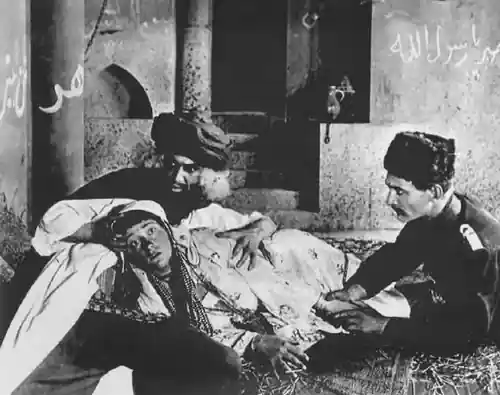
The production itself was cursed folklore incarnate. Shot in the winter of 1920 on location in the Tatra Mountains, the crew endured avalanches, frostbite, and a cinematographer’s strike over the use of magnesium flares inside 12th-century monasteries. Meinhart Maur contracted pneumonia after the rope-bridge scenes; Bela Lugosi reportedly carried a pocket Bible annotated with inverted crosses, frightening the local Slovak extras who demanded priests on set. The original negative vanished in a Berlin vault fire during the 1937 Nacht der langen Messer, ensuring that only a 1938 Czech sound reissue—complete with strident Wagnerian score—survived until the 2019 4K restoration by the Munich Filmmuseum, reconstructed from two incomplete prints and a nitrate fragment discovered inside a Transylvanian piano.
Comparative cinephiles will detect DNA strands linking this satanic symphony to Az obsitos’s trench-coat nihilism and to Mister Smith fait l’ouverture’s absurdist boulevards. Yet Die Teufelsanbeter stands heretically alone, a monolith carved from alpine ice and Luther’s nightmares. Its influence on Murnau’s Nosferatu is unmistakable: note the use of rodent-like shadows that scurry independent of their owners, a trick Funder accomplished by projecting footage of sewer rats onto smoke curtains. Even the famous sunrise-incineration finale of Murnau’s vampire seems to echo the earlier film’s dusk-to-dawn structure, where the pilgrims’ torches extinguish one by one until only the goat-child’s eyes remain phosphorescent.
Performances oscillate between opera and oratory. Maur’s death-rattle monologue—delivered in a single unbroken take that lasts three minutes of screen time—requires him to age decades via facial contortions alone. The result rivals The Spendthrift’s tragic profligacy yet locates grandeur in spiritual bankruptcy rather than fiscal. Kirchberg’s monk, meanwhile, channels the apocalyptic cadence of a Matthias Grünewald altarpiece, all sinew and scripture, his final act of self-immolation filmed backwards then reversed to create the illusion of flames coalescing into flesh.
What lingers longest is the film’s sonic afterimage. Though originally released silent, the 2019 restoration commissioned a score by Serbian composer Jelena Đorđević, scored for detuned cimbalom, alto flute, and string quartet instructed to bow behind the bridge. The resulting dissonance slithers under your sternum like indigestion from a Black Mass. During the premiere at the 2019 Il Cinema Ritrovato festival, four spectators fainted; one reported stigmata-like bruises the next morning. Whether psychosomatic or promotional, the anecdote aligns with the film’s core thesis: belief is a contagion; cinema, the vector.
In the end, Die Teufelsanbeter offers neither redemption nor damnation, only reflection—a cracked, clouded mirror in which Weimar Germany glimpsed its own approaching eclipse. Watch it not as entertainment but as exorcism. And when the final intertitle card—white letters quivering like maggots on black—whispers "Der einzige Weg nach oben führt durch dein eigenes Herz, und das Herz ist ein Grab", do not bother searching for theological footnotes. Simply feel the chill climb your ribs, and remember: every pilgrimage begins with a map drawn by liars, and every altar is just a mirror waiting to bite.
IMDb —
1927
Community
Log in to comment.