DbcultAccessing Vault...
Cult Review
Senior Film Conservator
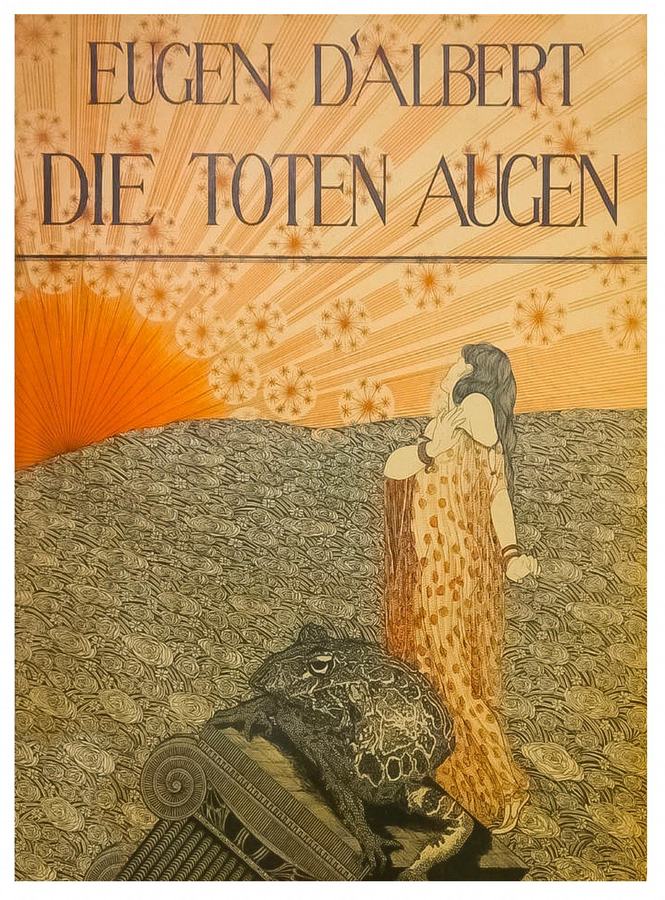
An Unblinking Gaze into the Soul: Revisiting 'Die toten Augen'
In the annals of early cinema, particularly the effervescent German landscape of the 1920s, certain films emerge from the shadows of time, not merely as historical artifacts but as living testaments to the enduring power of visual storytelling. Among these, Die toten Augen — 'The Dead Eyes' — stands as a singularly poignant and dramatically potent work, a film that, despite its relative obscurity compared to some of its more frequently canonized contemporaries, offers a compelling exploration of human vulnerability, obsession, and the profound nature of perception. It’s a melodrama, certainly, but one elevated by an incisive psychological depth and performances that cut to the very core of the human condition, particularly from its incandescent star, Pola Negri.
The narrative unfurls around Sybille (Pola Negri), a concert pianist whose life is defined by a vibrant interplay of sound and light. Her fingers dance across the keys, translating abstract emotion into tangible melody, her eyes reflecting the very soul of her music. Yet, fate, in its cruelest guise, intervenes, plunging her into an abyss of blindness. The film’s title, Die toten Augen, refers not just to the physical state of her sightless gaze but to the profound spiritual void that threatens to engulf her. This initial premise sets the stage for a narrative rich in pathos and moral complexity, drawing the audience into Sybille’s internal struggle with an immediacy that transcends the lack of spoken dialogue.
Pola Negri’s portrayal of Sybille is nothing short of mesmerizing. Her command of gestural language and facial expression is a masterclass in silent film acting. Negri eschews the broad, often exaggerated histrionics common to some performers of the era, opting instead for a nuanced, deeply internalised performance. We witness her initial despair, a silent scream conveyed through the slump of her shoulders, the tremor of her hands, the almost imperceptible quiver of her lips. But crucially, we also see her fierce resilience. Her blindness isn't portrayed as an end, but as a crucible. Negri’s eyes, even when unseeing, convey a universe of emotion – anguish, longing, hope, and eventually, a profound inner wisdom. This is a performance that rivals the most celebrated dramatic turns of the silent era, perhaps even inviting comparisons to the intensity seen in Koroleva ekrana, another film where a woman's fate hangs on dramatic circumstance, though Negri's internalisation here feels particularly groundbreaking. Her physical presence, often draped in elegant, yet somber, costuming, becomes a canvas upon which her character’s emotional journey is painted with exquisite detail.
Enter Dr. Viktor Brand (Nils Olaf Chrisander), an ophthalmologist whose brilliance is matched only by his chillingly possessive nature. Chrisander imbues Brand with an unsettling charisma, a veneer of scientific detachment that barely conceals a predatory obsession. His initial interest in Sybille is framed as purely professional, a desire to conquer the medical challenge her blindness presents. However, as the narrative progresses, his motives become increasingly sinister. Brand sees Sybille not as a patient to be healed, but as an object to be possessed, a symbol of his ultimate triumph, both professional and personal. Chrisander’s performance is subtle yet menacing; his gestures are precise, his gaze often fixed and unwavering, suggesting a mind utterly consumed by its own desires. He represents the danger of knowledge unmoored from empathy, a theme that resonates with a disturbing timelessness.
Contrasting Brand’s calculated malevolence is Julian (Ernst Hofmann), a struggling sculptor who offers Sybille an alternative path: one of unconditional love and acceptance. Hofmann’s portrayal is gentle and earnest, providing a much-needed warmth amidst the encroaching darkness. Julian sees beyond Sybille’s physical impairment, recognizing the vibrant spirit within. His love is not contingent on her sight; it is born from a deeper understanding of her soul. The scenes between Negri and Hofmann are imbued with a tender intimacy, a quiet understanding that speaks volumes without dialogue. Their connection is a beacon of authenticity, a stark counterpoint to Brand’s manipulative overtures. Julian represents the film's moral compass, a reminder that true vision emanates not from the eyes, but from the heart. One might even draw a parallel to the earnest, often struggling protagonists found in films like The Ne'er Do Well, who fight for love and integrity against challenging odds, though Hofmann's character is less about societal climbing and more about pure devotion.
The supporting cast further enriches the film’s emotional tapestry. Rosa Valetti, as Frau Elara, Sybille’s devoted governess, provides a grounded, maternal presence. Her character functions as an astute observer, sensing Brand’s insidious influence and offering quiet, albeit often unheard, warnings to Sybille. Valetti’s expressions convey a mixture of concern, weariness, and loyalty, highlighting the emotional toll taken by Sybille’s predicament on those closest to her. Her struggle to intervene against Brand’s medical authority and Sybille’s desperate hope for sight adds another layer of tragic realism. Magnus Stifter, portraying Herr Richter, a skeptical family lawyer, brings an element of rational suspicion to the unfolding drama. His presence underscores the growing unease surrounding Brand’s methods and motivations, providing an external voice of caution that Sybille, in her vulnerability, is initially unable to heed.
The thematic core of Die toten Augen is undoubtedly the multifaceted concept of 'sight.' It delves beyond the mere physical act of seeing, exploring spiritual, emotional, and intellectual vision. Sybille's physical blindness forces her, and by extension the audience, to examine what truly constitutes 'seeing.' Is it merely the reception of light, or is it the capacity for empathy, understanding, and love? Brand, despite his perfect physical sight, is morally blind, unable to perceive Sybille as an autonomous individual. Julian, conversely, possesses an profound inner vision, seeing Sybille's true beauty regardless of her physical condition. The film masterfully uses this dichotomy to illustrate that clarity of perception is often inversely related to physical capability, a powerful message delivered with striking visual metaphors. This exploration of inner versus outer vision is handled with remarkable subtlety, avoiding didacticism in favor of emotional resonance.
The direction, while not explicitly attributed in many records, demonstrates a keen understanding of silent film aesthetics. The use of light and shadow, a hallmark of German Expressionism, is employed with striking effectiveness. Shadows often loom over Dr. Brand, visually reinforcing his sinister nature, while Sybille is frequently bathed in soft, ethereal light when with Julian, signifying hope and purity. The camera work is deliberate, often lingering on Negri’s expressive face, allowing her performance to unfold with maximum impact. Intertitles are used sparingly but potently, serving to advance the plot or provide crucial emotional insights rather than merely narrating events. The pacing, though deliberate, builds tension inexorably, leading to a climax that is both emotionally charged and visually arresting. The sets, though perhaps not as overtly stylized as some contemporary Expressionist works, effectively convey the differing worlds of Sybille’s confinement and Julian’s artistic sanctuary.
The film’s narrative structure is a classic melodrama, but one executed with exceptional finesse. It carefully establishes Sybille’s initial tragedy, then introduces the two competing forces in her life – Brand’s manipulative promise of sight and Julian’s steadfast love. The tension builds through Brand’s insidious isolation tactics, his subtle undermining of Sybille’s confidence, and his attempts to discredit Julian. This slow burn of psychological manipulation is particularly effective, making Brand a truly chilling antagonist. The climax, where truth is finally unveiled, is not a sudden, explosive event, but a culmination of emotional pressures, forcing Sybille to make a choice that defines her spiritual rather than physical destiny. This intricate dance of emotional manipulation and genuine affection gives the film a depth that elevates it beyond mere tear-jerking fare.
In a broader context, Die toten Augen stands as a testament to the sophisticated storytelling capabilities of early German cinema. It showcases how silent films, through the artistry of their performers and the ingenuity of their directors, could explore complex psychological themes with nuance and power. The film’s thematic exploration of love, obsession, and self-realization through adversity places it within a tradition of profound human drama, perhaps echoing the emotional intensity found in films such as Love Never Dies, though with a distinctly more psychological edge. It reminds us that the absence of spoken dialogue often amplified the need for visual clarity and emotional authenticity, demanding more from both the actors and the audience. The enduring legacy of films like this lies not in their spectacle, but in their ability to probe the depths of the human heart, to reveal the struggles and triumphs that are universal and timeless.
The final scenes of Die toten Augen are profoundly moving. Sybille, having made her choice, remains physically blind, yet her spirit is undeniably illuminated. She returns to her piano, her music now imbued with a newfound depth and passion, Julian by her side. Her 'dead eyes' are no longer symbols of despair but of a profound inner peace, reflecting a vision far more complete than mere physical sight could ever provide. This resolution is not a convenient miracle cure, but a powerful affirmation of self-acceptance and the redemptive power of true love. It’s a bold artistic choice that elevates the film from a simple melodrama to a statement on the nature of human resilience and spiritual clarity.
This film serves as an invaluable reminder of Pola Negri’s unparalleled talent and her enduring impact on cinematic performance. Her ability to convey such a rich spectrum of human emotion, to make us feel Sybille’s agony and her eventual triumph without uttering a single word, is a testament to her genius. Die toten Augen is more than just a historical curiosity; it is a vibrant, emotionally resonant work that deserves wider recognition. It challenges us to look beyond the surface, to understand that true vision comes not from what we see with our eyes, but from what we perceive with our hearts and minds. It’s a film that, once seen, stays with you, its silent narrative speaking volumes about the human spirit’s capacity for endurance and love.
A profound journey into sight both seen and unseen, 'Die toten Augen' remains a compelling cinematic experience.

IMDb —
1919
Community
Log in to comment.