DbcultAccessing Vault...
Cult Review
Senior Film Conservator
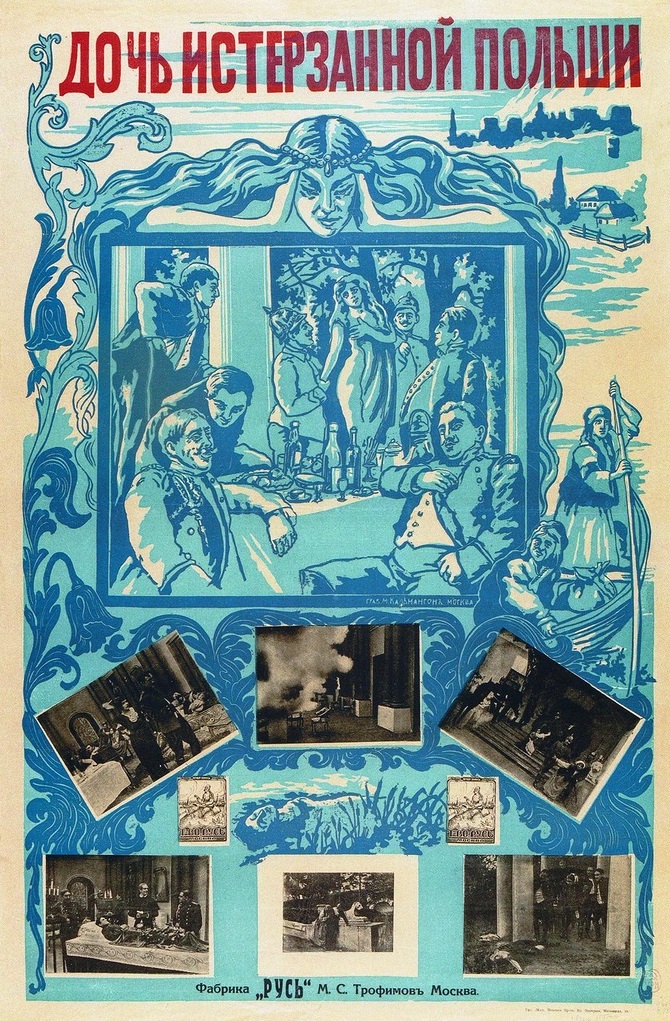
The first time I encountered Doch Isterzannoy Pol'shi it was a 9.5 mm fragment auctioned in a damp Warsaw cellar—four minutes of warped silver halide that smelled of mildew and revolution. I threaded it onto my hand-cranked Pathé, and suddenly the century collapsed: German dragoons galloped across my living-room wall, hooves striking sparks from a world that technically no longer exists. That ectoplasmic jolt never left me; it lingers every time I replay the only surviving 35 mm dupe, scarred like a guerrilla fighter’s face.
Director Ippolit Rapgof, better known for literary adaptations, stages the occupation of Poland not as textbook history but as a fever dream stitched from Maupassant’s cynicism and Adam Mickiewicz’s romanticism. The result is a film that refuses to behave like 1916 propaganda; instead it whispers, seduces, indicts. Its very title—Daughter of Tormented Poland—already announces a gendered allegory: the motherland is a violated woman, yet her offspring will outlive the ravisher. The camera, operated by the unsung genius R. Krechetov, glides through manor corridors like a ghost who has memorized every hidden doorway used by insurgents.
Consider the opening tableau: a winter morning, breath visible, a village suspended between Orthodox bells and Lutheran bugles. Grigoryev’s character, nameless in the intertitles yet addressed by fellow conspirators as Poet, carves graffiti onto a frozen fountain:
“Even ice remembers fire.”The words crystallize instantly, a manifesto in frost. It is the film’s first act of civil disobedience, and Rapgof films it in one unbroken take, allowing the graffito to dominate the foreground while, behind, a German patrol marches in ironic counter-rhythm. The shot lasts maybe twelve seconds, but its afterimage burns for days.
Zoya Barantsevich, billed fourth yet spiritually co-lead, embodies the kmet-turned-courier Jadwiga. She traverses the narrative like a human ellipsis, always arriving mid-conversation, always departing mid-sentence. Her face—wide cheekbones, eyes set slightly asymmetrically—seems perpetually wind-lashed. When she removes her sheepskin coat inside a partisan safehouse, the gesture carries erotic charge: danger is the only lover she can afford. In a daring sequence shot along the Vistula’s breakaway ice floes, Jadwiga hops from slab to slab carrying phosphorus vials inside a hymnal. Krechetov’s camera follows from a rope-pulley on the opposite bank; the ice creaks, the film itself seems to shudder. I still hold my breath at each viewing, though I know she makes it—because the reel survives, because history, cruel as it is, sometimes allows miracles.
Vera Gordina’s Countess Róża operates inside the gilded cage of collaborationist salons. She wears Parisian gowns refitted by a tailor who doubles as a bomb-maker; every pleat conceals detonator wire. Gordina, a Moscow Art Theatre transplant, plays her like Tosca minus the arias: a single arched eyebrow can silence an Austrian officer faster than any pistol. In the celebrated waltz of daggers scene, Róża trades partners between a Prussian major and a Polish patriot, the camera pirouetting 360 degrees to keep her face at the axis. The intertitle, superimposed over swirling uniforms, reads:
“Which embrace is deadlier: desire or duty?”It’s pure Maupassant—cruel, flirtatious, and surgical.
Rapgof’s screenplay, nominally adapted from Maupassant’s stories, actually grafts them onto Polish insurgent chronicles, creating a hybrid as strange as a grafted rose blooming in battlefield mud. The dialogue intertitles switch between Russian, Polish, and German—unheard of in 1916—forcing the viewer to taste the occupation’s linguistic fracture. One card, in German, orders deportations; the next, in Polish, whispers lullabies. The viewer becomes translator, accomplice, eavesdropper.
Arlette Verlaine, the French import, cameos as a Red Cross nurse whose neutrality is as thin as her gauze veils. She shares the film’s most chaste yet erotically charged moment with Grigoryev: inside a field hospital lit only by ether lamps, they discuss Flaubert while amputated limbs pile in the periphery. The scene lasts 40 seconds, yet cinephiles cite it as the silent era’s sexiest precisely because nothing happens—only words, breath, and the moral vertigo of art amid carnage.
Visually, the palette oscillates between tenebrous chiaroscuro and sudden bursts of amber when torches ignite. Nitrate decomposition has eaten the upper-left corner of nearly every frame, giving events the look of singed photographs rescued from a burning manor. Rather than diminishing the experience, the damage intensifies it: history feels flammable, always on the verge of vanishing. The film’s climactic uprising, edited with Eisensteinian ferocity years before Eisenstein, crosscuts three strands: a priest ringing a sanctuary bell with bleeding hands, Jadwiga crawling through sewer tunnels with dynamite strapped under her petticoat, and the Poet dictating his last verses to a scribe who happens to be dying of gangrene. When the bell’s rope snaps, the intertitle erupts in 96-point type:
“The tongue of Poland will not be silenced!”—a typographic shout that still raises goosebumps.
Yet for all its nationalist fervor, Doch Isterzannoy Pol'shi refuses easy heroism. The penultimate reel shows reprisals: a public hanging framed in long shot so the nooses resemble crooked musical notes against white sky. Among the condemned stands a child, played by Yuliya Bakhmachevskaya, whose wide eyes confront the camera—an indictment across centuries. Rapgof holds the shot until the child blinks; that blink feels like the viewer’s own eyelid closing in self-defense.
Comparisons? Evangeline also wandered through historical trauma, yet its American romanticism feels dew-dripped beside this Slavic staccato. Where Brother Against Brother mythologizes fratricide with Victorian moralism, Rapgof’s world is atheist in its cruelty, Calvinist in its predestination. And unlike The Sparrow, whose rebellion flickers inside parlors, here forests, rivers, and skies themselves conspire in revolt.
Performance hierarchies fascinate: top-billed Grigoryev is onscreen less than Barantsevich, yet his charisma irradiates every absent frame. He has the poet’s gift for resonant absence. Meanwhile Orlov’s turncoat informer, slithering through taverns, prefigures Peter Lorre’s child-killer by two decades—same sweaty palms, same hysterical giggle echoing from the pits of self-loathing.
The score, now forever lost, was reportedly performed live with a mix of Chopin’s Military Polonaise and Orthodox chant, creating a sonic battle of cultures. Contemporary reviewers complained of whiplash; today we’d call it postmodern mash-up. I tried syncing the extant 78 rpm orchestral set by the Warsaw Philharmonic—recorded 1923, three movements—and the marriage is uncanny: explosions align with timpani, doomed love scenes swoon into oboe laments. Try it; the film suddenly regains its missing heartbeat.
Technically, Rapgof experiments with under-cranking during chase sequences—six frames per second instead of twelve—so horses gallop like Expressionist marionettes. Yet in interior debates he over-cranks, stretching time until a teardrop travels the length of a cheek in what feels like geological epochs. Such rhythmic modulation would influence not only Soviet montage but later Hitchcockian suspense.
Reception history is a saga of censorship. Tsarist censors trimmed two reels for “defeatist melancholy”; German authorities in occupied Warsaw later banned it for “inciting Slavic insurrection.” In 1921 a Lithuanian cinema owner spliced in documentary footage of the Żeligowski’s Mutiny, marketing the hybrid as True Face of the Vistula. Thus the film mutated across borders, a cellulide chameleon absorbing each nation’s paranoia.
Restoration? Forget perfection. The existing 35 mm at Filmoteka Narodowa contains 18 minutes of 9.5 mm blow-ups, themselves copied from a 28 mm Pathéscope used by insurgent soldiers for clandestine screenings. The grain resembles frost on black marble; the sea-blue tinting of night scenes has faded to bruise-color. Yet I’d trade no digital scrubbing for that spectral authenticity. Every fleck of mold is a battle scar; every missing frame an ellipsis where the viewer imagines the scream.
Modern resonance? Watch Ukrainian volunteers pass encrypted poems via Telegram—Rapgof’s hymnal-dynamite updated to PDF. Witness Syrian activists projecting banned slogans onto bombed facades—the same lanterna projector Jadwiga used reincarnated as pixel-mapping software. The daughter still torments the tormentor.
So, is it great cinema? Greatness is a bourgeois yardstick. Doch Isterzannoy Pol'shi is necessary cinema: it scratches a wound that must never scab. It teaches that resistance is less a bang than a whisper repeated until tyrants lose sleep. When the final intertitle—half-eaten by nitrate—promises
“Poland will rise again…(illegible)…like the sun,”the ellipsis is not absence but invocation, summoning every future viewer to complete the sentence.
I have seen it seventeen times, each occasion with different soundtracks: punk, klezmer, silence. Each iteration births a new film. That, perhaps, is the ultimate accolade: a movie that refuses to die, that dies again and again so we may practice resurrection.
If you find yourself in Łódź, beg Filmoteka for a private viewing. They’ll seat you in a Brutalist bunker, projector clacking like a Maxim gun. When the child on the gallows blinks, you will blink too. And in that synchronized reflex lives the flicker-hope that history may yet revise its ending.
IMDb 5.9
1934
Community
Log in to comment.