DbcultAccessing Vault...
Cult Review
Senior Film Conservator
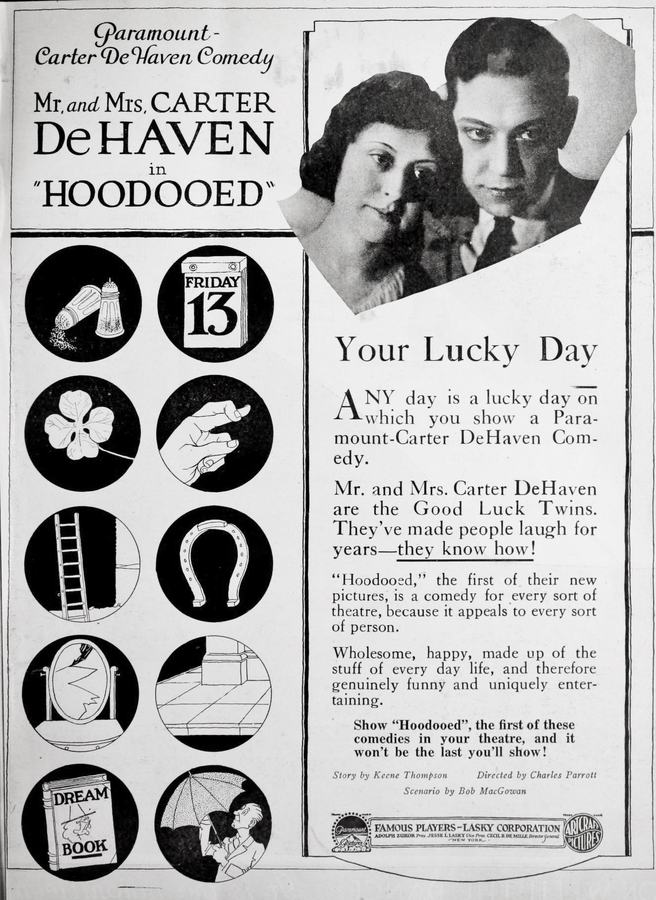
The first time I watched Hoodooed I spilled coffee on my keyboard—an irony the film would relish. Shot in 1919 and released the following year, this two-reel confection runs barely twenty minutes, yet it compresses the entire pathology of modern superstition into a tumble of sight gags so precise they feel like algebraic equations.
Carter DeHaven—rubber-faced, pencil-thin, always on the balls of his feet—plays the superstitious striver like a man negotiating a minefield of invisible tripwires. His morning ritual is a marvel of micro-acting: he cracks the dream-book, flinches, then vaults over the marital bed exactly ten times, counting on his fingers with the solemnity of a monk tolling vespers. Flora Parker DeHaven, his real-life spouse, counters with the economical exasperation of a woman who has seen every fad from ouija boards to the grapefruit diet. She suggests inviting the boss not as social climbing, but as exposure therapy—cure by confrontation.
The screenplay, hashed out by McGowan, Thompson, and DeHaven himself, weaponizes objects the way The Red-Haired Cupid weaponizes cherubic mischief. Salt becomes shrapnel; a mirror, a portal of doom; a horseshoe, both crown and guillotine. Each totem ricochets through the narrative with Rube-Goldberg inevitability, culminating in the cruelest of cosmic punchlines: the very act of renunciation triggers catastrophe.
Director DeHaven stages anxiety in depth: foreground clutter, midground chaos, background payoff. When the clerk spills ink across his employer’s trousers, the blot spreads like a Rorschach test—viewers project their own workplace disasters onto the stain. The camera lingers just long enough for discomfort to ferment, then cuts to a wide shot revealing the entire office staring, a Greek chorus in starched collars.
Compare this to Madame Du Barry, where opulence smothers tension under silk and candle smoke. Hoodooed instead weaponizes the mundane: a four-leaf clover trembles between thumb and forefinger like a nitroglycerin wafer. The film understands that superstition flourishes not in cathedrals but in kitchens, stairwells, coat pockets—territory mapped by jittery hands.
Modern viewers will flinch when the salt-blinded servant exits the frame; the gag hinges on a Black actor’s humiliation for a cheap laugh. Yet the moment also exposes the era’s racialized hierarchy of labor—who gets hired, who gets scapegoated, whose misfortune is disposable. The film, perhaps unwittingly, records the very superstitions that underpinned domestic apartheid: dark skin as bad omen, the threshold as color line.
In contrast, Mürebbiye explores household power through a governess who destabilizes class from within. Hoodooed never interrogates servitude; it simply uses the cook’s absence to escalate dinner-table panic. That absence, however, becomes the void around which the entire third act orbits—proof that even marginal bodies generate narrative gravity.
Viewed today, the film anticipates our algorithmic rabbit holes: knock on wood, don’t jinx it, Mercury retrograde. Each tic finds its digital twin—retweet rituals, knock-knock karma, screenshot talismans. The intertitle cards, hand-lettered in jittery font, read like proto-tweets: “For luck you lack, step on a crack!” One can almost see the hashtag forming in the grainy emulsion.
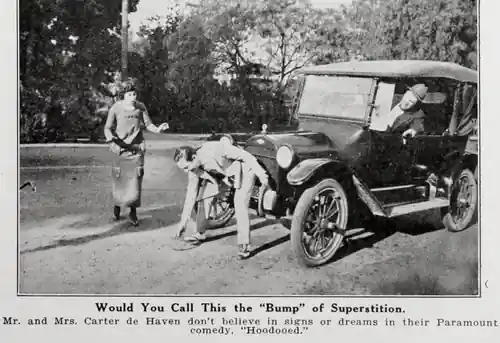
The climactic reveal—Friday the 13th printed on a wall calendar—lands harder now than it did a century ago. We have turned the date into a franchise, a tattoo, a marketing hook. DeHaven’s character renounces superstition at the precise instant the culture doubled down on it, an irony sharper than any horseshoe edge.
Carter DeHaven’s physical vocabulary splits the difference between Chaplin’s poetic glide and Harold Lloyd’s caffeinated climb. Watch him pin-collect: he drops to one knee with courtly grace, fingers tweezering each steel sliver as if defusing bombs. Flora Parker DeHaven underplays magnificently; her side-eye could wither a cactus. When she finally yanks the calendar page to reveal the fatal date, her smirk is half triumph, half condolence—the marriage in microcosm.
Their chemistry electrifies the domestic space, turning the cramped flat into a theater of war where love battles obsession. Compare this spousal dynamic to Erotikon, where desire ricochets across drawing rooms in operatic arcs. Here, tension is quieter, funnier, more recognizably human: the soundless sigh of a woman who has found her husband crouched in the hallway clutching a horseshoe like Hamlet with Yorick’s skull.
Shot on orthochromatic stock, the film renders skin as lunar pallor and shadows as inkwell abysses. Mirrors explode into mercury splinters; salt crystals glint like micro-stars. The horseshoe—black, heavy, impossibly crude—looms in close-up, its surface pitted with the scars of countless nailed-on hopes. When it falls, the camera tilts downward, letting gravity become fate’s exclamation point.
Such visual bluntness contrasts with the baroque chiaroscuro of Carmen (1918), where shadows seduce. Hoodooed opts for slapstick clarity: every object must announce its narrative function, every shadow must forebode. The result is a cartoon stoicism, a live-action Tom & Jerry stripped of catnip but loaded with dread.
Surviving prints circulate without original musical cues, so programmers often pair them with jaunty piano rags that undercut the existential hangover. I prefer a minimalist approach: solo violin scraping microtones, glass harmonica drones, the occasional hand-clap to mimic horseshoe thunder. The silence between gags should feel like breath held during a sneeze—inevitable, uncontrollable.
Why resurface this obscurity now? Because Hoodooed is a prophecy written in slapstick. Our phones are dream-books; our feeds fling salt into each other’s eyes. We step on digital cracks—broken hyperlinks, shadow-bans, demonetized videos—and blame Mercury retrograde. The algorithmic horseshoe hovers above us all, waiting for the moment we declare ourselves rational.
The film’s final irony—renunciation as trigger—mirrors our own: the more data disproves superstition, the more we double down. Analytics departments call it “negativity bias”; the film calls it hubris. Either way, the horseshoe always returns, arcing through the air in slow-motion silence, until it finds the one skull that will guarantee the promotion, the headline, the myth.
So watch Hoodooed at 3 A.M. when you can’t sleep because you walked under a ladder on Zoom. Watch it on your phone with the brightness turned low, the battery at 13%, the calendar app open. Let Carter DeHaven’s eyes—two haunted zeroes—remind you that luck is just narrative with the edges sanded off, and every story, like every horseshoe, comes back around.
IMDb 7.2
1923
Community
Log in to comment.