DbcultAccessing Vault...
Cult Review
Senior Film Conservator
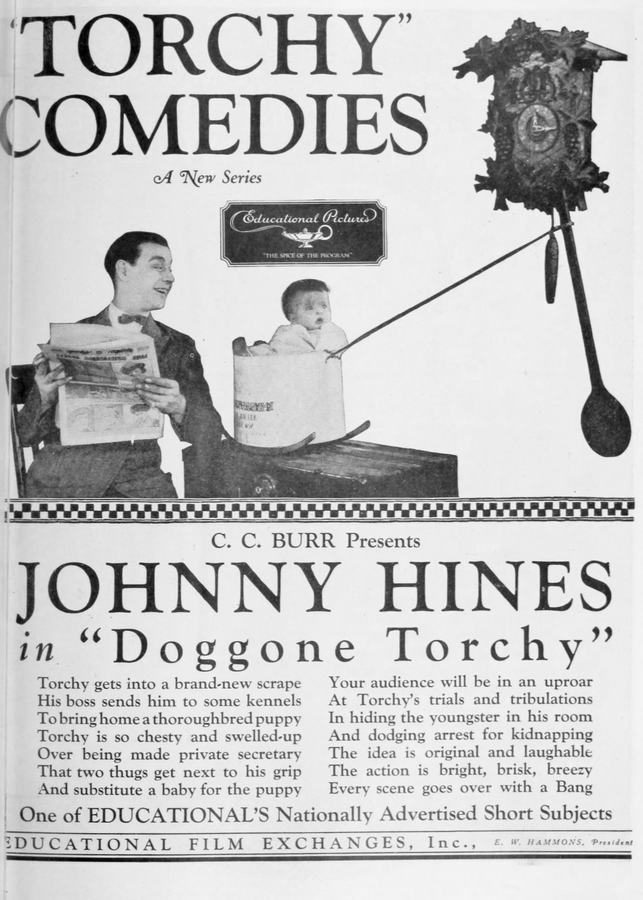
The first time I saw Doggone Torchy, the print crackled like a bowl of Rice Krispies soaked in bootleg gin—nitrate embers popping while Johnny Hines sprinted across the frame, a suitcase clutched like contraband hope. Ninety-seven years later, that same jittery strip of celluloid still feels perversely alive, a mischievous foundling left on cinema’s doorstep.
Picture it: 1926, the year Warner Bros. were flirting with talkies, yet most of Broadway’s foot-traffic still queued for pantomimed ecstasy. Into that liminal moment drops this 63-minute cyclone, directed by a workhorse named Charles Hines (Johnny’s brother) and stitched together by pulp titan Sewell Ford, whose Torchy stories had already colonized streetcar reading from Boston to Burbank. The film’s premise—errand boy nabs wrong luggage, gains baby—sounds like a Mack Sennett one-reeler stretched on the rack until it yells feature. Miraculously, the stretch marks never show.
New York here is less a place than a giant coin-op contraption: yank one lever—say, a kennel’s squeaky gate—and three cherries of calamity align. Torchy’s newsroom, all clattering typewriters and spittoons glinting like miniature suns, could be a cathedral for hustle culture. His editor, a bloated walrus in a green eyeshade, dispatches him with the casual cruelty of a Roman emperor: “Fetch the hound or fetch your last paycheck.” Thus our hero descends into a metropolis whose geography obeys dream logic: Riverside Drive overlooks the Gowanus, Central Park segues into the Brooklyn Navy Yard, and no one blinks.
The kidnappers, meanwhile, sashay out of a German Expressionist postcard—long shadows, homburgs tilted at menace, and a getaway Packard that hisses like a serpent. They snatch the child with such hushed efficiency that the scene plays less like crime than choreography. When they stash the toddler inside the dog’s suitcase, the camera lingers on the latch clicking shut; that tiny snik reverberates like a gunshot in church.
What elevates the picture above its slapstick cousins is how relentlessly it dislocates empathy. The moment Torchy—expecting a pampered pup—unzips the case and meets a pair of blinking infant irises, the film switches from screwball to something approaching sacred. Hines’ face cycles through disbelief, terror, and a flicker of paternal warmth so quickly you could miss it, yet the cut survives like a hairline fracture in porcelain.
From here, the gags germinate from necessity rather than tomfoolery. Torchy needs formula at 3 a.m.; he commandeers a horse-drawn milk float, barges into a speak-easy kitchen, and warms bottled nourishment on a still-smoky gin still. He improvises a diaper from newsprint—“EXTRA! EXTRA! Read all over him!” he quips via title card—and the joke lands because the paper’s ink literally tattoos the child’s flesh for days. We laugh, then recoil, then laugh again, caught in a loop that mirrors the character’s own panic.
Academia genuflects to Chaplin’s balletic despair and Keaton’s granite stoicism, yet Johnny Hines—the third prong of silent comedy’s trident—mapped a jittery, urban, motor-mouthed America long before sound allowed mouths to motor. His Torchy, equal parts newsboy and knight-errant, scampers through frames with a forward-leaning gait that predicts Cagney’s pugnacious swagger. Watch him scale a fire escape while cradling the infant like a halfback cradling a pigskin: every muscle telegraphs “I have no clue what I’m doing, but forward is the only gear I’ve got.”
Compare that to Beating the Odds, where Hines played a puglist whose bruises were badges. Here, vulnerability is the plot’s engine; his knuckles never clench, yet his eyes perform entire soliloquies of flop-sweat. In close-up, the whites gleam like porcelain under sodium streetlights, a reminder that silence amplifies physiognomy.
Pre-Code cinema often flaunts flappers brandishing sexuality like switchblades, yet Doggone Torchy codes its feminine power in absence. The kidnapped child’s mother appears only as a photograph clutched by the father—an aristocrat whose tuxedo carnation stays wilted throughout the ordeal. Torchy’s would-be sweetheart, a switchboard operator named Mazie, materializes halfway through, clutching a ukulele and a theory that every crisis needs a soundtrack. She strums “Yes Sir, That’s My Baby” while the infant sleeps in a desk drawer; the juxtaposition is so tonally deranged it achieves lullaby.
Mazie’s finest moment arrives when she strong-arms a cabbie into surrendering his coat—she needs warmth for the foundling—and pays him not with coin but with a single, defiant kiss. The title card reads: “Currency ain’t the only tender, pal.” It’s a line that prefigures the sexual bartering of Rouge and Riches yet retains a screwball innocence, as if the film itself fears overplaying its hand.
Cinematographer William Marshall (future husband of Gloria Swanson) shoots Manhattan like a jazz solo—improvised, brassy, occasionally reaching for blue notes. During a midnight chase along the docks, he tilts the camera 45 degrees so the waterline skews into a diagonal guillotine; every step Torchy takes threatens to slide him into the black drink below. Meanwhile, the kidnappers’ silhouettes ripple across warehouse tin, elongating until they resemble nothing less than gargoyles torn from cathedral eaves.
Inside a cramped hotel room lit by a single sodium lamp, Marshall employs a trick he’d recycle for Queen Kelly: he places a wavering mirror behind Hines so every gesture ghosts itself, suggesting Torchy’s splintering psyche. The baby, swaddled atop a mahogany dresser, gurgles at its own reflection—innocence confronting infinity in a 6-inch square of silvered glass.
Ford’s intertitles deserve sing-along status. He writes in a patois equal parts newsroom shorthand and Tin Pan Alley lyricism: “Torchy hoofed it from river to river, pockets as empty as a politician’s promise.” The alliteration crackles, yet the sentiment stays bruised. Compare that to the minimalist fatalism of Broken Blossoms; Ford opts for verbal jazz hands, a defiant optimism that the city, for all its serrated edges, might still cradle tenderness.
One title card dissolves over a shot of the Brooklyn Bridge at dawn: “Steel spiderwebs, but every thread hums a lullaby if you listen with your last nerve.” Read today, the line feels like something out of a modernist poem; read in 1926, it was a daredevil attempt to sell sentiment without syrup.
Scholars hunting for taxonomy boxes will leave bruised. The movie moonlights as crime thriller—the kidnappers’ hideout sequence drips noir before noir had a passport. It dabbles in social commentary: the child’s father is a banking magnate whose fortune cannot purchase competence; Torchy’s working-class ingenuity solves what affluence cannot. It flirts with romance, yet the central relationship is between man and infant, a buddy comedy where one buddy can’t speak and the other won’t shut up (at least in intertitles).
Even the dog—promised in the opening reel—remains off-screen until the final minute, when it bursts from a taxi, tail wagging like a metronome set to allegro. The delayed payoff feels less like a narrative cheat than a cosmic punchline: the universe, having wrung every possible mishap from human hubris, finally restores four-legged order.
Most 16-mm circulating prints lack original cue sheets, so contemporary screenings rely on accompanists’ improvisation. I caught a 2018 restoration at Brooklyn Academy of Music with a seven-piece mini-orchestra scoring it live. They rendered the kidnappers’ theme as a klezmer dirge in 7/8 time—equal parts menace and shtetl whimsy—while Torchy’s stroller-pushing sequences got a pizzicato waltz that turned every pothole into a pratfall. The baby’s close-ups were accompanied by a single bowed wine glass, its tremolo so ethereal you sensed lullabies leaking from the ether.
That experience cemented my suspicion: the film is a vessel; whatever music you pour in spills back as new meaning. Try syncing it to a garage-rock playlist and you’ll discover kidnappers who shimmy like Tarantino thugs; pair it with Philip Glass and the whole affair becomes existential opera.
Unlike Chûshingura or Salt of the Earth, Doggone Torchy never became a rallying cry for cine-clubs or syllabus fetishists. Rights lapsed into a legal swamp; the negative sat in a Syracuse attic until 1983, when a private collector discovered it doubling as insulation. Even now, the only HD transfer streams on niche platforms whose servers wheeze like grandpas.
Yet its DNA keeps mutating. The suitcase-switch gimmick resurfaces in Frantic; the man-child dyad prefigures Three Men and a Baby; the tonal whiplash between menace and mirth is pure Coen. Watch it back-to-back with Eva, wo bist du? and you’ll notice both films weaponize urban anomie, but only Torchy dares resolve it with a lullaby.
If you measure art by the pound, skip it—this is a soufflé, not steak. If you crave a film that treats narrative like a hand-cranked kaleidoscope, spins morality into cotton candy, and still leaves you misty-eyed over a stranger’s baby, then yes—hound down a copy. Just don’t blame me if, the next time you’re at Penn Station, you side-eye every suitcase that whimpers.
As for me, I keep a bootleg on my phone for emergency gloom. When the world feels like a broken vending machine that refuses my quarters, I flip it open, watch Torchy dangle from a fire escape while the child clutches his suspenders, and remember that chaos sometimes roundhouse-kicks us toward grace. The final iris shot closes on the puppy—finally home—licking the infant’s face. Fade out. No moral, no sequel hook, just the flicker of a universe that, for once, got the joke and decided to laugh along.
IMDb 6
1923
Community
Log in to comment.