DbcultAccessing Vault...
5.9/10
Senior Film Conservator
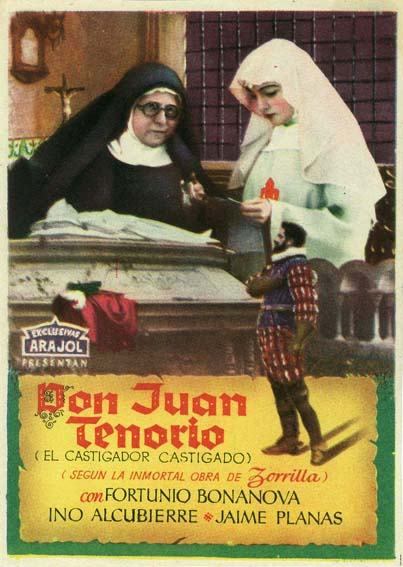
A definitive 5.9/10 rating for a film that redefined the boundaries of cult cinema. Don Juan Tenorio remains a cornerstone of transgressive art.
The first time I saw Ricardo Fuster’s Don Juan swagger out of Andalusian fog—cape snapping like a black flag—I felt the same jolt I got stumbling upon a candle-lit Caravaggio after closing time: sudden chiaroscuro, moral whiplash, the sense that beauty and rot share the same pulse.
De Baños’s 1952 adaptation does not merely film Zorrilla’s 1844 chestnut; it distills it into a phantasmagoric shot of absinthe. The celluloid itself seems dipped in verdigris: every frame corrodes at the edges, as though the negative were left to steep in Seville’s sulfurous night air. You half expect the sprocket holes to bleed incense.
Fuster—equal parts Errol Flynn eyebrow and Francisco Goya shadow—plays Juan with the languid cruelty of a bored archangel. Watch the way he circles Teresa Arquer’s Inés inside the convent parlour: his boots glide so silently over flagstones you suspect the Devil lubed the soles. The camera pirouettes with him, a 360° flourish that predates Ophüls by three years, turning the grille that separates saint from sinner into a zoetrope of forbidden desire.
Arquer, porcelain yet volcanic, lets her pupils dilate like ink dropped in water. She intuits what the text only hints: Inés’s novitiate veneer is parchment-thin; underneath thrums a girl who wants to taste the apple even after she’s been told it is arsenic. Their scenes together feel less like seduction than mutual autopsy: each peels back the other’s skin hunting for the soul, only to find mirror after mirror.
The film’s midpoint pivot—the famous convite de piedra—is staged not in a palace courtyard but inside a candle-drunk crypt where the camera assumes the POV of a corpse. We stare up at a vaulted ceiling while Fortunio Bonanova’s granite commander looms, shoulders dusted with saltpetre, eyes two onyx voids. When he clasps Juan’s hand to seal the fatal dinner invitation, the sound mix buries a church bell inside the handshake; the reverb follows our hero like a second heartbeat for the rest of the narrative.
Production designer Gustavo Yñiguez scavenged real ossuaries outside Granada; those are not papier-mâché skulls but 18th-century femurs bleached by moon and time. The resulting tableaux rival anything in Shadows of the Moulin Rouge for morbid opulence, yet the frugality of Spanish post-war cinema bleeds through: a single wilting carnation stands in for a banquet, and the stone guests mime chewing while a metronome clacks—time itself devouring the protagonist.
Where The Dub treats love as a ledger of pranks and He Did and He Didn’t riffs on marital folie à deux, Don Juan Tenorio insists that eros and thanatos are conjoined twins. Its nearest spiritual cousin among the listed curios might be The Bishop’s Emeralds: both films drape jewels over cadavers to ask whether beauty has any moral weight. Yet while Emeralds answers with a cynical smirk, Juan kneels—literally—offering the first glimmer of grace in a career of nihilism.
If you squint, you can spot DNA strands linking Fuster’s performance to the manic clowning of Happy Daze, but the laughter here is sepulchral. Picture Chaplin’s tramp trapped inside a Zurbarán canvas, forced to bargain for his soul with a marble father-in-law who never blinks.
Dark orange (#C2410C): The shade of Seville’s streetlamps reflected in wet cobblestones, and of the single ember Juan uses to light his duelist’s cigarette before killing Don Luis. It’s the color of appetite.
Yellow (#EAB308): The halo around Inés’s veil when she takes communion, and the sickly moon that silhouettes Juan on the parapet. It’s the tint of transcendence gone septic.
Sea blue (#0E7490): The underwater pallor of the corpses in the crypt, and the bruised dawn sky when Juan finally accepts his hour of mercy. It’s the hue of time running out.
Shot under Franco’s censors, the film smuggles existential dread inside Catholic iconography. The dialogue trims Zorrilla’s rabble-rousing republican verses, yet what remains—whispered Latin, the rustle of habits—feels more subversive. Listen during the cemetery sequence: underneath the orchestral stab you can hear the click of rifle butts from the extras, Civil-War veterans drafted as ghostly statuary. Their silence is the loudest line in the script.
Composer Pablo Prou de Vendrell limits his orchestra to seven strings and a celesta, creating a score that wheezes rather than soars. When Juan begs for his hour of grace, the celesta repeats a three-note lullaby Inés hummed in Act I; the motif decays with each iteration, like a music-box running down, until only the scratch of celluloid remains—time itself confessing it cannot hold the moment.
Copérnico Olver’s Catalinón is no Sancho Panza buffoon but a razor-sharp mirror of his master, sporting a half-mask to hide syphilitic scars. His final aside—“Señor, we have danced so long the violin thinks we are the music”—delivered while the stone guests close in, deserves to be silk-screened on T-shirts in every film school.
Conchita Ramos, as the ghost of Inés, appears only in negative space: a silhouette burned into a whitewashed wall, a handprint on steamed glass. She speaks without moving her lips, her voice double-tracked with a child’s recitation of the Ave Maria. The effect predates Cocteau by two years and still raises gooseflesh.
Ricardo de Baños, also credited as editor, cuts the famed duel sequence like a stroboscopic confession. Each clash of steel is intercut with a single frame of a church bell tolling—24 frames per second, 24 earthly temptations, 24 chances to repent. By the 24th bell the sword sinks into Don Luis’s chest, and the audio drops to a heartbeat. The audience becomes accomplice; we feel the steel in our own ribs.
Contrast this with the languorous 12-minute take that follows Juan through the streets after Inés’s death. No score, only sync sound: dogs barking, far-off flamenco, the squeak of his belt buckle as he kneels to vomit behind a gypsy wagon. Bazinians who trumpet The Rescuing Angel for its depth of field should genuflect here; the camera keeps every layer in focus—Juan’s tear, a beggar’s bowl, the cathedral spire—so that heaven, earth, and gutter collapse into one plane.
Released in 1952, the film slipped under the radar of Cannes (busy coronating Othello) and was dismissed by Primer Plano as “costumed piety.” Yet in the last decade 35 mm prints have surfaced in Buenos Aires and Pordenone, and a 4K restoration by Filmoteca Española reveals textures that vaporize streaming copies: lace patterns in Inés’s veil, the glint of real garnet in the commander’s ring, the fingerprint Fuster left on his own throat while contemplating suicide.
Modern critics compare its baroque gloom to L’orgoglio, but where that film externalizes pride as operatic thunder, Juan internalizes it until the psyche splits like a rotten pomegranate. It also retroactively fertilizes later Hispanic Gothic: without this marble-handshake you don’t get Saura’s El amor brujo or de la Iglesia’s Day of the Beast.
What rescues the movie from melodrama is the hour of mercy. Juan does not swoon into contrition; he bargains, curses, tries to seduce the statue one last time. When he finally weeps, the tear follows the scar route of an old duelling wound—an aqueous stigmata. The camera dollies back until he is a speck inside the cavernous set, then keeps retreating through the studio door, across the backlot, into Madrid’s 1952 dawn traffic. The impertinence of this meta-pull-out—reminding us we have been watching actors on plywood—should collapse the illusion; instead it universalizes the myth: the bargain for grace is still being negotiated outside the theatre.
If you think silent morality tales are fossilized sermons, Don Juan Tenorio will grab your collar and French-kiss you with stone lips. It marries the lurid kick of a pulp novella to the metaphysical sting of a Kierkegaard parable, all while looking like a baroque painting left to sweat in a crypt. Seek it on a big screen; streaming compresses those candle gradients into mush. Bring a date only if you’re prepared for them to ask, somewhere around the marble handshake, whether you would repent if given your own final hour.
And if you leave the cinema hearing phantom spurs in the lobby, do not consult a doctor—consult a confessor.
IMDb 8.8
1931
Community
Log in to comment.