DbcultAccessing Vault...
Cult Review
Senior Film Conservator
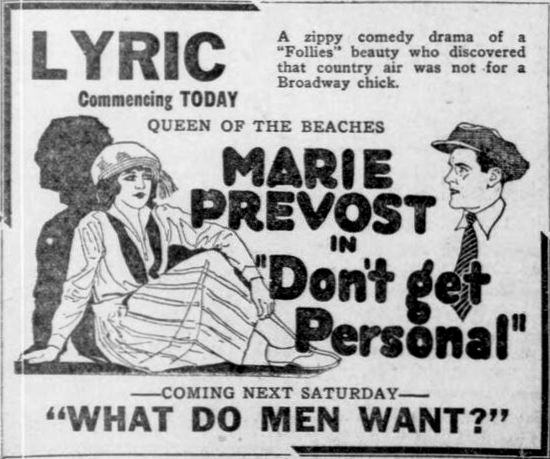
Country air, cigar smoke, and the rustle of taffeta—Don't Get Personal distills 1922 into a champagne-cork pop of misread motives and moonlit farce.
The moment Patricia’s train exhales its last steam sigh into the station, the film swaps Broadway’s rhinestone glare for firefly gloaming, and you feel the celluloid itself take a restorative breath. Directors Irving Cummings and his scenario muse Doris Schroeder aren’t merely rustling up a city-mouse-in-the-barn comedy; they’re staging a miniature war between artifice and innocence, between the shimmy and the sermon, between a vamp who chews men like gingersnaps and a flapper who still believes hearts can be tuned like ukuleles.
Strip the narrative to its studs and you find a bedrock Shakespearean mix-up: boy loves girl, boy strays, second girl engineers rescue, third boy misreads rescue as seduction, fists fly, fathers roar, cosmic order restored via last-reel repentance. Yet within that scaffold, Don't Get Personal wedges a dozen delicious contortions. The bridal party that isn’t a wedding, the elopement that isn’t an elopement, the woman-hater who suddenly discovers his own pulse hammering like a snare drum—every certainty corkscrews into comic delirium.
Marie Prevost’s Patricia arrives with the kinetic shimmer of a tossed coin; she cocks her cloche hat at rakish angles, every eyelash a semaphore of mischief. Watch her in the barn-loft sequence where she strums a broom-handle ukulele while Horace stammers—Prevost lets the grin leak sideways, a tiny admission that the character knows she’s staging joy rather than simply feeling it. It’s a meta-wink that predates the talkie wink by nearly a decade.
Ralph McCullough’s John begins as a walking thundercloud—shoulders hinged like a gate resisting trespass—yet the moment he spies Patricia dragging Horace through the hedgerows, Cummings inserts a lightning-cut close-up: pupils widening, nostrils flaring, the ice of misogyny fissuring. One shot, and we register the man’s ideological ship turning mid-ocean.
Sadie Gordon’s Maisie Morrison slinks through frames like cigarette smoke given ankles. She never twirls a mustache—she doesn’t need to; her villainy is hedonic, almost merciful. When she drapes herself over Horace at the mock-altar, the camera tilts five degrees, as if the world itself were sliding toward her gravitational languor.
Cinematographer (uncredited, as was cruel custom) floods night exteriors with a mercury-blue tint that turns cornfields into inland seas. Interior parlors glow tobacco-amber, the fireplace embers rhyming with Patricia’s auburn bob. Intertitles—often a silent film’s weak ankle—here crackle with jazz-age slang: "Button the lip, big boy—the lady’s scripting her own third act!"
Notice the repeated visual motif of thresholds: train carriage door, garden gate, barn loft hatch. Each crossing marks a social membrane; characters step through and emerge re-costumed by scandal or desire. By the time John hauls Patricia back across the Wainwright threshold in the final reel, we’ve witnessed at least six micro-baptisms.
The picture pretends to be a trifle, yet its sexual politics sizzle like a branding iron. Patricia’s agency rattles the patriarchal teacups; she engineers courtships, terminates entanglements, and still lands on the right arm of the heir. John’s declared misogyny is played for laughs, but the script lets it root in war trauma—he limps from a liminal wound never named, a scar that codes women as sirens luring men back to slaughter. When he finally lunges at Horace, the punch carries years of unprocessed trench terror; the film flirts with darkness, then pirouettes back into moonlit scherzo.
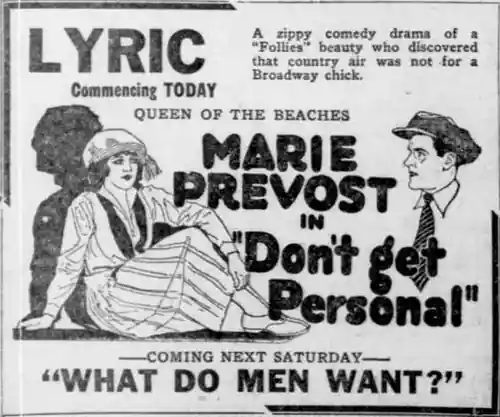
Cummings edits comedy like percussion. He ends scenes on half-beats: Patricia slams a gate—cut to chickens flapping, an ellipsis of panic. The eye blink-length shot of Maisie’s lacivious wink lands faster than a 78-rpm record skip; the viewer’s brain stitches the leer to the ensuing chaos. Compare this to the pastoral languor of Just Pals or the maritime tableaux of When the Whale Was Jonahed, and you appreciate how Don't Get Personal opts for staccato where others choose legato.
In the wake of post-war ennui, rural escapism sold like bathtub gin. Yet urban audiences also craved flapper vindication: proof that a girl could swap tap-dance for hay-bale and still out-maneuver provincial predators. The picture functioned as both cautionary tale—don’t cavort with vamps—and liberation pamphlet: you can rewrite the rules if your wit is quicker than their gossip.
Financially, it rode the crest of the short-lived but lucrative "country-cosmopolitan" cycle that The Beauty Market and To the Highest Bidder also explored. Critics of Variety called it "a mint julep laced with cayenne," praising Prevost’s "electric shimmy-shake of propriety."
Even at a brisk five reels, the film over-sweetens its denouement: John’s sudden ethical pirouette feels less earned than mandated by commercial clocks. Emily, though competently played by Alida B. Jones, remains a porcelain doll passed between suitors; the script denies her the textured yearning it lavishes on Patricia. And Maisie’s comeuppance arrives off-screen—a narrative shove into the wings that deprives us of a cathartic curtain-call.
Additionally, the racial homogeneity of Wainwright’s estate—every face a variant of eggshell—dates the film with the musty reek of exclusion, common to 1922 but jarring to modern retrospectives. One wonders how the comedy might have deepened with even a tertiary character of color whose presence wasn’t servile backdrop.
Only two incomplete 35mm prints are known: one in an Ohio private vault (Reel 2–4), another at Cinémathèque royale de Belgique missing its finale. A 2018 2K reconstruction married both sources, bridging gaps with stills and translated intertitles. Kino Lorber’s MOD Blu-ray occasionally surfaces on auction sites; grayscale is lush, though the tints remain speculative. For the fearless, a 4K DIY scan of a 16mm abridgement circulates in cinephile torrent waters—grainy, flecked, but crackling with campfire immediacy.
Screen it beside Assunta Spina for a double shot of endangered womanhood negotiating patriarchal chokeholds—Italian neorealist grit against American pastoral fluff, both revealing the era’s gender faultlines.
Swipe-right romances and influencer catfights are merely Maisie Morrison with better bandwidth. Patricia’s insistence on authoring her own narrative anticipates every TikTok manifesto about boundary-setting. John’s incel-adjacent bitterness, played for laughs in 1922, now reads as proto-toxic masculinity, making the film an accidental field guide for today’s gender skirmishes. When Patricia eye-rolls Silas’s patriarchal bellow, you half expect her to produce a ring-light and start a podcast.
Minor blemishes aside, Don't Get Personal is a champagne bubble of a film—effervescent, slightly dizzy, leaving an acidic pop that wakes the palate. It proves that even in the primordial ooze of early twenties cinema, actresses could steer plot like helmsmen, directors could splice farce with sociological bite, and a five-reel trifle could smuggle a manifesto inside a wink. Seek it, project it, argue over it; just don’t dare dismiss it as a relic. Patricia’s ghost still tap-dances on every modern woman told to pipe down, and Maisie’s mascaraed smirk lurks inside every algorithm that promises pleasure at a hidden cost.
Grade: A- (for ingenuity, star wattage, and historical curiosity; marked down for narrative tidiness and blinkered social lens)
IMDb —
1918
Community
Log in to comment.