DbcultAccessing Vault...
Cult Review
Senior Film Conservator
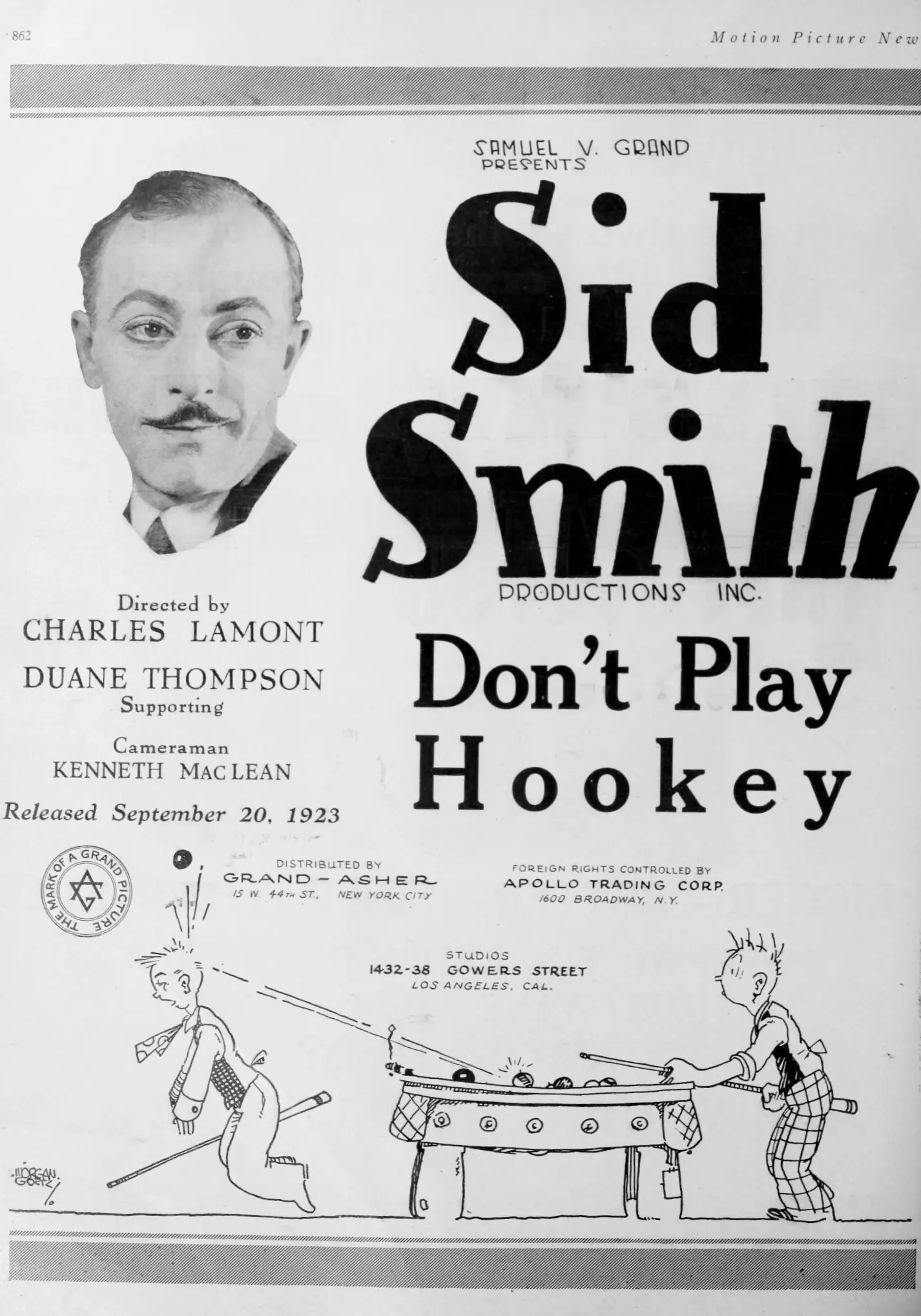
The 1920s were a period of frantic transition, and nowhere is this more evident than in the ephemeral brilliance of the two-reel comedy. Don't Play Hookey stands as a testament to the era's obsession with speed, technology, and the subversion of authority. Sidney Smith, a performer whose physicality often bordered on the elastic, occupies a space in this film that is both protagonist and catalyst for catastrophe. Unlike the more grounded narratives of Acquitted, which sought to explore the heavy moral weight of justice, this film operates on the light, buoyant logic of the gag. It is a film that refuses to sit still, much like the truant children it eventually seeks to capture.
The opening sequence, featuring Sid as a street photographer, is a masterclass in the comedy of errors. In an age where photography was becoming democratized, Smith’s character represents the 'shyster' archetype—a man selling a version of reality that is distorted, blurry, and fundamentally incorrect. The 'instant' nature of his photography serves as a precursor to our modern obsession with immediacy, yet here it is played for laughs. When a customer receives a photo that looks nothing like them, we see the burgeoning anxiety of the 20th century: the fear that technology will erase the self rather than preserve it. This thematic depth is often overlooked in silent shorts, but when compared to the more straightforward action of Oh! Shoot, Smith’s work reveals a more cynical, biting edge.
The pivot in the second reel is where the film finds its heart. The introduction of Duane Thompson as the school teacher injects a sense of purpose into Sid’s aimless wandering. Thompson, who often brought a sophisticated charm to her roles, acts as the perfect foil to Smith’s erratic energy. While films like Princess Jones leaned heavily into the romantic whimsy of the era, Don't Play Hookey uses the teacher-student dynamic to facilitate a series of increasingly complex chase sequences. The 'truant' is not just a child skipping class; it is a symbol of the untamed spirit of the era, resisting the encroaching walls of institutionalization.
The choreography of the children’s evasion is nothing short of brilliant. There is a rhythmic quality to the way the scholars disappear and reappear, a visual dance that reminds one of the pantomime excellence found in Pierrot the Prodigal. However, where Pierrot is steeped in a classical, almost mournful tradition, Smith’s film is aggressively modern. The urban backdrop, the use of props, and the rapid-fire editing all point toward a future where the film is no longer a recording of a play, but a unique medium of its own. It lacks the somber historical weight of The Indian Wars, choosing instead to focus on the micro-struggles of the city street and the schoolhouse yard.
To understand the appeal of Don't Play Hookey, one must look closely at Sidney Smith’s performance. He does not possess the melancholic grace of Keaton or the everyman charm of Lloyd; instead, he offers a brand of frantic desperation. He is a man constantly at odds with his environment. Whether he is wrestling with a malfunctioning camera or attempting to corral a group of rebellious youths, his body is in a state of perpetual motion. This 'kinetic anxiety' is a hallmark of the Christie comedies and provides a fascinating contrast to the more theatrical performances seen in Lights of London.
Smith’s interactions with the children are particularly noteworthy. There is no sentimentality here. The children are adversaries, clever and ruthless in their pursuit of freedom. This unsentimental view of childhood is refreshing, especially when compared to the Victorian-tinged morality often found in films like Melissa of the Hills. In Sid’s world, the struggle for the classroom is a battle of wits, and more often than not, the adult is the one left looking foolish. This subversion of the hierarchy is what gives the film its lasting resonance.
Technically, the film utilizes the limited depth of field of the era to create a sense of claustrophobia in the photography scenes, which then opens up into wide, expansive shots during the outdoor chases. The use of natural light is effective, capturing the grit and texture of the 1920s schoolyard. While it may not have the high-concept visual ambition of The Leavenworth Case, its simplicity is its strength. Every frame is dedicated to the gag, every camera angle chosen to maximize the impact of a fall or a double-take.
The editing, too, deserves praise. The transition from the first reel’s episodic gags to the second reel’s more cohesive narrative arc is handled with a deftness that suggests a deep understanding of audience pacing. In an era where films like Telefondamen were experimenting with different narrative structures, Don't Play Hookey remains remarkably focused. It knows exactly what it wants to be: a whirlwind of comedic energy that leaves the viewer breathless.
When we place Don't Play Hookey alongside its contemporaries, its unique flavor becomes even more apparent. It lacks the deceit-driven plot of The Love Liar or the high-society satire of Daisy. Das Abenteuer einer Lady. Instead, it finds its humor in the mundane—the job, the school, the camera. It is a 'blue-collar' comedy that speaks to the frustrations of the working man. Even the title itself is a command, a piece of societal pressure that the film proceeds to dismantle through laughter.
The film also avoids the heavy-handed moralizing found in Cheating the Public. While there is a lesson to be learned about duty and education, it is buried under layers of slapstick. The teacher is not a saintly figure but a woman in need of help, and Sid is not a hero but a man trying to survive his own incompetence. This humanity is what makes the film endure. It is a reflection of a world that is messy, unorganized, and frequently ridiculous.
In the grand tapestry of silent cinema, Don't Play Hookey might appear as a small thread, but it is one of vibrant color. It captures a specific moment in time when the world was moving too fast for its own good, and the only response was to laugh. The chemistry between Sidney Smith and Duane Thompson provides a solid foundation for the film's more outrageous moments, ensuring that the comedy never feels hollow. It is as much a character study as it is a slapstick romp, exploring the persona of a man who is perpetually out of step with the world around him.
For those who enjoy the intricate plotting of Nothing But the Truth or the rugged adventure of White Eagle, this film offers a refreshing change of pace. It is a reminder that sometimes, the most profound thing a film can do is make us laugh at our own failures. The street photographer with the bad pictures and the truant officer who can't catch a child are both versions of ourselves—struggling, failing, and yet, somehow, persevering. In the end, Sid might not get the perfect picture, and the children might not learn their lessons, but the audience is treated to a spectacle of pure, unadulterated joy. It is a film that rewards the viewer for 'playing hookey' from the seriousness of life, if only for twenty minutes.
The legacy of this short is found in its influence on the 'working man' comedies that would follow in the sound era. The DNA of Sidney Smith’s bumbling photographer can be seen in countless sitcom characters who followed. Even the absurd medical comedy of When Dr. Quackell Did Hide shares a similar spirit of institutional mockery. Don't Play Hookey is a vital piece of the comedic puzzle, a frantic, funny, and surprisingly thoughtful exploration of 1920s life that deserves its place in the sun.
IMDb —
1913
Community
Log in to comment.