DbcultAccessing Vault...
Cult Review
Senior Film Conservator
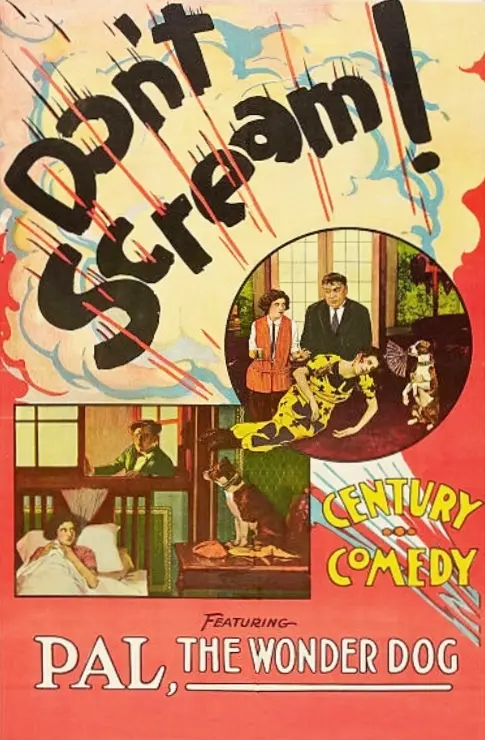
If you delve deep enough into the sepia-toned archives of 1920s cinema, you eventually stumble upon the specialized sub-genre of the 'canine procedural.' While Rin Tin Tin was busy being a dramatic hero, Pal the Dog was carving out a niche in the realm of high-stakes domestic management. In the 1928 short Don't Scream, directed by the prolific Albert Herman, we are presented with a premise that is as absurd as it is technically impressive: a dog who functions as a high-society valet. This isn't just a gimmick; it's a profound commentary on the helplessness of the upper-class male, portrayed here by the physically imposing but socially inept Jack Earle.
Jack Earle, often billed as the 'Texas Giant,' stands in stark visual contrast to Pal. This height disparity creates a unique cinematic geometry that Herman exploits for maximum comedic effect. Unlike the domestic tranquility found in Just Neighbors, Don't Scream leans into a more aggressive form of slapstick. The narrative engine is fueled by the master's desperate need to appear respectable at a ball—a goal that requires a dress suit he does not possess. Enter Pal, the furry thief with a heart of gold and the tactical mind of a seasoned burglar.
The film's middle act is a masterclass in silent-era pacing. When Pal embarks on the mission to 'acquire' a dress suit, the camera follows him with a fluidity that was quite advanced for 1928. There is a sequence involving the scaling of a window that rivals the physical prowess seen in The Bulldogs of the Trail. But where that film focused on the ruggedness of the trail, Don't Scream focuses on the claustrophobia of the urban environment. The dog weaves through furniture and avoids detection with a panache that suggests Albert Herman spent significant time choreographing these movements to match the rhythmic expectations of a Jazz Age audience.
The visual irony of Jack Earle—a man of gargantuan proportions—being utterly dependent on a small terrier-mix is the film's greatest strength. It subverts the traditional power dynamics of the era. While films like King, Queen and Joker played with mistaken identities, Don't Scream plays with biological hierarchies.
The transition from the comedy of manners (the ball) to the gritty rescue mission is jarring but effective. When the master finds himself cornered by a gang of thugs, the film shifts its palette. The lighting becomes more high-contrast, reminiscent of the darker tones found in Le ravin sans fond. Pal’s transformation from a valet to a combatant is handled with a sincerity that avoids the pitfalls of mere parody. This isn't a cartoonish rescue; it's a sequence filled with genuine tension and choreographed brawls that highlight the physical vulnerability of the master.
Billy Engle and Fred Spencer provide the necessary comedic foils, their performances grounded in the vaudevillian tradition of exaggerated facial expressions and frantic gestures. However, it is Marjorie Marcel who provides the necessary emotional tether, her presence grounding the film's more outlandish elements. The chemistry between the human cast is secondary to the undeniable magnetism of Pal, whose 'acting' involves a level of focus and intentionality that makes one wonder about the training methods employed on the set.
Albert Herman was a director who understood that the audience's suspension of disbelief was tied to the tangibility of the stunts. In Don't Scream, the stunts feel visceral. When the dog maneuvers through a crowd or engages with the thugs, there is a lack of trick photography that lends the film a documentary-like verisimilitude. This stands in contrast to the more ethereal qualities of Through Dante's Flames or the atmospheric dread of The Beetle. Herman’s world is one of brick, mortar, and fur.
The writing, credited to Herman himself, is lean. There is no wasted motion. Every gag serves the dual purpose of character development and plot advancement. We learn of the master's incompetence not through dialogue intertitles, but through his inability to perform the simplest of tasks without Pal’s intervention. This efficiency is a hallmark of the late silent period, where visual storytelling had reached its zenith just before the advent of 'talkies' threatened to reset the cinematic language.
In the broader landscape of 1920s cinema, Don't Scream occupies a middle ground between the social realism of The Eternal Grind and the pure escapism of Passion's Playground. It doesn't possess the sweeping scale of Dawn of the East, nor the moral weight of The Testing Block. Instead, it is a localized, intimate comedy that prioritizes the bond between man and dog above all else. It shares some DNA with The Children in the House in its depiction of domestic vulnerability, yet it remains far more optimistic.
Even when compared to international fare like Fången på Karlstens fästning, which deals with themes of imprisonment, Don't Scream suggests a different kind of captivity: the master is a prisoner of his own social expectations, and Pal is his only key to freedom. The film’s lightheartedness is its greatest asset, providing a reprieve from the more somber narratives of the time, such as From the Valley of the Missing or the educational earnestness of Tommy Tucker's Tooth.
Why does Don't Scream still resonate today? It’s the timelessness of the 'smart pet' trope. We see echoes of Pal in modern cinema, but rarely with this level of practical execution. The dog’s ability to steal a dress suit is not just a gag; it’s a feat of animal training that remains impressive in an era of CGI. The film concludes not with a grand moral lesson, but with the restoration of the status quo—the master is safe, the suit is (presumably) returned or forgotten, and Pal is ready for the next service. It is a picaresque loop that mirrors the cyclical nature of early 20th-century short subjects.
For those interested in the evolution of the comedy short, this film is an essential watch. It captures a moment when cinema was confident enough to let a dog lead the narrative. It doesn't have the technicolor vibrancy of Rainbow, but its monochromatic depth tells a story that is just as colorful. Albert Herman managed to create a world where a dog’s bark is not just a sound, but a command that drives the entire plot forward. In the end, Don't Scream is a testament to the silent era's ability to find extraordinary stories in the most ordinary (and hairy) of places.
IMDb 7.4
1933
Community
Log in to comment.