DbcultAccessing Vault...
Cult Review
Senior Film Conservator
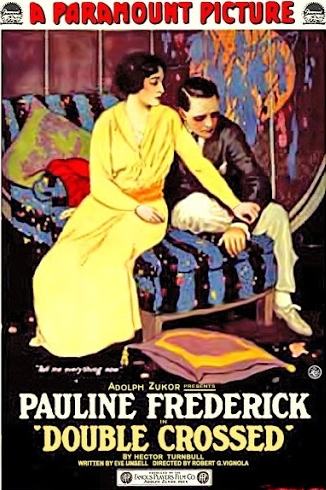
Stepping back into the flickering shadows of early cinema, one encounters narratives that, despite their age, resonate with a timeless profundity. Among these, the 1917 silent drama, Double Crossed, stands as a stark testament to the enduring power of moral quandaries and the insidious grip of past mistakes. It’s a film that, even a century later, manages to pull at the threads of human vulnerability, weaving a tale of blackmail, desperation, and the relentless pressure of societal expectations. This isn't merely a historical curiosity; it's a meticulously crafted character study, a slow-burn thriller that prefigures many tropes we now take for granted in the crime genre.
At its heart, Double Crossed is a profound exploration of consequence, demonstrating how a single, seemingly minor misstep can cascade into a torrent of life-altering dilemmas. The film introduces us to Frank Stratton, portrayed with a nuanced blend of youthful arrogance and underlying decency by Crauford Kent. Stratton, a scion of wealth, finds himself in a temporary financial bind—a situation perhaps exacerbated by the casual extravagance often associated with his social standing. In a moment of ill-advised convenience, he "borrows" a valuable bracelet, failing to return it to its rightful owner. This act, born not of malicious intent but rather a casual disregard, becomes the original sin that underpins the entire narrative's tension. It's a relatable human failing, one that highlights the precariousness of reputation and the fragility of even the most privileged existence.
Enter Jim Foley, a character of chilling opportunism, brought to life by the formidable Clarence Handyside. Foley is no ordinary lawman; he's a crooked detective, a predator cloaked in the guise of authority. Upon discovering the unreturned bracelet in Stratton's possession, Foley doesn't see an opportunity for justice; he sees leverage. Instead of an immediate arrest, he orchestrates a far more insidious form of control: he coerces Stratton into signing a confession of theft. This document, a potent weapon forged in duplicity, is Foley’s ace in the hole, a silent threat to be deployed at a moment of maximum strategic advantage. The film brilliantly establishes this initial power dynamic, setting the stage for a slow-burn psychological torment that transcends mere physical confinement.
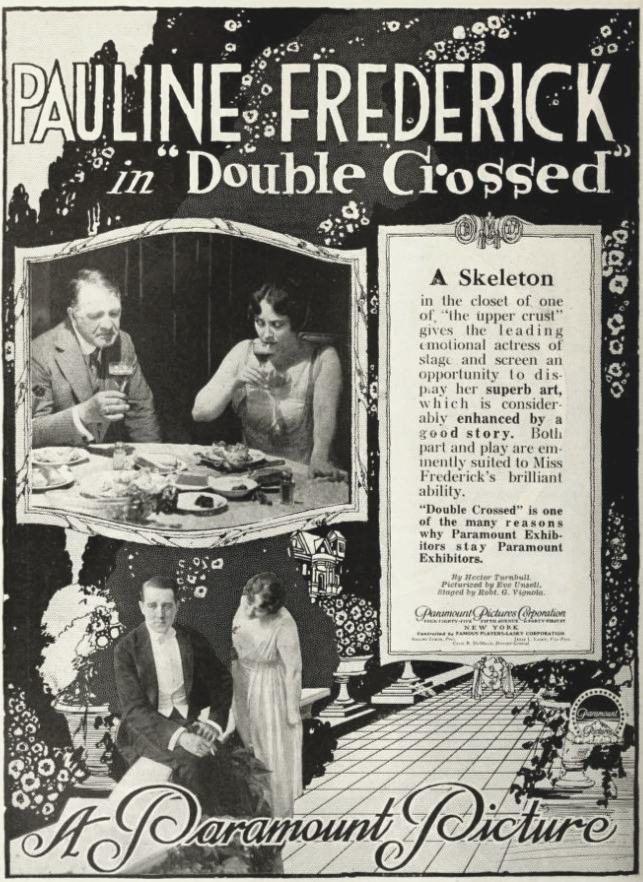
Years unfurl, carrying with them the illusion of forgotten transgressions. Stratton, one presumes, has moved on, perhaps even forgotten the precise details of that youthful folly. But Foley, the meticulous architect of ruin, has not. The narrative then shifts into a higher gear with the introduction of a political subplot, a common device in early cinema to heighten stakes and broaden the social commentary. A powerful political boss, facing the imminent threat of electoral defeat, seeks Foley’s particular brand of expertise. His objective: to acquire sensitive papers from his opponent, Worthington Lawrence, a man of integrity and, crucially, a close friend of Stratton. This is where the threads of the past begin to tighten around Stratton once more.
Foley, with his encyclopedic knowledge of hidden vulnerabilities, immediately recognizes the strategic value of Stratton's connection to Lawrence. He confronts Stratton, brandishing the long-dormant confession. The choice presented to Stratton is agonizing: betray his friend, commit an act of political espionage, and further compromise his own moral compass, or face the public humiliation and ruin that the revelation of his past theft would inevitably bring. This central dilemma forms the dramatic core of Double Crossed, forcing both the character and the audience to grapple with the profound implications of choices made under duress. The film excels in portraying the psychological weight of this blackmail, making Stratton’s internal struggle palpable even without spoken dialogue.
The success of any silent film hinges significantly on the expressiveness and conviction of its performers, and Double Crossed is particularly fortunate in its ensemble. Pauline Frederick, a luminary of the era, graces the screen, though her precise role in this particular narrative is often understated in plot summaries, her presence invariably elevates the film. Frederick was renowned for her intense emotional portrayals, her ability to convey deep feeling through subtle gesture and piercing gaze. While the primary conflict revolves around Stratton and Foley, Frederick's character often serves as the moral compass or the emotional anchor, her reactions amplifying the stakes and reflecting the audience's own anxieties. Her performance, even in a supporting capacity, adds layers of pathos and sophistication to the unfolding drama, reminding us of the human cost of these Machiavellian games.
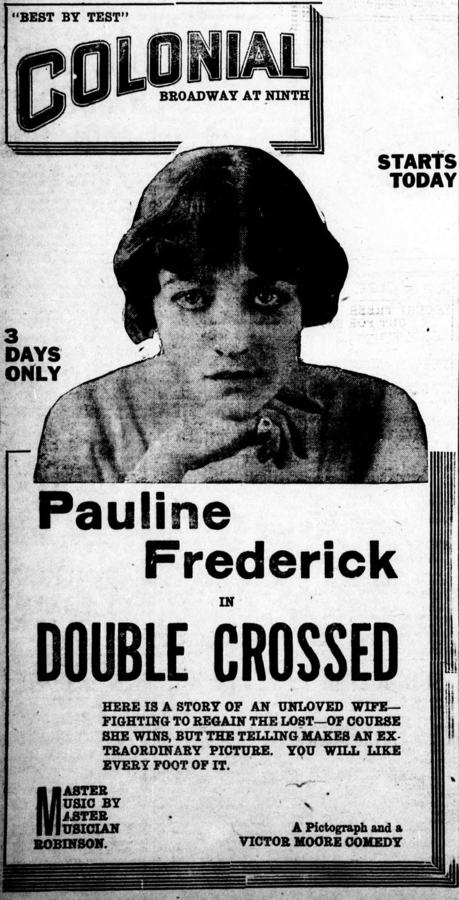
Crauford Kent, as Frank Stratton, carries the considerable burden of the protagonist's moral wrestling. He navigates the character's journey from careless privilege to tormented victim with commendable skill. His initial nonchalance regarding the bracelet gradually gives way to a visible anguish as Foley's grip tightens. Kent's physicality and facial expressions are crucial in conveying Stratton's internal turmoil, particularly in a medium devoid of spoken words. One can almost feel the weight of the signed confession pressing down on him, a spectral presence in every scene.
Clarence Handyside's portrayal of Jim Foley is a masterclass in villainy. He imbues Foley with a sinister charm, a calculating intelligence that makes him far more menacing than a mere brute. Handyside doesn’t resort to overt theatrics; instead, he crafts a character whose power lies in his quiet menace, his unwavering resolve to exploit human weakness. Foley is not just a crooked detective; he is an embodiment of corruption, a man who understands the dark undercurrents of society and uses them to his advantage. His performance is a chilling reminder that true evil often wears a veneer of respectability.
Supporting players like Joseph W. Smiley, Riley Hatch, and Harris Gordon contribute to the film’s rich tapestry, each adding depth and authenticity to their respective roles, whether as the calculating political boss or the unwitting victim Worthington Lawrence. Their collective efforts ensure that the world of Double Crossed feels lived-in and believable, enhancing the dramatic impact of the central conflict.
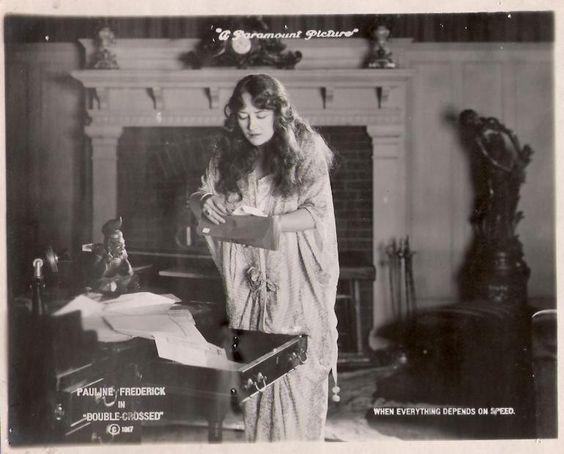
The directorial hand, though uncredited in many early films, and the screenwriting efforts of Hector Turnbull and Eve Unsell are evident in the film's taut pacing and well-structured narrative. Turnbull and Unsell, adept at crafting compelling stories for the silent screen, understood the necessity of visual storytelling. They built a plot that, while intricate, remains remarkably clear through its intertitles and the actors' performances. The way the narrative slowly builds from a minor transgression to a full-blown political conspiracy is a testament to their skill in escalating tension organically.
The screenplay avoids unnecessary digressions, keeping the focus firmly on Stratton's predicament and Foley's relentless manipulation. This focus allows the audience to fully immerse themselves in the psychological drama, making Stratton's moral dilemma acutely felt. The writers also deserve credit for creating characters that, despite the archetypal nature often found in early cinema, possess enough complexity to feel genuinely human. Foley, for instance, is not a cartoon villain; he's a pragmatic opportunist, making his actions all the more disturbing. The narrative structure, with its initial setup of the blackmail, the passage of time, and the eventual re-activation of the threat, is remarkably sophisticated for its era, demonstrating a keen understanding of suspense and dramatic irony.
Cinematically, Double Crossed, like many films of its period, relied on clear, functional compositions. While the elaborate camera movements and sophisticated editing techniques of later eras were still nascent, the film effectively uses framing and lighting to convey mood and emphasize character. The stark contrasts of light and shadow, characteristic of silent film, are employed to underscore the moral ambiguities of the story. Close-ups, though perhaps not as frequent or as emotionally charged as in later German Expressionist works or the films of D.W. Griffith, are used judiciously to highlight key facial expressions, particularly during moments of intense emotional conflict or revelation.
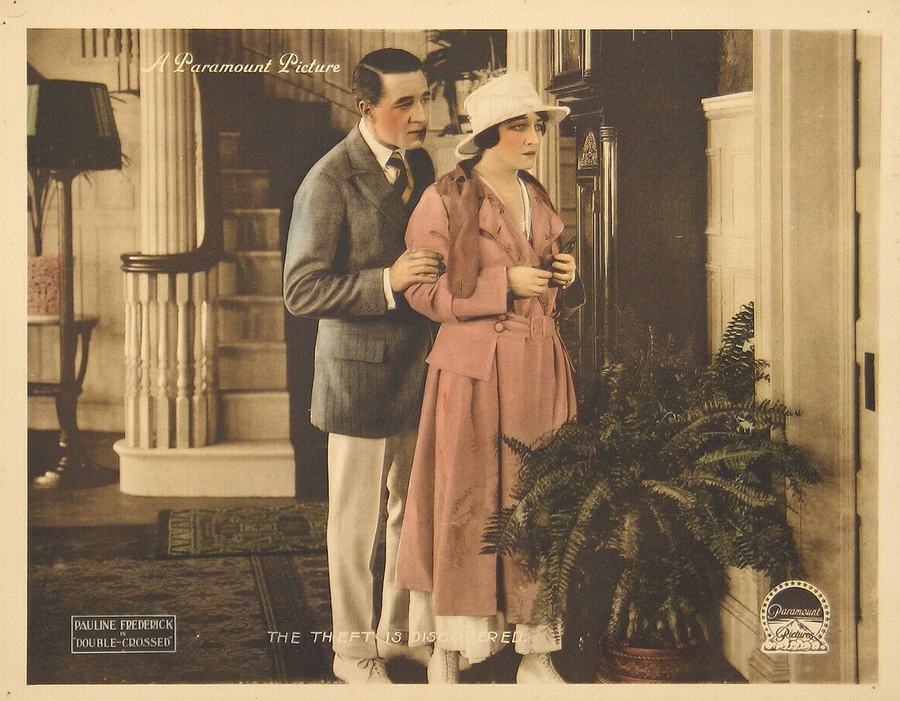
The production design, while not overtly lavish, successfully establishes the social strata of its characters, from Stratton's comfortable milieu to Foley's more utilitarian, yet equally imposing, environment. The setting of the political machinations adds another layer of intrigue, grounding the personal drama within a broader societal context. These visual elements, combined with the actors' performances, ensured that the narrative remained compelling and easy to follow, a crucial factor for audience engagement in the silent era.
Double Crossed exists within a fascinating period of cinematic development, a time when storytelling conventions were rapidly evolving. Its themes of blackmail, moral compromise, and the corrupting influence of power resonate with other films of its time and even anticipate later noir traditions. One might draw parallels to the intricate moral dilemmas found in films like Their Compact, where personal commitments clash with external pressures, or the darker undercurrents explored in Cross Currents, another film that delves into the complexities of human relationships and hidden motives. While not a direct stylistic comparison, the grand narratives and moral struggles seen in epics like The Last Days of Pompeii (1913) or the adventurous spirit of The Three Musketeers (1916) offered audiences different forms of escapism, Double Crossed grounded itself in a more psychological realism, albeit heightened for dramatic effect.
The film's exploration of a past secret coming back to haunt the protagonist finds echoes in works like Shadows from the Past, where hidden histories invariably rise to the surface, demanding reckoning. Similarly, the theme of social standing and its vulnerabilities, so central to Stratton's predicament, can be observed in films like The Sporting Duchess, which often explored the fragility of reputation within aristocratic circles. The tension between personal integrity and corrupt external forces, particularly in a political context, is a recurring motif in cinema, and Double Crossed tackles it with a directness that foreshadows later political thrillers.
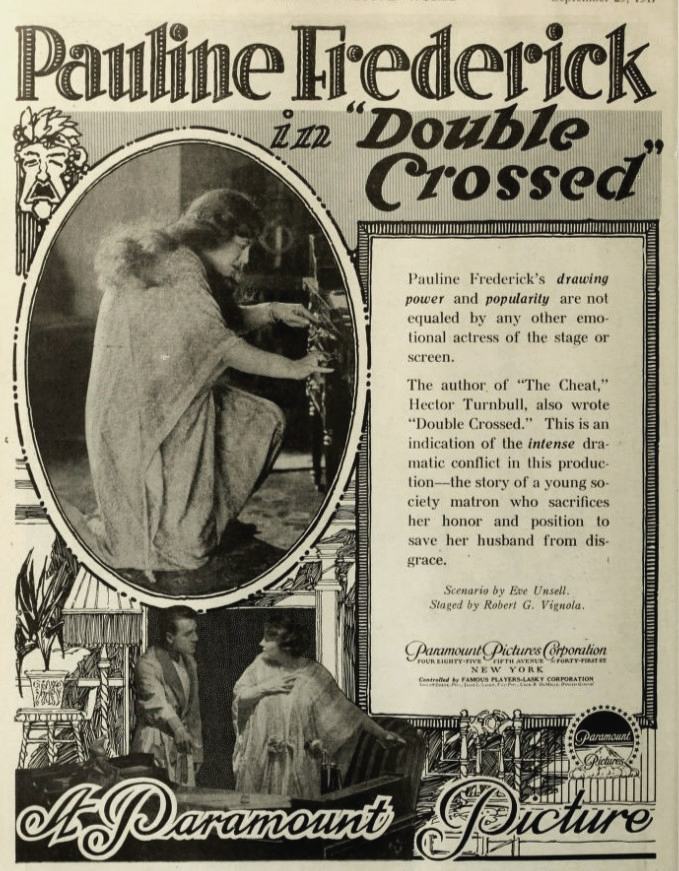
Moreover, the film's focus on the moral degradation caused by coercion and the ethical compromises demanded by survival aligns it with a lineage of narrative that examines the darker aspects of human nature. It’s less about grand historical events and more about the intimate, devastating impact of personal failings and systemic corruption. This makes it a compelling precursor to the more intricate psychological dramas that would emerge in subsequent decades, showcasing how early filmmakers were already grappling with complex character motivations and moral ambiguities.
Double Crossed, while perhaps not as widely known as some of its more epic contemporaries, holds significant value for both film historians and casual viewers interested in the roots of cinematic storytelling. It demonstrates a sophisticated understanding of narrative tension, character development, and the power of visual communication, even within the technical constraints of the era. The moral dilemma at its core—the choice between personal ruin and betraying a friend—is universally resonant and remains a potent source of dramatic conflict.
The film serves as a potent reminder of the fragility of reputation and the long shadow cast by past misdeeds. It argues, implicitly, that even the most fleeting lapse in judgment can be weaponized by those who seek to exploit vulnerability. The character of Jim Foley is particularly memorable, a chilling archetype of the corrupt power broker whose influence extends far beyond the confines of the law. His methodical cruelty, contrasted with Stratton’s increasingly desperate plight, creates a powerful emotional dynamic that keeps the audience invested.
In an age where digital effects and rapid-fire editing often dominate, revisiting a film like Double Crossed offers a refreshing perspective on the foundational elements of compelling cinema. It proves that a gripping story, well-developed characters, and emotive performances are the true bedrock of any enduring film. The film's ability to maintain suspense and explore complex ethical questions without a single spoken word is a testament to the artistry of silent cinema and the talent of its creators, Hector Turnbull and Eve Unsell, in conjunction with the dedicated cast. It's a film that quietly demands attention, rewarding the viewer with a narrative that is both historically significant and dramatically satisfying. For those seeking to understand the evolution of the thriller genre and the psychological drama, Double Crossed is an essential watch, a compelling artifact from a bygone era that continues to speak volumes about the human condition.
IMDb 5.8
1934
Community
Log in to comment.