DbcultAccessing Vault...
5.6/10
Senior Film Conservator
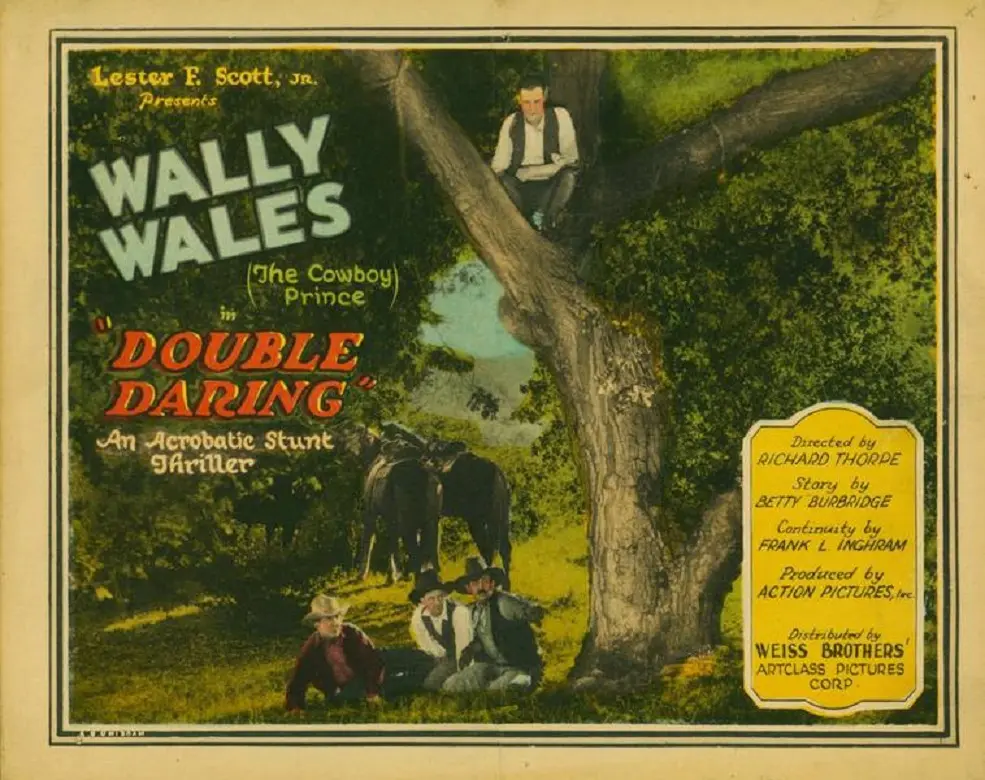
A definitive 5.6/10 rating for a film that redefined the boundaries of cult cinema. Double Daring remains a cornerstone of transgressive art.
Is Double Daring worth seeking out in an age of high-definition blockbusters? Short answer: only if you have a deep-seated reverence for silent-era Westerns or a scholarly interest in the early career of Jean Arthur. For the casual viewer, it will feel like a dusty artifact, but for the cinema historian, it offers a fascinating glimpse into the Poverty Row production machine of 1926.
This film is for the completionists who want to see the DNA of the American Western before it became a polished myth. It is NOT for anyone who requires fast-paced editing, complex dialogue, or a narrative that deviates from the standard 'hero-saves-the-day' template. It is a slow burn that relies entirely on the charisma of its leads and the physical danger of its stunts.
1) This film works because of its unvarnished physicality and the genuine danger present in its stunt work.
2) This film fails because the script by Betty Burbridge and Richard Thorpe relies on every cliché available in the 1920s Western handbook.
3) You should watch it if you want to witness the humble beginnings of Jean Arthur before she became a screwball comedy icon.
Double Daring is a product of its time, and that is both its greatest strength and its most glaring weakness. Directed by Richard Thorpe, who would go on to become one of the most prolific directors in Hollywood history, the film exhibits a functional, almost workmanlike approach to storytelling. Unlike the experimental flourishes seen in Kino Pravda No. 16: Spring Kino-Pravda. A Picturesque, Lyrical Newsreel, Thorpe isn't interested in the 'truth' of the camera. He is interested in the movement of the horse.
The pacing is deliberate, bordering on glacial by modern standards. In one early sequence, Wally Wales spends an inordinate amount of time simply mounting his horse and surveying the horizon. To a 1926 audience, this was world-building. To a 2024 audience, it’s a test of patience. However, there is a rugged honesty in the cinematography. The dust isn't a special effect; it's real. The sweat on the actors' brows isn't glycerin; it's the result of a grueling shoot in the California sun.
Wally Wales (born Hal Taliaferro) was a star who never quite reached the pantheon of Wayne or Ford, but in Double Daring, you can see why he was a reliable B-movie lead. He possesses a lean, wiry athleticism that feels more authentic than the beefed-up stars of later decades. He doesn't act so much as he exists within the frame. His performance is entirely physical, a necessity in a medium devoid of spoken word.
There is a specific scene involving a chase across a rocky ridge that highlights Wales' capabilities. He performs his own stunts, and the lack of safety nets or CGI is palpable. When his horse stumbles slightly on a loose stone, the tension in the frame is real. It’s a moment of genuine peril that modern films often struggle to replicate with all their digital wizardry. It works. But it’s flawed. The emotional range Wales displays is limited to 'determined' and 'slightly more determined.'
The most compelling reason to watch Double Daring today is the presence of Jean Arthur. Long before she was the witty, husky-voiced lead of Mr. Smith Goes to Washington, she was a versatile player in silent shorts and features. Here, she is relegated to the 'damsel' role, but she brings a level of nuance that the script doesn't necessarily deserve. Her eyes do more work than the intertitles.
In a scene where she confronts the villain, played with mustache-twirling relish by Slim Whitaker, Arthur displays a flash of the fire that would later define her career. While the film lacks the sophisticated social commentary found in Hypocrites, Arthur’s performance suggests a character with internal life beyond the plot's requirements. She feels out of place in the best way possible—too talented for the material, yet giving it her all regardless.
Richard Thorpe’s direction is efficient. That is the kindest word for it. He doesn't take risks. Every shot is composed to ensure the action is clear and the actors are visible. It lacks the atmospheric dread of The Carter Case or the domestic tension of Discontented Husbands. Instead, Thorpe focuses on the mechanics of the Western: the gunfight, the ride, the rescue.
The cinematography is stark. The high-contrast lighting of the outdoor scenes often washes out the background, creating a sense of isolation. This might have been a budget constraint, but it works to the film's advantage. It makes the frontier feel like a void where only the characters exist. The editing is functional, though some of the transitions feel abrupt, likely a result of the surviving prints' condition rather than the original intent.
If you are looking for a masterpiece of silent cinema, look elsewhere. Double Daring is a B-movie through and through. However, if you are interested in the evolution of the Western genre, it is an essential piece of the puzzle. It represents the transition from the theatricality of early silents to the more grounded, action-oriented style of the 1930s.
Is it entertaining? In short bursts, yes. The stunt work remains impressive, and the chemistry between Wales and Arthur is better than expected. But it requires a specific mindset. You have to be willing to engage with a film that is nearly a century old and accept its limitations. It’s not a 'good' movie by modern standards, but it is a fascinating one.
Pros:
- Early performance by Jean Arthur.
- Genuine 1920s location shooting.
- Physicality of the lead actor.
- Short runtime makes it an easy watch for historians.
Cons:
- Extremely predictable plot.
- Static camera work in many scenes.
- Lack of character depth for the supporting cast.
- Poor print quality in most available versions.
Double Daring was produced in a time when films were churned out like widgets. It doesn't have the artistic pretensions of Prima Vera or the social weight of Open Your Eyes. It was made to fill a Saturday afternoon slot in a rural theater. There is something noble in that simplicity. It wasn't trying to change the world; it was trying to provide 50 minutes of escapism.
When you compare it to other films of the era, like A Girl at Bay or Hush Money, you see a clear divide. While those films were exploring domestic drama and urban mystery, Double Daring was keeping the myth of the West alive. It’s a myth that would eventually be deconstructed by later filmmakers, but here, it is presented with total sincerity.
Double Daring is a minor work in the grand scheme of film history, but it is a sturdy one. It survives as a testament to the durability of the Western and the early talent of its stars. It isn't a essential viewing for everyone, but for those who love the flicker of nitrate and the sound of a silent projector, it’s a journey worth taking. It’s a 5/10 as a film, but an 8/10 as a historical document.
IMDb —
1919
Community
Log in to comment.