DbcultAccessing Vault...
Cult Review
Senior Film Conservator
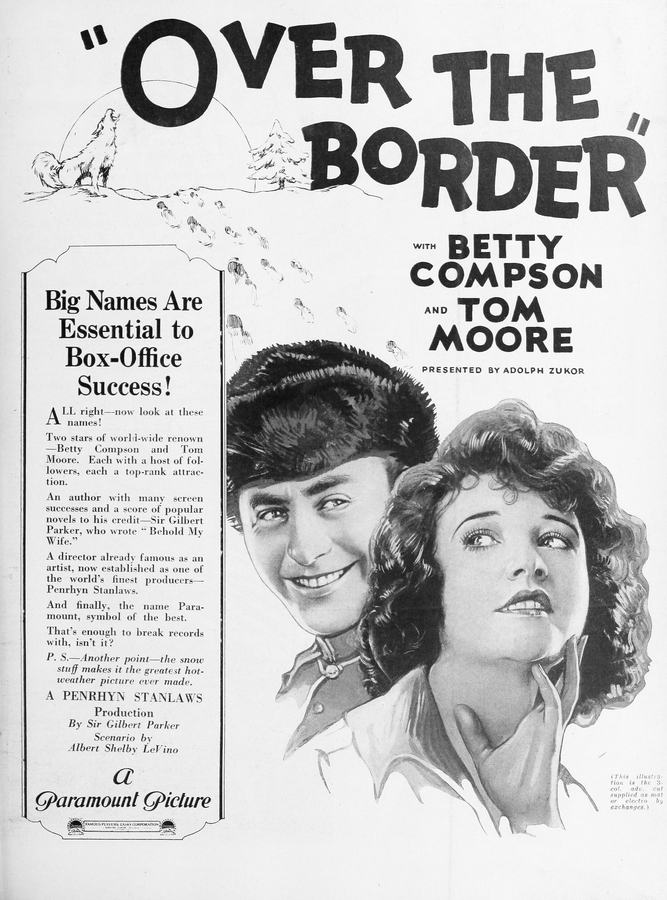
The first time you witness Betty Compson’s Jen Galbraith pressing her gloved palm against the frost-laced window of a clapboard distillery, you realize Over the Border is not merely another Prohibition-era programmer—it is a chiaroscuro symphony, a film that inhales the metallic tang of bootleg liquor and exhales something close to pastoral tragedy. Director William C. deMille—often eclipsed by his more flamboyant younger brother Cecil—opts here for a spartan lyricism, allowing the Canadian wilderness to dwarf human scheming until faces become punctuation marks in an endless sentence of snow.
Cinematographer L. William O’Connell shoots the white expanses as if they were a moving charcoal sketch: every flake is a pin-prick of mercury, every breath a ghost. The smugglers’ sleighs, lacquered in tar and pulled by steaming Percherons, carve black scars across the frame—an inverted meteor shower. When Jen races through the forest to warn her father, the camera pirouettes 360 degrees, a gambit that predates Spielberg’s famous truck chase in Raiders by six decades, yet achieves kinetic rapture without a single sync-sound rev.
Betty Compson, fresh from her triumph in The Miracle Man, modulates Jen’s arc from dewy idealism to granite resolve with nothing more than the tremor of a lower lip and the flare of a nostril. Watch her eyes in the close-up after the Mounties slap handcuffs on her wrists: the pupils dilate, not with fear, but with the sudden recognition that love and blood can occupy the same breath. Opposite her, Joe Ray’s Sgt. Flaherty is stoic without sliding into oak-paneled caricature; his jawline, sharp enough to slice bannock, softens only when Jen’s letter—snow-damp, ink blurred—reaches his frost-bitten fingers.
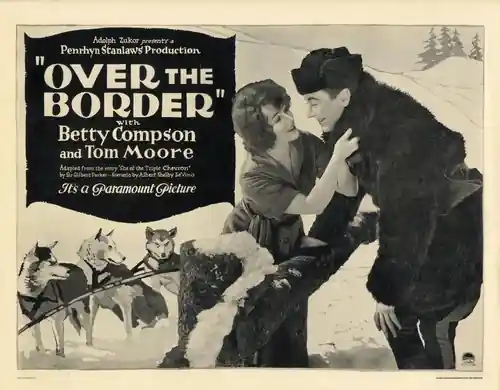
Casson Ferguson’s Val is a marvel of neurasthenic energy, a man whose moral compass spins like a weather vane in a cyclone. When he levels his Colt at Snow Devil, the camera captures not the gun but the tremor in his wrist—a micro-ballet of hesitation that speaks louder than any intertitle. J. Farrell MacDonald, as the paternal moonshiner Peter, delivers the film’s most chilling line via title card: "A wolf doesn’t ask permission to cross a line drawn by men." The words linger, superimposed over his face half-shadowed by kerosene lamplight, and you feel the entire Canadian wilderness concur.
Albert S. Le Vino’s scenario, adapted from a Gilbert Parker short, compresses what could have been a lumbering 12-part serial into a taut 68 minutes. The narrative obeys the Aristotelian unities more rigorously than most stage plays: the bulk of the action unfolds within a 36-hour blizzard, creating a pressure cooker where every creak of timber sounds like doom. Notice how the screenwriters withhold physical confrontation until the final reel; instead, they weaponize weather itself—snow becomes both curtain and character, erasing footprints, identities, and ultimately guilt.
Yet the film’s boldest gambit is structural: the traditional climax—Val’s capture—arrives only to be instantly undercut by Pierre’s dying confession. In effect, the screenplay stages its own deus ex machina, then dares us to question the morality of such divine favors. The result is a meta-textual wink that feels startlingly modern, akin to the rug-pulls in The Evil Eye or the moral vertigo of For a Woman’s Fair Name.
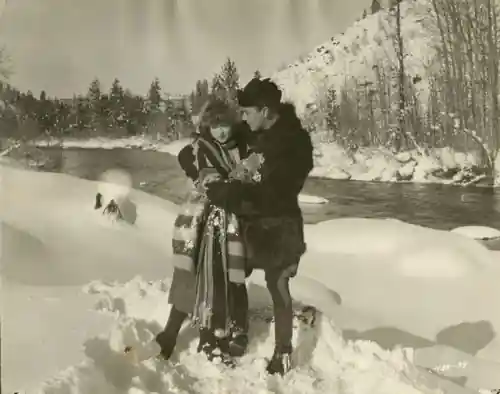
Silent cinema rarely granted women agency without punishing them for it; Over the Border bends but does not break that rule. Jen’s ride through the maelstrom to deliver Flaherty’s dispatch is no mere damsel errand—it is an act of authorship, rewriting the official record with her own frozen fingers. Still, the film hedges its bets: her heroics are ultimately in service of the male legal apparatus. Compare this to the more radical gender subversion in The New York Peacock, where the heroine weaponizes her sexuality without narrative reprimand. Here, Jen’s reward is matrimony, not autonomy—a compromise that tastes of the very whiskey her family traffics: sweet burn, then residual bitterness.
Viewed today with a contemporary score—say, a minimalist string quartet punctuated by Inuit throat-singing—the film acquires an uncanny second life. The crunch of snow under horse-shoe, the hiss of a kerosene lantern, the brittle snap of a Mountie’s leather glove: these sounds exist only in your cortex, yet they resonate with bone-conduction intimacy. The silence is so absolute that when an intertitle intrudes—white letters on black—it feels like a gunshot. Try watching the blizzard sequence alongside Malick’s Days of Heaven; both films understand that the most terrifying sound is the wind when there is no voice to counter it.
Place Over the Border beside A Daughter of Australia and you see two antipodean explorations of frontier lawlessness—one antiseptic with snow, the other sun-scorched into myth. Pair it with The Channel Raiders and the thematic rhymes echo: smugglers, spies, lovers who must choose between bloodline and badge. Yet none of its contemporaries stage nature itself as both antagonist and absolution. Even Pals First, for all its masculine bravado, retreats to urban salons when danger looms. DeMille keeps his camera outdoors until the final clinch, letting frostbite stand in for conscience.
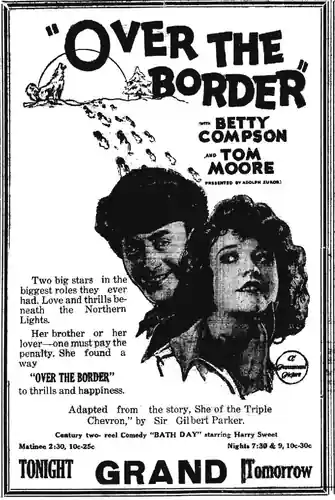
For decades the film languished in the Library of Congress’s paper-print collection, viewable only on a crank-viewer in the Madison building’s sub-basement. Then came the 2018 4K restoration by the National Film Board of Canada, scanned from a French Pathé nitrate struck in 1923. The tints—amber for lamplight, viridian for forest gloom, cobalt for blizzard—breathe like living tissue. The new Blu-ray, available via Kino, includes an audio essay by Shelley Stamp and a 20-page booklet on the feminist read of contraband cinema. Buy it, if only to witness how grain, when properly restored, can look like stardust scattered across obsidian.
Is Over the Border flawless? No. The comic-relief tavern keeper with his eye-rolling minstrel shuffle lands with a thud, and the interpolated biblical quotation ("Though your sins be as scarlet, they shall be white as snow") veers toward sanctimony. Yet these are flecks of ash on an otherwise immaculate stretch of white. The film endures because it trusts landscape to do what dialogue cannot: reveal the thin membrane separating civility from savagery, love from betrayal, snow from blood.
Watch it on a January night when pipes creak and windows frost over. Let the radiator clank in counter-rhythm to the on-screen howling wind. Feel your own living room become an annex of that 1922 blizzard, and ask yourself: if the borders of law and desire dissolved in your life, would you race across the drifts to save the very person duty-bound to imprison you? Jen Galbraith did. Her hoofbeats still echo, faint as film grain, loud as conscience.
References for further exploration: Married in Name Only • The Trufflers • Den tredie magt
IMDb —
1934
Community
Log in to comment.