DbcultAccessing Vault...
Cult Review
Senior Film Conservator
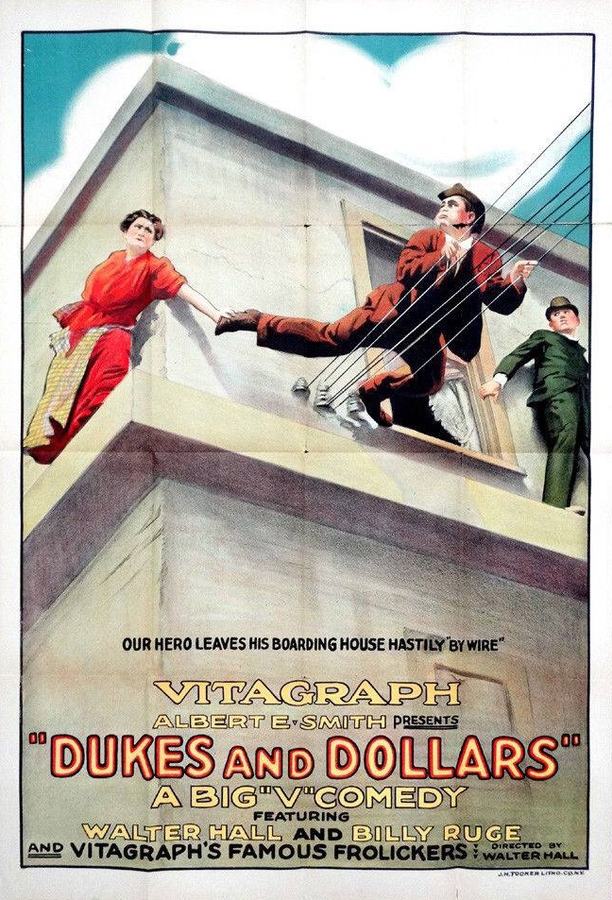
Ah, the silent era! A veritable crucible of cinematic innovation, where narratives unfolded through the exquisite ballet of gesture, expression, and the rhythmic flutter of intertitles. Among the myriad treasures unearthed from those nascent years, 'Dukes and Dollars' emerges as a particularly delightful artifact, a film that, despite its age, still possesses a vibrant, almost audacious energy. It’s a frothy confection, yes, but one laced with a surprisingly sharp social commentary, delivered with the kind of physical comedy and character-driven charm that defined the best of its contemporaries.
At its heart, 'Dukes and Dollars' is an exploration of ambition, specifically the kind that blossoms in the fertile ground of social stratification. Our protagonist, Bertie, portrayed with an endearing blend of roguish charm and desperate aspiration by Billy Ruge, is hardly a villain. He’s more of a dreamer, albeit one whose dreams are paved with other people’s gold. Ruge, a familiar face from early screen comedies, brings a palpable sense of wide-eyed determination to Bertie, making his audacious scheme to pose as a European duke not merely opportunistic, but almost sympathetic in its sheer audacity. His physical comedy, often subtle yet effective, speaks volumes in the absence of dialogue, conveying Bertie's internal struggles and external bluster with remarkable clarity.
Ruge’s performance is a masterclass in silent film acting. He understands the camera’s gaze, using exaggerated postures and micro-expressions to communicate Bertie’s inner turmoil – the flicker of fear when nearly exposed, the puffed-up pride when his deception momentarily succeeds, the frantic energy of a man perpetually on the brink. It’s a performance that recalls the nuanced, yet broad, comedic styles seen in films like The Social Secretary, where a protagonist navigating social strata often relies on a carefully constructed persona. Bertie’s 'Duke Reginald de Posh' is a magnificent construction, a caricature of European aristocracy filtered through an American lens, complete with affected gestures and a perpetually quizzical, yet self-assured, expression.
The narrative, deftly crafted by Walter R. Hall, who also features in a pivotal role, builds its comedic tension through a series of escalating near-misses and mistaken identities. Hall’s dual contribution here, both behind the typewriter and in front of the lens, is noteworthy. As Mr. Sterling, the shrewd industrialist, Hall embodies the pragmatic American antithesis to Bertie's European affectations. His Sterling is not merely a wealthy patriarch; he is the embodiment of common sense and a keen observer of human nature. His skepticism about 'Duke Reginald' is not born of snobbery, but rather a deep-seated distrust of superficiality, a character trait that lends considerable weight to the film’s eventual moral reckoning.
The dynamic between Bertie and Sterling is the film’s comedic engine, a delightful clash of pretension versus perspicacity. Sterling’s quiet, watchful presence constantly threatens to dismantle Bertie’s elaborate charade, creating moments of genuine suspense blended seamlessly with laugh-out-loud humor. The introduction of Eleanor, Sterling's daughter, adds another layer of complexity. She is not merely a prize to be won but a character with her own agency and desires, secretly devoted to Jack, the earnest inventor. This romantic subplot is handled with a delicate touch, avoiding melodrama in favor of highlighting the authenticity of true affection against the allure of mere titles and fortunes. It subtly echoes themes found in films like A Kentucky Cinderella, where societal expectations clash with genuine sentiment.
The arrival of the *real* Duke Reginald, an impoverished but genuinely aristocratic figure, is where the film truly hits its comedic stride. This plot device, a staple of farcical narratives, is executed with particular panache here. The real duke, seeking solace from the very superficiality Bertie craves, provides a stark, ironic contrast. The scenes where the two 'dukes' inadvertently cross paths or are mistaken for one another are exquisitely choreographed, showcasing the precision required for silent comedy. The film’s direction, though uncredited beyond the writer Walter R. Hall (who likely had a significant hand in shaping the visual narrative), maintains a brisk pace, ensuring that the comedic momentum never flags.
Visually, 'Dukes and Dollars' captures the opulence of the Gilded Age with considerable flair. The society balls, the lavish costumes, and the grand interiors are all rendered with an attention to detail that transports the viewer directly into this world of conspicuous consumption. Yet, beneath the glittering surface, the film poses fundamental questions about identity and value. Is a title truly worth more than integrity? Can money buy happiness, or merely a temporary illusion of it? These are timeless inquiries, and the film tackles them with a light touch, never descending into heavy-handed moralizing, but allowing the unfolding events to speak for themselves.
The screenplay by Walter R. Hall is remarkably tight, a testament to the structured storytelling prevalent in the silent era. Each character serves a distinct purpose, and every plot twist propels the narrative forward, escalating the stakes for Bertie with each passing scene. The intertitles, crucial conduits of information and emotional nuance in silent film, are crafted with wit and precision, often injecting additional humor or foreshadowing. They are an integral part of the film's overall comedic rhythm, much like the meticulously placed intertitles in a film such as The Hoosier Schoolmaster, which also relied heavily on textual narrative to guide its audience.
While Ruge and Hall anchor the film, the supporting cast, particularly the actress portraying Eleanor, brings a quiet dignity and intelligence to her role. She is not merely a damsel in distress or a passive object of affection; she possesses an inner strength and a clear understanding of her own desires. The character of Gumshoe Gus, the private investigator, provides another layer of comedic relief, his bumbling yet persistent efforts to uncover the truth adding to the delightful chaos. The ensemble works cohesively, each player contributing to the vibrant tapestry of the story, reminiscent of the well-orchestrated casts in ensemble pieces like Revelation, where every character, no matter how small, adds to the overall impact.
The climax of 'Dukes and Dollars' is a masterclass in comedic resolution. The grand society gala, a recurring motif throughout the film, becomes the stage for the ultimate unmasking. The convergence of both 'dukes,' the suspicious Sterling, the earnest Eleanor and Jack, and the bumbling Gumshoe Gus creates a pressure cooker of impending revelation. The unraveling of Bertie’s deception is handled with a satisfying blend of comeuppance and a touch of pathos, allowing the audience to feel both the justice of his exposure and a slight pang of sympathy for his failed ambitions. It’s a moment that, while comedic, also carries a profound thematic weight, highlighting the film’s central message about authenticity.
'Dukes and Dollars' stands as a testament to the enduring power of classic comedic storytelling. Its themes of social climbing, mistaken identity, and the pursuit of love over lucre are as relevant today as they were a century ago. It’s a narrative structure that has been revisited countless times, from the screwball comedies of the 1930s to modern romantic farces, underscoring its timeless appeal. The film reminds us that while the trappings of wealth and status may change, human nature – with its desires, follies, and occasional moments of genuine grace – remains remarkably consistent.
For enthusiasts of early cinema, 'Dukes and Dollars' offers a compelling glimpse into the sophisticated comedic sensibilities of the era. It’s a film that proves that silent cinema was far from simplistic; it was a highly expressive and nuanced art form capable of delivering complex narratives with both humor and heart. The performances, particularly Ruge’s captivating turn, are a joy to behold, a reminder of the unique demands and triumphs of acting without spoken words. The film's ability to elicit genuine laughter and thoughtful reflection is its greatest strength, solidifying its place as a significant, albeit perhaps lesser-known, entry in the silent film canon.
In an age saturated with spectacle and sound, there's a particular charm in revisiting a film like 'Dukes and Dollars.' It invites us to engage our imaginations, to read the nuances in a glance, the humor in a pratfall, and the emotion in a well-timed gesture. It’s a cinematic experience that rewards careful observation and offers a delightful escape into a bygone era, all while delivering a timeless message about the true meaning of wealth and happiness. If you appreciate the intricate plotting of The Poor Rich Man or the dramatic reveals of The Concealed Truth, you'll find 'Dukes and Dollars' to be a kindred spirit, a film that leverages its comedic premise to explore deeper human truths.
The film’s legacy, while not as widely celebrated as some of its more famous contemporaries, is nonetheless important. It showcases the versatility of its cast and writer, and its narrative structure remains a blueprint for countless romantic comedies that followed. It’s a film that, like a perfectly preserved antique, reveals more of its intricate craftsmanship the closer one examines it. So, if you ever find yourself yearning for a cinematic journey back to a time when expression was paramount and laughter was a universal language, seek out 'Dukes and Dollars.' You’ll be richly rewarded with a tale that is as entertaining as it is insightful, a delightful reminder that true value lies not in inherited titles or bulging wallets, but in honesty and genuine affection.
The craft involved in creating such a vibrant and engaging story without a single spoken word is truly remarkable. From the elaborate set designs that transport us to the grand ballrooms of the elite, to the nuanced performances that convey a spectrum of human emotion, every element works in concert. The pacing is deliberate, allowing comedic moments to breathe and dramatic tension to build, a hallmark of effective silent filmmaking. It avoids the common pitfalls of overly simplistic plots or one-dimensional characters, instead presenting a world rich with human foibles and aspirations. The film’s ability to evoke empathy for Bertie, despite his deceptive nature, is a testament to Ruge’s performance and Hall’s skillful writing. We understand his desperation, even if we don't condone his methods. This humanistic approach elevates 'Dukes and Dollars' beyond mere slapstick, positioning it as a sophisticated social commentary wrapped in a comedic package.
IMDb —
1933
Community
Log in to comment.