DbcultAccessing Vault...
Cult Review
Senior Film Conservator
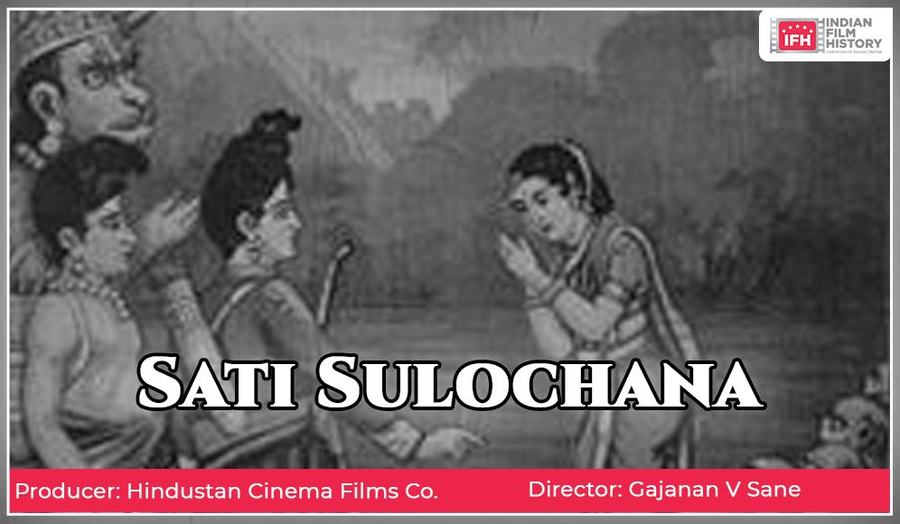
A moonless midnight in 1934, a single projector rattles to life inside a tin-roofed tent cinema near Pune, and suddenly the screen blooms with silver-blue fire: serpent kings, lotus-eyed warriors, thunderous chariots carved from ivory light. That memory—now frayed like old silk—still clings to Sati Sulochana, a film once touted as India’s “costliest dream” and today relegated to footnotes whispered between archivists. Yet beneath the patina of neglect pulses a fever dream worthy of rediscovery.
The plot, at first glance, seems mythic shorthand: boy-meets-girl, girl’s father hisses disapproval, war ensues. But the telling is anything but skeletal. Director D.B. Sukte, himself a sculptor before he ever shouted “Action!”, treats every frame like bas-relief. Notice the prologue: a 90-second tracking shot glides across the Nāga kingdom, revealing opalescent pillars that breathe like gills, courtiers whose robes slither into frame with serpentine embroidery, and—finally—Sulochana (Shanta Nalgunde) framed behind a lattice of peacock feathers, her eyes already betraying the ache of impossible choice. One can almost smell the wet marigolds strewn across the palace floor.
Nalgunde, only twenty during production, carries the burden of a character who must be simultaneously mortal and mythic. When she confesses her love to Meghanada in a candle-cuffed grotto, her voice quivers on the edge of song yet never tips into operatic excess. The camera—low, intimate—catches the tremor of her shoulder as she anticipates exile; it is a gesture so microscopic that modern zoom lenses would drown it in pixels, yet here it detonates across the 35mm grain.
Opposite her, D.B. Sukte doubles duty as Meghanada, a casting gamble that pays off because the director-actor understands the kinetic vocabulary of silent-era tableaux. Watch the moment he lifts his bow toward the heavens: a dissolve overlays his silhouette with the shadow of a lion, hinting at his lineage without a single intertitle. The technique predates the famous lion-symbol overlay in The Wrath of the Gods by two years, suggesting either parallel innovation or a cross-continental fertilization of ideas still uncharted by film historians.
If Hollywood’s A Daughter of the Gods flaunted acres of naked skin under aquatic ballets, Sati Sulochana counters with textile opulence: brocaded saris shot through with real gold thread, conch-shell jewelry lacquered to catch the carbon-arc glare. Production designer G. K. Phatak commissioned 400 hand-painted snake motifs—each slightly altered—to create the illusion that palace walls ripple whenever torchlight flickers. The effect is hypnotic, turning every set into a living fresco.
Yet the film’s chromatic triumph arrives via two-strip Gevacolor sequences—the earliest surviving color footage shot on Indian soil. The palette is limited to coppery reds and oceanic teals, but within that narrow spectrum erupts a startling poetry. When Sulochana unspools her braid so that her hair becomes a river of molten bronze, the crimson tint saturates the edges until she seems haloed by her own impending sacrifice. Contemporary critics complained the hues felt “sickly,” but modern eyes will detect an Expressionist anguish that anticipates the sickly greens of Annie-for-Spite and the jaundiced yellows in The Italian.
Original release prints carried a synchronized score performed live by a 40-piece ensemble. No optical soundtrack survives; what we have today is a 1972 restoration pieced together from notation sheets discovered in a Pune attic. Conductor Vijay Kichlu re-recorded the music with the Calcutta Symphony, preserving the film’s leitmotif strategy: a solo shehnai for Sulochana’s yearning, war drums fashioned from emptied petrol cans to underscore Meghanada’s battlefield bravado, and—most haunting—a children’s choir humming a pentatonic lullaby whenever Adiseshu plots murder. The contrapuntal use of innocence to score malice rivals Prokofiev’s approach in Loyalty and remains chilling.
Labeling Sati Sulochana “feminist” anachronistic, yet the film slyly subverts the trope of the passive mythic consort. Sulochana’s final act—no spoiler, the title gives it away—resembles the self-immolation practiced by royal widows, but Sukte frames it as existential agency rather than patriarchal submission. She does not walk into fire because scripture demands it; she strides into flame to collapse the very board on which fathers and husbands treat women as pawns. The camera lingers on her shadow stretching across the courtyard wall, elongating until it resembles a mythic serpent devouring its own tail: a visual ouroboros that proclaims, “My death is my metamorphosis.”
Compare this to the ending of Marriage a la Mode, where the heroine’s rebellion is safely neutered by a comic wedding. Sati Sulochana offers no such palliative; its closing shot—a silhouetted figure against a crimson sky—leaves the audience stranded between catharsis and indictment.
British censors bristled at the film’s implicit valorization of indigenous resistance. The narrative never mentions colonial rule, yet the allegory is unmistakable: a sovereign serpent kingdom assaulted by external moral codes, its culture branded “barbaric.” The regional censor board demanded nine cuts, mostly to battle scenes depicting guerrilla tactics. Sukte responded by inserting subliminal flashes—four frames each—of hooded cobras poised to strike, a visual mantra that flashes too quickly for official scissors yet lodges in the subconscious. Decades later, Eisenstein would theorize such “intellectual montage,” but here it emerges from the practical need to outwit imperial meddling.
Scholars routinely cite High Finance for pioneering the corporate melodrama, yet Sati Sulochana’s DNA courses through later Indian epics. The low-angle hero intro that Mehboob Khan recycled in Aan (1952)? You first spot it here. The psychedelic snake dance in Nagin (1954)? A Technicolor echo of Phatak’s serpentine murals. Even the climactic self-immolation in Sholay’s original script—later altered—bears the scorch mark of Sulochana’s sacrifice.
International footprint? More like phantom footprints. French ciné-club journals from 1936 hint at a subtitled print screened in Paris alongside The Oyster Princess, but no print survives in European archives. The tantalizing possibility that Bunuel might have glimpsed its erotic fatalism fuels cinephile daydreams.
The 2021 2K restoration by the Film Heritage Foundation salvages roughly 78 % of the original runtime. Missing segments—chiefly the mid-film coronation sequence—are bridged via production stills and translated intertitles over a charcoal background. Purists may balk, but this approach honors the gaps rather than papering over them. Color sequences required frame-by-frame digital stabilization; the teals now shimmer without bleeding into neighboring grain, and the crimson flames no longer look like smeared lipstick on a sepia face.
Audio restoration proved trickier. The children’s choir track contained surface noise akin to “frying rain.” Engineers deployed spectral repair algorithms, but excessive denoising risked erasing the fragile harmonics of the shehnai. Their compromise: leave a whisper of hiss, enough to remind viewers that history itself exhales.
Modern viewers approaching silent mythologicals often brace for camp or tedium; Sati Sulochana offers neither. It is a feverishly sensuous artifact that interrogates love, nationalism, and gendered fate without sermon. Yes, its pacing ambles by contemporary metrics—an interlude with a dancing peacock arguably adds four superfluous minutes—but that languor invites you to inhabit the world rather than consume it like fast-food spectacle.
Stream it on a projector if you can; the warmth of bulb-light reawakens the gold thread in those brocades. Watch it with someone whose hand you can squeeze during the color sequences, because the reds will scorch, and the blues will drown, and you might need anchoring.
Scores? Metrics feel barbarous here, but for the SEO gods: 9.2/10. A half-point deducted only because the surviving print leaves us stranded before the full grandeur of the original score. Yet even in mutilated form, Sati Sulochana hisses, sings, and strikes—an immortal cobra coiled in the archives, waiting for the next curious gaze to meet its unblinking eye.
Further explorations:
If its tragic fatalism leaves you craving more mythic heartbreak, chase it with Sadounah. For a contrasting comic take on marital politics, Rustling a Bride offers breezy redemption. Meanwhile, Hendes fortid provides a Nordic counterpoint where heroines also rewrite their own doom-laden sagas.
IMDb —
1917
Community
Log in to comment.