DbcultAccessing Vault...
Cult Review
Senior Film Conservator
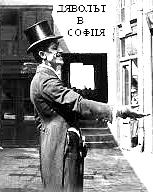
Imagine, if you will, the Prince of Darkness reduced to a vaudeville interlude—horns filed down, pitchfork swapped for a cane of polished mahogany—sauntering down Tsar Osvoboditel Boulevard only to discover that the capital of newly liberated Bulgaria can out-vicious his sulphurous résumé. Vassil Gendov’s 1920 provocation Dyavolat v Sofia (literally The Devil in Sofia) is less a narrative than a séance where silent-era cynicism dances the horo with expressionist shadow. The film survives only in fragmentary reels, yet what remains combusts with a satirical brimstone so acrid it still singes nostrils a century later.
The opening iris-in reveals a cavernous set straight out of The Pawn of Fortune, all jagged stalactites and dry-ice vapors. Our Mephistopheles—played by Gendov himself with a razor-slit grin—yawns, bored of tormenting mustachioed bureaucrats in the afterlife. A single intertitle, white on obsidian, quips: “Even damnation grows dull when sinners out-devil the devil.” Cue the descent: a wooden elevator rigged with visible pulleys drops him through a trapdoor that belches coal-smoke. The crude special effect, rather than undermining illusion, exposes mechanics the way the film will later expose society’s scaffolding of greed.
On Sofia’s streets, the fiend’s first reception is a hailstorm of stones flung by urchins who mistake his forked cape for a carnival prop. The montage—rapid jump-cuts between jeering faces, a policeman’s baton, and a stray dog baring yellow fangs—owes as much to Soviet agitprop as to home-grown theatricality. Within minutes, Gendov announces his thesis: post-war Bulgaria has grown so morally calloused that even Satan passes unnoticed.
Salvation (of sorts) arrives via technology: a shoebox-sized contraption that cranks out crisp banknotes. Once the devil exchanges goat-hoof boots for spats, citizens bow as if choreographed. In a sly visual pun, a shop-window mannequin tips its hat: consumerism itself genuflects before capital. The sequence recalls Jim the Penman, yet where that American film moralizes over forgery, Gendov’s camera lingers on the absurdity of instant respectability, letting laughter fester into unease.
With newfound liquidity, the devil purchases a mansion that once housed Russian émigrés. Its baroque interiors—mirrors in gilded frames, a chandelier heavy as a family tree—become the stage for soirées teeming with monocled officers, thick-necked bankers, and soprano prima donnas whose laughter shatters crystal. The set design intentionally over-flowers: every ottoman, every ashtray overstuffed, suggesting a society compensating for wartime deprivation through baroque excess.
Enter Mara (Maria Popova), the prostitute who eyes the devil’s wallet with the ravenousness of a woman long denied bread coupons. Popova’s performance oscillates between feline seduction and raw fatigue; her cigarette trembles like a seismograph measuring the city’s collective anxiety. She and Gendov share a delirious tango scored by a tinny salon orchestra. Their bodies, silhouetted against white curtains, foreshadow a danse macabre with society’s decay.
“I sell illusions; you buy eternity—let us trade,” Mara whispers, sealing the pact not with signed parchment but with a lipstick print on a champagne flute.
The film’s midpoint detours into a cramped apartment that smells of boiled cabbage and kerosene. Mara’s father (Ivan Popov) is a human bruise, eyes pickled from rakiya, fingers yellowed by petty larceny. He polishes stolen spoons while humming an off-key revolutionary hymn. The mother (Zhana Gendova) hunches over a sewing machine, feeding it cuffs like sacrificial offerings. Their kitchen becomes a microcosm: the father steals from kin, the mother enables survival, and Mara monetizes her flesh. The devil sits at their table, tasting soup seasoned with resignation, and realizes that every strata—high or low—boasts its own infernal pecking order.
In a scene both comic and harrowing, the father bargains with Satan: “Take my soul, but leave the bottle.” Gendov stages it in a single static take, forcing viewers to marinate in discomfort. The request is granted; the old man gulps plum brandy while his shadow, distorted by candlelight, sprouts horns of its own. Visual rhyming suggests the devil’s corruption is redundant; humanity has pre-corrupted itself.
The plot pivots when Madame Ivanova (Meri Mihaylova), draped in pearls thick as slave shackles, proposes a bargain: dispose of her ailing husband, inherit his tobacco plantations, and she will bankroll the devil’s mint. Instead of dirtying his manicured nails, Satan subcontracts the stab to Mara’s father, who accepts with a shrug that says: “Tuesday.” The murder occurs off-screen; we glimpse only the blood-spattered handkerchief he drops into the gutter, where rainwater dilutes crimson into pink, then nothing. The economy of violence—outsourced, sanitized, forgotten—mirrors the bourgeoisie’s relation to suffering.
Once the husband’s carcass cools, the father double-crosses his demonic employer, snatching the money-printer and fleeing toward the Greek border. Intertitles sardonically note: “Crime does pay—up front, in small unmarked bills.” The devil’s empire collapses overnight; creditors evaporate, lackeys pretend not to recognize him. A chilling montage intercuts beggars warming hands over trashcan fires with aristocrats waltzing under electric chandeliers, implying both groups burn refuse—only the trash differs.
Stripped of silk and swagger, the devil staggers through a nocturnal Sofia rendered by cinematographer Elena Snezhina as a labyrinth of tilted angles and smeared streetlamps. Fog slithers; stray newspapers slap his calves like ghostly cuffs. In a café, a former lackey pours seltzer on the devil’s shoes, laughing in pantomime so wide his dental fillings glint. The sequence is intercut with the fleeing father aboard a moonlit boxcar, cranking the machine that spews banknotes into the wind—an inverted snowfall of hollow promise.
Broken, the protagonist crawls toward Mount Vitosha, where a sulphuric vent promises passage home. His cloak is tattered, yet the ascent is shot as vertical liberation: the camera tilts skyward, stars swirling like sparks from a forge. A final intertitle reads: “Among mortals, I found my own inferno—let me retreat to the lesser evil.” Fade-out on his silhouette dissolving into smoke, leaving only the echo of laughter—audience or infernal, one cannot be sure.
Gendov’s visual grammar hybridizes German expressionist shadowplay with local theatrical flamboyance. Sets are often overbuilt, ceilings lowered to squash characters into their own greed. Lighting is sculptural: characters emerge cheekbones-first, eyes hollowed as if already skulls. Compare this to the sober naturalism of Daybreak, and you see why Bulgarian critics of 1921 derided the film as “decadent cosmopolitanism,” fearing its caricature of capital life might be mistaken for documentary.
The editing is propulsive even by Soviet standards. Overlays of coins, lips, and blood drops fuse lust, lucre, and violence into a single triptych. Meanwhile, the intertitles—hand-lettered on what resembles burnt parchment—ooze proto-surrealist wit: “Morality is a promissory note never redeemed.”
No original score survives; archives suggest orchestras accompanied screenings with a pastiche of kopanitsa folk rhythms and Wagnerian stabs. Modern restorations often commission discordant jazz, and rightly so: the devil’s waltzes beg for brass that slurs like alcoholics. When I re-watched at Sofia’s Kino Odeon, a live trio used clarinet glissandi to mimic the printing machine’s crank—an aural motif that burrowed under my skin long after the houselights rose.
Maria Popova’s Mara exudes the brittle glamour of Clara Bow after a weeklong binge, equal parts magnetism and desperation; watch how she pockets coins, fingers fluttering like trapped sparrows. Ivan Popov, as the parasitic patriarch, never tilts into buffoonery; his drunkenness is methodical, a slow erasure of self rather than comic shtick. And Gendov himself underplays Lucifer, relying on eyebrow arches that could slice bread. His gaunt frame, wrapped in velvet, becomes a black hole sucking moral light from every room.
Secondary roles sparkle briefly: Georgi Sotirov as a corrupt police prefect who times bribes with a pocket watch, and Elena Snezhina as a society duchess whose smile never reaches her pan-stick eyes. Collectively they form a frieze of civic rot worthy of The Price of Vanity or A Branded Soul, yet rooted in Balkan specificity.
Shot in the summer of 1920 amid agrarian unrest, the production faced obstruction from authorities who feared international embarrassment. Police seized reels, claiming “monetary propaganda undermines the lev.” Gendov negotiated their release by adding a sanctimonious epilogue—since lost—in which a priest denounces the love of money. The missing footage explains the abrupt ending on surviving prints; scholars still hunt for an uncut negative rumored to languish in a Viennese basement.
Financially, the picture hemorrhaged money; distributors hesitated to market a domestic satire when escapist melodramas like Lucciola drew safer receipts. Yet its failure fertilized future satire, influencing Angel Vagenshtain’s later socialist parables and even the grotesque humor of World Is Big and Salvation Lurks Around the Corner.
Where Murnau’s Faust externalizes evil as cosmic force, Gendov internalizes it as socioeconomic rot. Likewise, while Mr. Wu exoticizes Eastern villainy for Western gaze, Dyavolat v Sofia indicts local turpitude without orientalist varnish. Its DNA resurfaces in noir precursors such as Jim the Penman, where forgery and identity mutation breed moral vertigo. One can even detect proto-elements of screwball nihilism later perfected in Captain Jinks of the Horse Marines.
Unlike Hollywood fallen-woman tearjerkers, Mara controls her commodification. She negotiates terms, arranges introductions, and ultimately profits from the patriarch’s crime. True, patriarchal structures trap her, but the film grants her agency rare in 1920s cinema. Compare her to the sacrificial heroines of Kidnapping Caroline or The Clouded Name; Mara’s survival instinct feels refreshingly pragmatic, even if doomed.
Replace the money-printing machine with an NFT generator or algorithmic trading bot, and the film could be set in contemporary Sofia. Swipe-right aristocrats, oligarchs laundering billions through offshore “cultural centers,” influencers renting Lamborghinis for weekend clout—Gendov anticipated them all. The devil’s discovery that attention, not virtue, is the true currency mirrors today’s social-media economy where visibility trumps veracity.
During the 2022 Bulgarian Presidency of the EU Council, activists projected clips from Dyavolat v Sofia onto the façade of the former Communist Party headquarters as a protest against corruption. The juxtaposition of 1920 counterfeit leva with 2022 money-laundering scandals proved the film’s diagnosis perennial.
The best surviving elements—35mm nitrate with Czech and Bulgarian censor marks—were scanned at 4K by the Bulgarian National Film Archive in 2019. Scratches, chemical bloom, and emulsion cracks remain, yet the restoration team resisted digital scrubbing, preserving patina that testifies to the film’s turbulent afterlife. The tinting follows archival notes: amber for interiors, cyan for exteriors, rose for the brothel scenes. A limited Blu-ray with English subtitles is available through BNFA; streaming rights are held by DAFilms, though geo-restrictions apply.
Watching Dyavolat v Sofia is akin to sipping rakia laced with broken glass—sweet going down, shredding on reflection. Its critique of runaway capitalism, performative morality, and urban anonymity feels startlingly contemporary. Yes, the acting is pitched to the balcony, and continuity errors abound (watch for a cigarette that lengthens between cuts), yet these rough edges amplify the film’s savage charm.
For historians, the movie is a Rosetta Stone of Balkan modernity; for cinephiles, it’s a missing link between German expressionism and Soviet montage; for insomniacs scrolling doom-feeds at 3 a.m., it’s a reminder that today’s algorithmic devils merely automate age-old grifts. Enter expecting a curio, exit suspecting your own wallet of complicity.
Rating: 9 counterfeit leva out of 10.
IMDb 5.8
1931
Community
Log in to comment.